In short: While wineries enjoy broad direct-to-consumer shipping rights across the country, craft distillers face restrictive state laws. Distilleries must rely on traditional three-tier distribution, local tasting rooms, and strict compliance strategies to grow their brands until legislative parity is achieved for spirits.
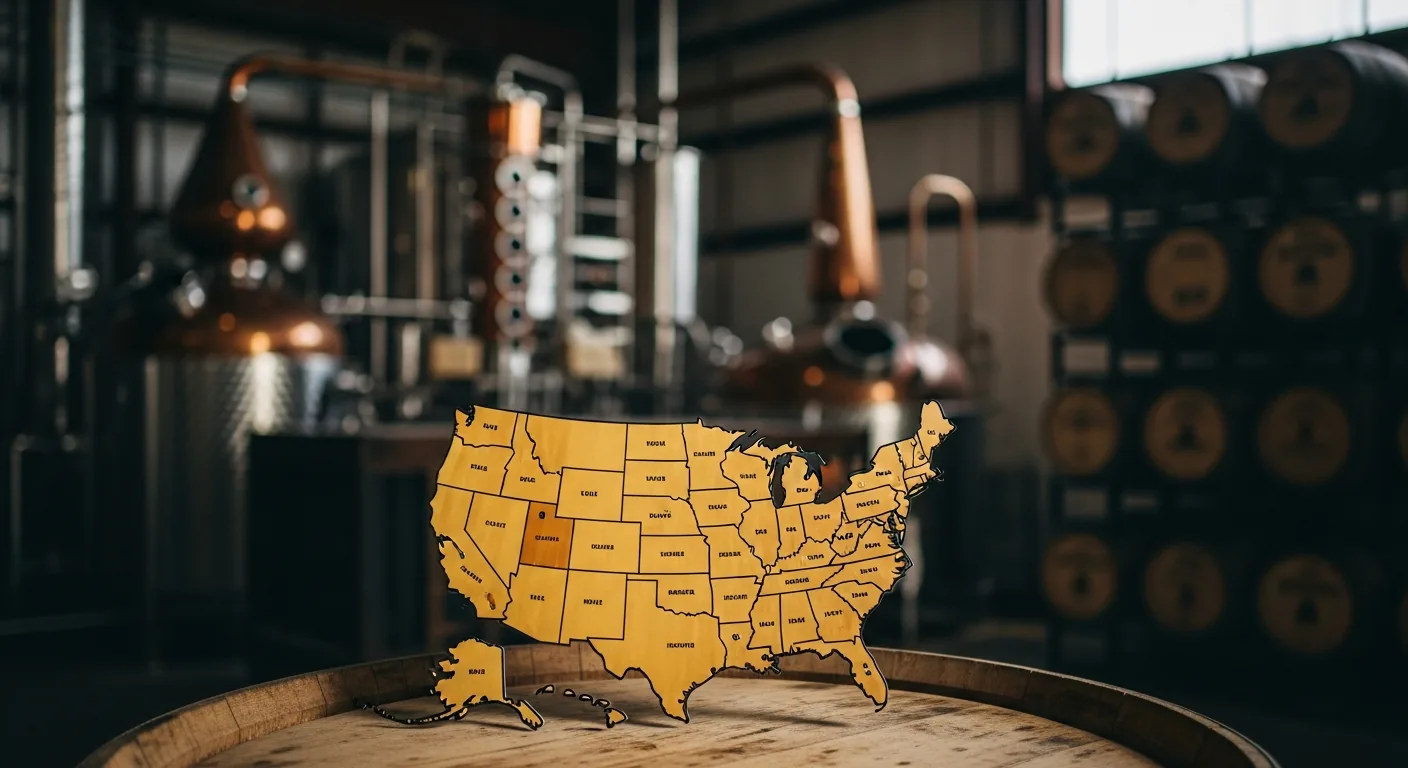
When viewing the broad map of states allowing direct-to-consumer wine shipping, craft distillers often wonder when distilled spirits will achieve the same legislative parity. Currently, the vast majority of the country permits wineries to ship their products directly to residential doorsteps. However, only a small fraction of states extend this privilege to distilleries. Understanding the legal differences between wine and spirits distribution, and navigating the standard wholesale models, is essential for any modern distilling operation trying to reach new customers. Please note that this article provides general industry information based on shared distiller experiences and does not constitute tax or legal advice.
For the current state-by-state reference on where spirits can legally ship, see our direct-to-consumer shipping guide by state, which is kept current with effective-dated rules.
Why do states allowing direct-to-consumer wine shipping restrict spirits?
The disparity between wine and spirits shipping privileges is rooted in decades of distinct legislative battles. Following a landmark 2005 Supreme Court ruling, the wine industry successfully lobbied state legislatures across the country to open up residential delivery. The court ruled that states could not ban out-of-state wineries from shipping directly to consumers if they allowed in-state wineries to do so. Distilled spirits, however, are still governed by much stricter interpretations of the three-tier system under the 21st Amendment. Because spirits possess a higher alcohol by volume, lawmakers historically treated them with greater regulatory caution.
While a few states permit reciprocal spirits shipping or intra-state shipping for local distilleries, a true national map for spirits shipping does not exist. This lack of parity means that a bourbon or whiskey brand cannot simply launch a national e-commerce store and ship bottles via standard parcel carriers to out-of-state buyers. Instead, distilleries must rely heavily on traditional wholesale distribution networks or focus on building highly localized brand loyalty through their physical tasting rooms.
To bridge this gap, some craft beverage producers choose to operate with dual licenses. By holding both a federal winery permit and a federal distilled spirits plant permit, a facility might produce fruit wines, ciders, or certain lower-proof ready-to-drink beverages classified as wine. These specific products can then be shipped into the broader network of wine-friendly states. However, operating a dual-licensed facility requires meticulous physical segregation of the premises and strict adherence to federal regulations governing authorized operations, as outlined in 27 CFR Part 19.
How does the three-tier system work for craft spirits?
Because broad direct shipping is restricted, most distilleries must participate in the traditional three-tier system. Under this model, alcohol is one of the few consumer goods where the manufacturer is generally prohibited from selling directly to the retailer or the end consumer. Instead, the distillery sells to a licensed wholesaler, who then sells to a retail liquor store or bar, who finally sells to the consumer.
There are limited exceptions. Roughly thirty states allow some form of producer self-distribution, granting craft distilleries the ability to bypass the wholesaler and sell directly to local retailers. Pennsylvania, Colorado, and Ohio offer variations of self-distribution privileges, though these often come with strict annual volume caps. Once a distillery exceeds these production limits, they are legally required to sign with a distributor.
A common misconception among new distillery owners is that signing with a distributor means the distributor will actively build the brand reputation. In reality, most seasoned distillers view their wholesale partners strictly as logistics providers. Distributors act similarly to a specialized freight delivery service. They fulfill the orders, but they rarely generate the initial consumer demand. Successful distilleries focus on building a dedicated tasting army of local consumers first. Once the local demand is undeniable, distributors become much more willing to take on the brand and ensure shelves remain stocked.
Furthermore, distilleries must be acutely aware of franchise laws. In many states, once you sign a contract with a wholesaler, franchise laws make it nearly impossible to leave that distributor without showing strict legal cause. Even if the distributor performs poorly, breaking the contract can cost a distillery thousands of dollars in legal fees and buy-out clauses.
What markup and margin should I expect across the tiers?
Pricing your spirits correctly for wholesale distribution is one of the most critical math exercises a distillery owner will perform. The standard industry rule of thumb is a thirty-thirty-thirty split. This means aiming for roughly a thirty percent margin at wholesale over your production costs, allowing a thirty percent margin for the distributor, and leaving a thirty percent margin for the retailer.
It is vital to understand the difference between margin and markup, as confusing the two will severely damage your profitability. Margin is based on the final sale price, whereas markup is based on the cost. A thirty percent margin actually requires roughly a forty-three percent markup. If a bottle costs ten dollars to produce, marking it up by thirty percent gives you a price of thirteen dollars. However, to achieve a true thirty percent margin, you must divide your ten dollar cost by zero point seven, resulting in a wholesale price of fourteen dollars and twenty-eight cents.
When pricing a new bourbon or rye for the market, you should always work backward from your target retail shelf price. You set your wholesale price solely to the distributor. You cannot dictate the final retail price, but you can project it accurately. By calculating the standard retail and wholesale margins, you can determine exactly what your wholesale revenue will be per bottle.
From that revenue, you must subtract your cost of goods sold and your federal excise taxes. The Alcohol and Tobacco Tax and Trade Bureau determines your tax liability based on the exact proof and volume of the spirit, making an accurate proof gallon calculator an essential daily tool. Distilleries must account for the cost of raw grain, yeast, enzymes, barrel depreciation, glass bottles, closures, labels, and shipping cartons. Never reveal your raw production costs to your distributor. Always price your products conservatively to ensure you can sustain your operations as you scale.
How do control states handle distillery distribution?
The distribution model shifts dramatically when a distillery operates in or sells to a control state. In a control state, the state government itself acts as the sole wholesaler and frequently as the sole retailer. Rather than negotiating pricing and placements with private distribution companies, you sell your product directly to the state liquor commission.
The state applies a mandatory statutory markup to your wholesale price. This markup can be steep, often approaching one hundred percent. For instance, a bottle sold to the state warehouse for fifteen dollars will likely hit the retail shelf at thirty dollars.
Getting your product onto those shelves requires navigating bureaucratic listing procedures. In Pennsylvania, the liquor control board reviews new product submissions only during specific open periods twice a year. Distilleries must submit a detailed new item submission sheet and wait for approval. Control states also frequently operate on a bailment inventory system. Under bailment, the distillery ships cases to the state warehouse but retains ownership of the inventory until the state actually ships the cases to a retail store. The distillery does not get paid until the product moves to retail, tying up significant cash flow in sitting inventory.
In Maine, the system is slightly different. A private agent handles the physical distribution to retailers on behalf of the state, and there is no state-level production tax. However, distillers must remember that federal excise tax is still strictly owed the moment the product is removed from the bonded premises, governed by the tax rules in 27 CFR Part 19 Subpart P.
Can a distillery owner operate an off-premise retail store?
As distilleries look for ways to maximize revenue outside of traditional distribution, owners often ask if they can simply open their own off-premise retail liquor store. The answer depends heavily on tied-house laws, which are designed to prevent monopolies and undue influence across the three tiers of the alcohol industry.
At the federal level, owning a retailer outright is sometimes permissible. The federal tied-house regulations, detailed in 27 CFR Part 6, prohibit producers from inducing retailers to purchase their products to the exclusion of others. If a distillery owner owns one hundred percent of a retail shop, federal regulators generally recognize that a person cannot illegally induce themselves. The federal focus is primarily on ensuring that a manufacturer is not offering bribes, free equipment, or hidden rebates to an independent retailer.
State laws, however, are almost always much stricter than federal laws. Many states completely prohibit any cross-tier ownership. A manufacturer cannot hold a retail license. Some states go even further, extending these strict ownership prohibitions to the spouse and immediate family members of the distillery owner. Texas is notoriously strict regarding cross-tier ownership and family involvement. Before attempting to vertically integrate your sales channels, you must maintain rigorous distillery compliance checks with your local alcohol beverage control board. Violating state tied-house rules can result in immediate license revocation.
What is the timeline for federal and local distillery licensing?
Before a distillery can even consider distribution, direct shipping, or retail margins, it must survive the grueling licensing phase. Securing the legal right to distill alcohol is a sequential and time-consuming process that requires significant financial runway.
You must obtain your federal basic permit and distilled spirits plant registration from the federal government before most states will even accept your state licensing application. A handful of states allow you to submit concurrent applications by marking your federal permit status as pending, but this is the exception, not the rule. The federal application requires an incredibly precise plant diagram, detailing all equipment sizes, makes, models, and the exact physical boundaries of the bonded premises.
While the federal and state agencies each typically take roughly ninety days to process applications, local municipality approvals are the true bottleneck. Local zoning boards, fire marshals, and building inspectors routinely take well over two hundred days to approve a distillery buildout. Distilleries deal with highly flammable, high-proof ethanol. This usually classifies the building as a high-hazard occupancy rather than a standard factory space. Upgrading a building to meet heavy fire codes requires specialized ventilation, explosion-proof electrical fixtures, and heavy-duty fire suppression systems.
Experienced distillers recommend budgeting for twelve to eighteen months of rent payments before you can legally produce a single drop of alcohol.
Crucially, you must never assume you can begin test-distilling just because your federal permit has arrived. State restrictions usually govern the actual production of alcohol, not just the commercial sale. Operating a still without the final state permit in hand is a severe violation. Some states mandate a physical inspection by the department of agriculture or the state fire marshal before allowing equipment to be turned on. Unauthorized test batches have resulted in forced product destruction and criminal charges for impatient operators.
Managing Your Distilled Spirits Plant Operations
Navigating the strict rules around shipping, distribution pricing, and complex state compliance requires airtight organization and meticulous record-keeping. Whether you are selling cases through a control state bailment warehouse, self-distributing to local bars, or managing your tasting room inventory, manual spreadsheets will quickly become a liability.
Spirit Sight provides a comprehensive enterprise distillery management system built specifically for the needs of bourbon and whiskey producers. From tracking bulk spirits in the rickhouse and calculating precise proof gallons to managing the exact cost of goods sold for wholesale distribution, Spirit Sight keeps your daily records accurate and audit-ready. By centralizing your production data, your compliance reviews start from numbers that tie out perfectly, allowing you to focus on scaling your craft distillery.
Key takeaways
- Direct shipping privileges for spirits lag significantly behind the legislative map for wine.
- Wholesale pricing should strategically target a thirty percent margin across the producer, distributor, and retail tiers.
- Federal basic permits must typically be secured before a distillery can apply for state-level production licenses.
- Strict federal and state tied-house laws heavily regulate whether a distillery owner can also operate an off-premise retail store.
- Local zoning and fire code approvals often take far longer than federal or state alcohol licensing.
Frequently asked questions
Can a distillery ship spirits directly to consumers?
Only a small handful of states permit direct shipping for distilled spirits, unlike the broad privileges granted to wineries. You must verify local statutes with your state alcohol control board before attempting any direct shipments across state lines.
How do you calculate wholesale pricing for a distributor?
Distillers usually work backward from a target retail shelf price. A common industry standard is to allocate roughly a thirty percent margin for the retailer and a thirty percent margin for the wholesaler, leaving the producer with the remainder to cover production costs and federal excise taxes.
Do I need a federal permit before getting a state distillery license?
Yes, most state alcohol boards require an approved federal basic permit from the Alcohol and Tobacco Tax and Trade Bureau before they will issue a state manufacturing license. Operating a still or producing alcohol without both federal and state approvals is strictly prohibited.
What is a control state in alcohol distribution?
In a control state, the state government acts as the primary wholesaler and often the sole retailer for distilled spirits. Distillers must sell their products directly to the state warehouse at a mandatory statutory markup.