In short: Distillery safety and environmental compliance spans multiple regulatory frameworks. A unified system consolidates OSHA incident logs, fire-code maximum allowable quantities, EPA permit thresholds, and hazard communication data. Centralizing these requirements ensures accuracy, reduces manual paperwork, and keeps your facility prepared for inspections and audits.
A distilled spirits plant is one of the more heavily regulated industrial sites a small or mid-size company will ever run. You are simultaneously a manufacturer subject to OSHA regulations, a flammable liquid storage occupancy under the fire code, a chemical handler under hazard communication rules, and an air, water, and waste generator under EPA programs. Each regulatory regime has its own forms, specific thresholds, and reporting deadlines. The hard part is rarely complying with any single rule. The true challenge is keeping all of these moving parts coherent and current at the same time.
Please note that this is general information for educational purposes, not tax or legal advice. Always consult with qualified legal counsel, environmental consultants, or your local authority having jurisdiction for your specific compliance needs.
How do OSHA injury and illness recordkeeping rules apply?
The foundation of any industrial safety program is accurate and honest recordkeeping. The Occupational Safety and Health Administration requires covered employers to maintain specific records of workplace injuries and illnesses. Under 29 CFR 1904, most distilleries must maintain three primary documents. The OSHA 300 Log records work-related injuries and illnesses. The 301 Incident Report provides detailed information about each specific case on the log. Finally, the 300A Annual Summary aggregates the year's data and must be posted in a visible location for employees from February 1 to April 30 each year.
A case becomes recordable under 29 CFR 1904.7 if it involves death, days away from work, restricted work, job transfer, medical treatment beyond first aid, loss of consciousness, or a significant diagnosed injury or illness. A frequent source of confusion is the distinction between first aid and medical treatment. OSHA provides a definitive list of first aid treatments, such as using non-prescription medication at non-prescription strength, cleaning surface wounds, or using butterfly bandages. If an injury requires treatment beyond this strict list, such as stitches or prescription antibiotics, it crosses the threshold into medical treatment and must be recorded.
It is crucial to understand that recordable is not the same as reportable. A reportable event is an immediate emergency notification to OSHA. Under 29 CFR 1904.39, a workplace fatality must be reported to OSHA within 8 hours. An in-patient hospitalization, an amputation, or the loss of an eye must be reported within 24 hours. Treating recordable and reportable as a single concept is a common and costly mistake. A good distillery ERP system tracks them as two distinct flags and starts the correct reminder clock for each scenario.
Once cases are logged properly, the two critical rate metrics that regulators and insurance providers care about calculate automatically. The Total Recordable Incident Rate (TRIR) is calculated by multiplying the number of recordable cases by 200,000, and then dividing that number by the total hours worked by all employees. The Days Away, Restricted, or Transferred (DART) rate applies the same mathematical formula, but only counts cases that resulted in days away from work, restricted duty, or job transfer. The 200,000 constant normalizes the data to represent 100 full-time employees working 2,000 hours a year. This makes your safety rates directly comparable year over year and benchmarkable against industry peers, regardless of the size of your facility.
How does the fire code handle MAQ and barrel storage?
High-proof spirit is a flammable liquid, and the fire code strictly limits how much you can keep in a given space without triggering stricter building requirements. The Maximum Allowable Quantity (MAQ) per control area comes from the International Fire Code, specifically IFC Table 5003.1.1. Buildings can be divided into distinct control areas using rated fire barriers, which allows operators to store more liquid before the building tips into a High-Hazard (H-3) occupancy classification.
The base MAQ quantities established in the code can be increased. They typically increase by 100 percent for a fully sprinklered area and by another 100 percent for using approved flammable storage cabinets. These increases are cumulative, allowing up to four times the base quantity under optimal conditions.
Two specific points frequently trip up growing distilleries. First, NFPA 30 classifies flammable liquids by flash point, not by Alcohol by Volume (ABV). Barrel-entry spirit, usually around 125 proof, typically falls into the Class IB category, defined as having a flash point below 73 degrees Fahrenheit and a boiling point at or above 100 degrees Fahrenheit. Typical bottling-proof spirit, ranging from 80 to 110 proof, is generally Class IC, with a flash point at or above 73 degrees Fahrenheit and below 100 degrees Fahrenheit. Knowing the difference is vital because the MAQ differs significantly between Class IB and Class IC liquids.
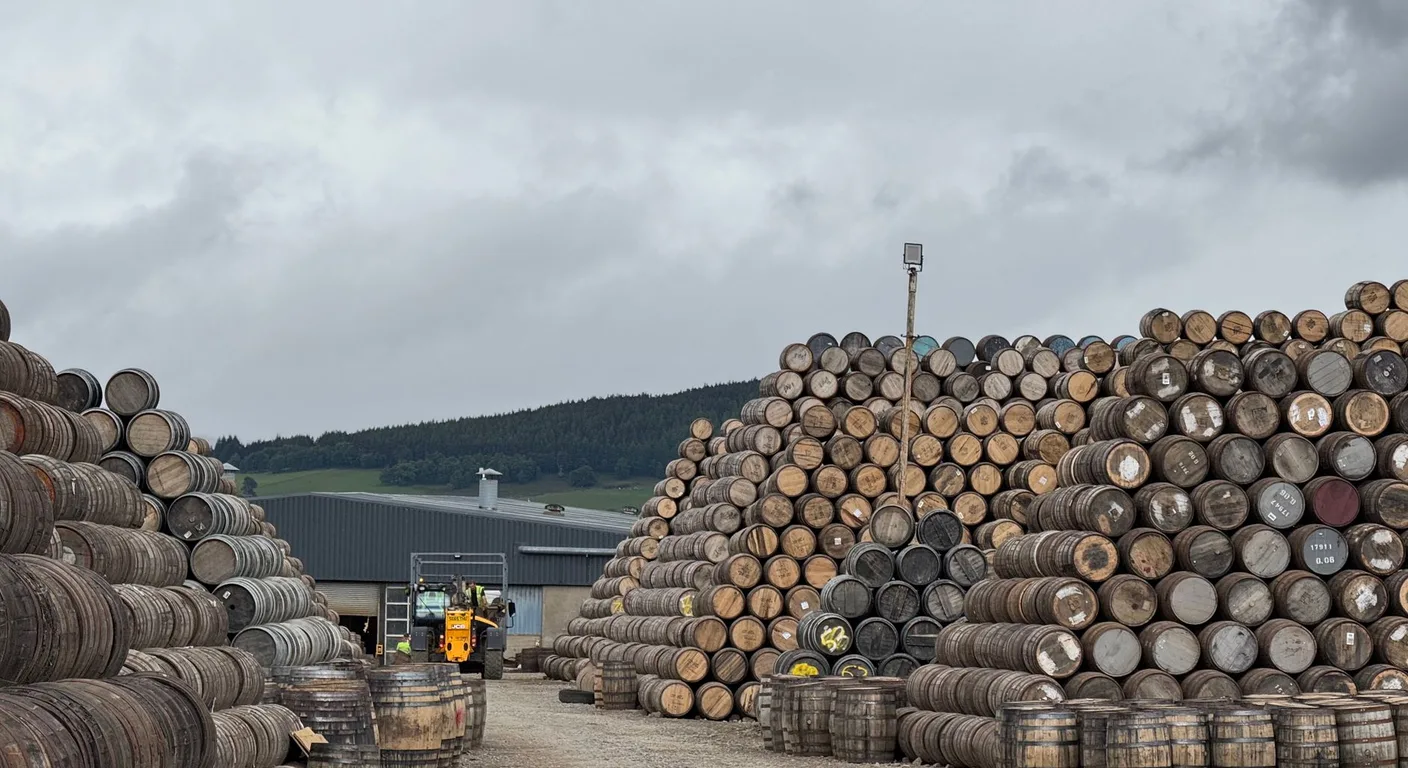
Second, barreled spirit aging in a traditional rickhouse is usually not counted against the standard control-area MAQ. Instead, it is governed by IFC Chapter 40 as an alternative storage method. This chapter outlines specific requirements for sprinklers, pallet height limits, flue spaces, drainage, and spill containment. Under this alternative framework, barrel storage is typically classified as an S-1 occupancy if the spirit is above 20 percent ABV, or an S-2 occupancy if it is at or below 20 percent ABV. Because actual MAQ table values and Chapter 40 adoptions depend on your local jurisdiction, a robust software system treats the base quantity as a configurable setting. It computes your headroom and applies sprinkler and cabinet multipliers based on your inputs, rather than asserting a rigid legal ceiling.
What goes into SDS, hazard communication, and NFPA 704?
Every chemical on your site, from the caustic cleaners in the brewhouse to the bulk ethanol in your tanks, falls under the OSHA Hazard Communication Standard detailed in 29 CFR 1910.1200. This standard requires you to maintain a current 16-section Globally Harmonized System (GHS) Safety Data Sheet (SDS) for each product on site. You must also maintain an accurate chemical inventory, ensure all containers are properly labeled, provide unhindered employee access to the SDS library, and conduct regular hazard training.
The GHS utilizes specific signal words, primarily DANGER and WARNING, paired with nine standard pictograms to convey risks. Alongside the GHS system, the familiar NFPA 704 diamond is heavily utilized in distilleries. This color-coded diamond communicates health hazards (blue), flammability (red), instability (yellow), and special hazards (white) to emergency responders at a glance.
Regulatory overlap happens frequently here. Proper placarding of chemical hazards often aligns with the Alcohol and Tobacco Tax and Trade Bureau requirements under 27 CFR 19 for identifying equipment and securing premises. Keeping the SDS library, the chemical inventory, and the NFPA 704 placarding data in one centralized system means a new cleaning chemical or additive is described once. The downstream documents, container labels, and warning signs stay consistent, reducing the risk of a citation during a surprise inspection.
Why is pressure equipment relief critical?
Distilleries utilize heavy industrial equipment. Stills, mash cookers, boilers, and steam distribution systems carry immense pressure. Pressure-relief devices, such as rupture disks and pressure relief valves, are mandatory safety controls that require scheduled inspection and rigorous testing.
While the specific engineering standards, such as ASME relief sizing, and state-level boiler regulations are highly specific to your facility's mechanical design, the compliance discipline is identical to the rest of your EHS program. You must track each protected vessel, log its associated relief device, monitor the required inspection interval, and forecast the next-due date. A system that unifies this maintenance tracking ensures that critical safety checks never quietly lapse into non-compliance.
Which EPA environmental permits affect distilleries?
Environmental Protection Agency programs add a substantial layer of complexity. Distilleries generate waste, emit vapors, and discharge water, all of which are heavily regulated.
The Resource Conservation and Recovery Act (RCRA) governs hazardous waste. Your generator status is determined by your monthly hazardous waste quantity under 40 CFR 262. Generating at or below 100 kilograms a month classifies you as a Very Small Quantity Generator (VSQG). Generating between 100 and 1,000 kilograms makes you a Small Quantity Generator (SQG), and 1,000 kilograms or more triggers Large Quantity Generator (LQG) status. Each tier has strict accumulation time limits and storage requirements.
Air quality is another major hurdle. Barrel-aging ethanol loss, commonly known as the angel's share, consists of Volatile Organic Compounds (VOCs). These emissions count toward Clean Air Act Title V potential-to-emit thresholds. Crossing 100 tons per year of VOCs, or hitting 10 tons per year of a single hazardous air pollutant, triggers rigorous permitting requirements.
Spill prevention also falls under EPA jurisdiction. The Spill Prevention, Control, and Countermeasure (SPCC) rule under 40 CFR 112 applies to oil storage. If your facility stores 1,320 gallons or more of oil in aggregate aboveground, you must maintain a written SPCC plan. In a distillery context, this includes diesel fuel for backup generators, fuel oil for boilers, and even bulk cooking oils if used on site.
Finally, wastewater discharges to a public treatment works fall under Clean Water Act pretreatment standards. Distillery stillage has an exceptionally high Biological Oxygen Demand (BOD) and high Total Suspended Solids (TSS). Discharging raw stillage into a municipal sewer will quickly overwhelm local treatment plants and result in severe fines. Pretreatment, such as pH adjustment and solids separation, is usually required. Because actual permit limits and municipal agreements are highly site specific, an intelligent software system stores these parameters as operator configuration. It computes exceedances, tracks accumulation days, and triggers alerts against the specific numbers you enter.
How does one system create a unified Safety Binder?
The true value of pulling OSHA, fire code, hazmat, and EPA regimes together into a single enterprise resource planning system is not just operational convenience. It is the assurance that a single event propagates correctly across all compliance silos.
When a workplace injury occurs, a recorded incident updates the OSHA 300 Log, instantly recomputes your TRIR and DART rates, and resets the days-since-recordable counter on your command center dashboard. When a new chemical is added to your inventory, its SDS and NFPA 704 data carry over to every location where that chemical is staged or used. If you plan a movement of high-proof spirit from the stillhouse to the bottling hall, a fire-code transfer is previewed against your live MAQ headroom before the pump is even turned on, preventing an accidental occupancy violation.
When an OSHA inspector, a fire marshal, or an insurance auditor arrives and asks for evidence of compliance, the burden of proof is on you. Instead of scrambling through physical binders and outdated spreadsheets, the EHS module generates a comprehensive Safety Binder. This assembles the current state of your logs, inventories, and maintenance records into one clean export.
Spirit Sight brings OSHA recordkeeping, fire-code MAQ tracking, SDS and HazCom management, equipment relief scheduling, and environmental permit tracking into one connected platform built explicitly for distilleries. You can explore the full safety and compliance suite on the EHS Command Center page.
Key takeaways
- OSHA 1904 requires distilleries to maintain the 300 Log, 301 report, and 300A summary, keeping recordable injuries distinct from immediate reportable emergencies.
- TRIR and DART rates utilize a 200,000 constant to normalize data, allowing safety records to be compared accurately across different facility sizes.
- Fire-code maximum allowable quantities rely on IFC Table 5003.1.1 and classify high-proof spirits by flash point rather than ABV.
- Barreled spirits stored in rickhouses are typically managed under IFC Chapter 40 alternative storage methods rather than counting against standard control-area limits.
- A unified EHS software system tracks hazard communication, equipment relief intervals, and EPA permit thresholds in one centralized command center.
Frequently asked questions
What is the difference between a recordable and a reportable injury under OSHA?
A recordable case meets the 29 CFR 1904.7 criteria for medical treatment beyond first aid and goes on the OSHA 300 Log. A reportable event is an immediate emergency notification: under 1904.39, a fatality must be reported within 8 hours, while an in-patient hospitalization, amputation, or loss of an eye must be reported within 24 hours.
How is TRIR calculated?
TRIR equals the total number of recordable cases multiplied by 200,000, and then divided by the total hours worked by all employees. DART uses the identical 200,000 constant but only includes cases that resulted in days away from work, restricted duty, or job transfer.
Are barreled spirits counted against my fire-code maximum allowable quantity?
Generally, no. Distilled spirits aged in barrels are typically handled under IFC Chapter 40 as an alternative storage method, classifying them as an S-1 or S-2 occupancy. This separates them from the standard control-area MAQ tallies, subject to the approval of your local authority having jurisdiction.
Does waste alcohol always count as hazardous waste?
No, it depends on the concentration. Under 40 CFR 261.21, an aqueous solution containing less than 24 percent alcohol by volume is excluded from the ignitability characteristic, meaning dilute distillery wastewater is generally not classified as D001 hazardous waste. Higher concentration byproducts with a flash point below 60 degrees Celsius remain fully regulated.