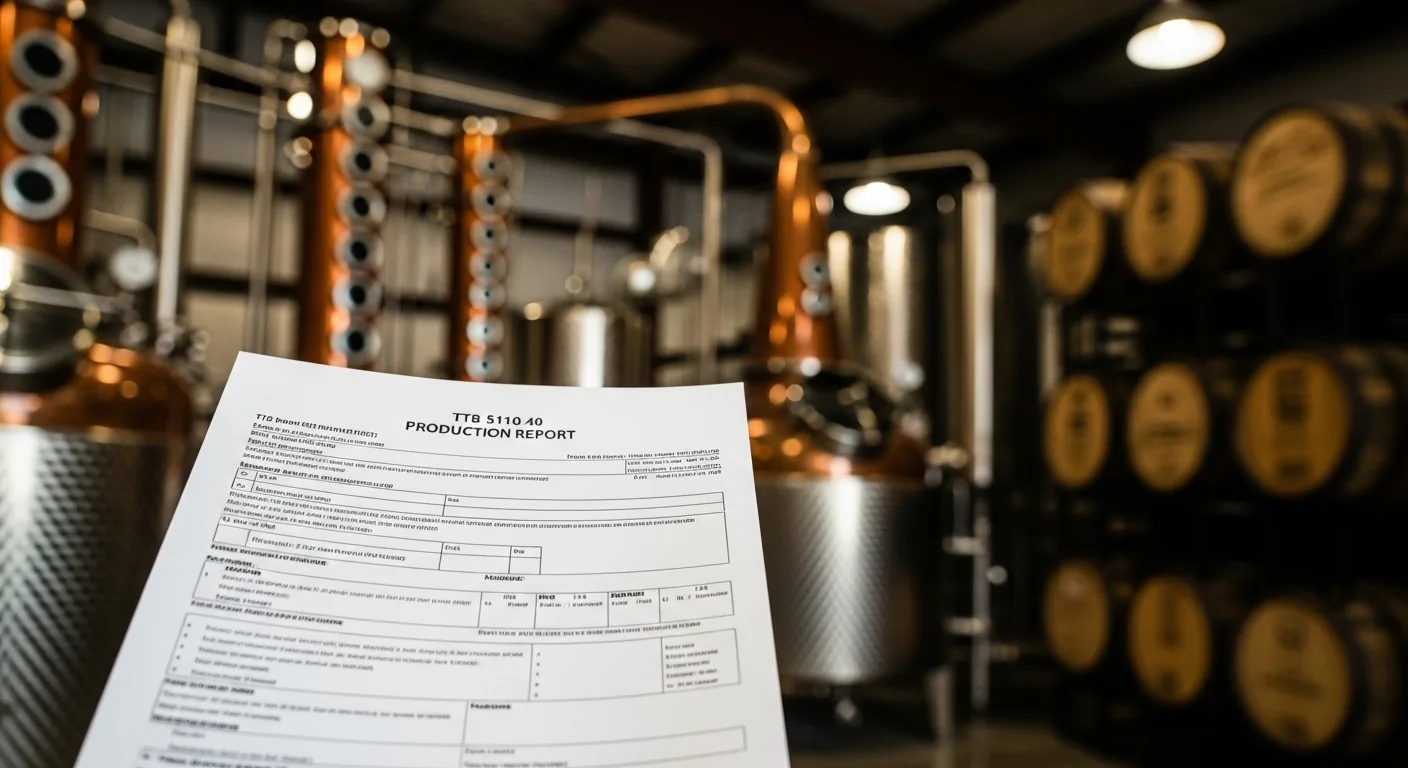
In short: TTB Form 5110.40 is the monthly federal report where distilleries record raw materials used and bulk spirits produced. This guide explains how to calculate proof gallons, log grain usage, and transfer finished spirits accurately to your storage or processing accounts to maintain federal compliance.
Navigating federal compliance can feel overwhelming. If you operate a distilled spirits plant, understanding mandatory documentation is critical to your success. One of the most important documents you will file is TTB Form 5110.40, which serves as your monthly production report. This form is where you record the raw materials mashed and the resulting bulk spirits distilled during the month.
The production report strictly tracks the creation of raw alcohol. It does not cover barrel aging, bottling, or the final payment of federal excise tax. By understanding exactly what goes into this report, distillery owners and operations staff can build accurate recordkeeping habits that prevent regulatory headaches down the road.
Please note that this article provides general educational information and does not constitute tax or legal advice. Always consult current guidance from the Alcohol and Tobacco Tax and Trade Bureau at https://www.ttb.gov.
What is a distilled spirits plant under federal law?
To understand the production report, you first need to understand how the federal government views a distillery. A distilled spirits plant is a facility qualified under federal law to produce, bottle, rectify, process, or store beverage alcohol. The rules governing these facilities are outlined in Title 27 of the Code of Federal Regulations, which you can read directly at https://www.ecfr.gov.
The federal government tightly controls beverage alcohol because it is a major source of excise tax revenue. The Alcohol and Tobacco Tax and Trade Bureau oversees this process. They require operators to trace every ounce of alcohol from the moment grain enters the mash tun until a sealed bottle leaves the loading dock. TTB Form 5110.40 is the first formal checkpoint in that lifecycle.
Why does the TTB separate production from storage and processing?
The Alcohol and Tobacco Tax and Trade Bureau divides distillery operations into three distinct accounts. These accounts are Production, Storage, and Processing.
Under federal regulations, every drop of spirit on your bonded premises must live in one of these three accounts. The production account is the starting point. This is where raw materials like corn, rye, malted barley, fruit, or molasses are fermented and run through the still to become alcohol. You can think of the production account as your active manufacturing phase.
Once the spirit is distilled and collected in a receiver tank, it must be officially transferred out of the production account. If you are putting the spirit into barrels to age, it moves to the storage account. If you are cutting it with water to bottle immediately or flavoring it, it moves to the processing account. TTB Form 5110.40 only cares about the very first step in this chain. It acts as the ledger that proves exactly how much raw material you used and exactly how much new make spirit you created.
What goes into TTB Form 5110.40 step by step?
The form itself is divided into distinct sections that track your inputs, your outputs, and your withdrawals. You can find the most current version of the document on the official TTB forms page. Distilleries must submit this report monthly, typically by the fifteenth day of the following month.
The first major section tracks the materials you used to produce spirits. This is where you will log your grain bill, fruit, molasses, or other fermentables. The TTB requires you to report grain in pounds and liquids in gallons. If you run a bourbon distillery, you will weigh your milled corn, rye, and barley, and record the total pounds mashed during that month.
Accuracy here is absolutely critical. The TTB uses these material numbers to check your yield. If you claim to have used ten pounds of corn but produced a thousand gallons of alcohol, the math will flag a major discrepancy in your operation. The government knows the average theoretical yield of different grains. Your reported numbers must align with reality.
The second major section tracks the actual spirits you produced. This section categorizes the alcohol by class and type. You must separate your production into columns based on what the spirit is legally defined as upon creation. For example, whisky, neutral spirits, brandy, and rum all have their own designated spaces on the form.
How do you calculate proof gallons for your production report?
One of the most common stumbling blocks for new distillery staff is the requirement to report all spirit volumes in proof gallons rather than standard liquid gallons. When you fill out your production totals, you cannot simply look at the sight glass on your receiver tank and write down the liquid volume.
A proof gallon is a standardized unit of measurement that equals one liquid wine gallon of spirits at 100 proof, which is 50 percent alcohol by volume. Federal excise tax scales with the alcohol content of the spirit, so the government mandates that all tracking be standardized to this 100 proof baseline.
To calculate a proof gallon, you multiply the actual liquid volume in wine gallons by the true proof of the spirit, and then divide by 100.
Let us look at a practical example. If you distill 100 liquid gallons of new make whiskey and gauge it at 120 proof, you multiply 100 by 120 to get 12000. You then divide by 100 to arrive at 120 proof gallons. You can also speed up your daily math by running the numbers through a TTB gauging calculator before logging your daily runs.
Temperature dramatically affects the density of alcohol, so you must always correct your proof readings for temperature. The official standard is 60 degrees Fahrenheit. A spirit that reads 120 proof on a hydrometer at 80 degrees Fahrenheit is actually a lower proof when corrected to 60 degrees. You must use official TTB gauging tables, specifically Table 1, to find the true proof. Accurate gauging is a strict federal requirement before any spirit is removed from the production account.
What supporting records do you need for the production report?
TTB Form 5110.40 is a summary document. It contains the aggregated totals for the entire month. However, federal law requires you to keep detailed daily records that back up every number on that form. If you are audited, an inspector will ask to see the daily logs that add up to your monthly totals.
Your daily production records should track several key data points. First, you need mash records. These logs must show the exact date, the types of grain or fermentables used, and the precise weight or volume of those materials.
Second, you need distillation records. Whenever you run the still, you must record the date, the volume of mash distilled, the proof of the resulting spirit, and the total proof gallons collected in your receiver tanks.
Third, you need gauge records. A gauge record is a highly specific document that notes the temperature, the observed proof, the true corrected proof, the wine gallons, and the final proof gallons of a given tank or batch. You must perform a formal gauge before transferring any spirit out of the production account.
When and how do spirits leave the production account?
The production report also tracks withdrawals. Spirits cannot sit in the production account indefinitely. Once a production batch is complete and collected in a receiver tank, you must log where it goes next. The third section of the form is dedicated to these transfers.
Most craft distilleries will log a withdrawal as either transferred to storage or transferred to processing. When you pump your new make bourbon from the receiver tank into oak barrels and roll them into the rickhouse, you log that volume as a transfer to the storage account. On your paperwork, this exact volume will then appear as a deposit on your separate monthly storage report.
The two reports must mirror each other perfectly. The amount of proof gallons leaving the production account must equal the amount entering the storage account.
If you are making an unaged product like vodka, gin, or white rum, you will likely transfer the spirit directly to the processing account. Once in processing, the spirit can be filtered, diluted with water, flavored, and eventually bottled. Again, the volume removed from production must match the volume deposited into processing.
Proper cutoff procedures at the end of the month are vital. You must pick a consistent time, usually the end of business on the last day of the month, to gauge your tanks and finalize these transfers so your reports stay synchronized.
What happens if spirits are lost or destroyed in production?
Not every drop of alcohol makes it to a bottle or a barrel. Spills, leaks, and accidents happen in a working distillery. The TTB understands this, but they still require you to account for the missing volume.
If a loss occurs while the spirit is still in the production account, it must be recorded in the withdrawals section of TTB Form 5110.40. You will see specific lines for losses and destruction. A loss usually refers to an accidental spill, evaporation, or a tank leak. Destruction refers to intentionally disposing of a spirit, perhaps because a batch was ruined or tainted.
In either case, you must maintain a detailed written record of the incident. If the loss is unusually large, the TTB may require an explanation or a formal claim for allowance of loss. Never hide a spill. Always record it accurately to keep your production account balanced.
What are the most common reporting errors on Form 5110.40?
Even experienced distillery operators make mistakes on their monthly reports. According to real-world discussions among craft distillers, the most frequent errors usually involve simple math, timing issues, or unit confusion.
The most common mistake is confusing wine gallons with proof gallons. It is incredibly easy to read a flow meter on a transfer pump, write down the liquid wine gallons, and accidentally enter that number on the TTB form. Always double check that your final production and withdrawal numbers have been correctly converted to proof gallons.
Another frequent issue is a mismatch between accounts. If you transfer 500 proof gallons out of production on the last day of the month, you must remember to log those same 500 proof gallons as entering the storage or processing account on those respective reports. When these numbers fail to align across your monthly filings, it automatically triggers red flags in the federal reporting system.
Failing to round correctly is another minor but common issue. The TTB requires you to track proof gallons to the first decimal place for most bulk records. Dropping decimals or rounding incorrectly can lead to fractional discrepancies that compound over time.
Finally, many new distillery owners forget to file when their stills are quiet. You must file a monthly operations report as a zero report even before you produce anything, and during any subsequent month where no production occurs. If your federal basic permit is active, your reporting obligation is active. Failing to file zero reports can lead to compliance audits and formal inquiries.
How can modern software simplify monthly compliance?
Managing federal compliance by hand using spreadsheets is a heavy administrative burden. It steals valuable time away from distilling, marketing, and building your brand. Calculating accurate proof gallons, tracking grain usage, and ensuring your production, storage, and processing accounts always balance perfectly requires meticulous daily attention.
A single typo on a spreadsheet can throw off your entire monthly report, forcing you to spend hours hunting down the discrepancy. As your distillery grows, the volume of data becomes impossible to manage efficiently with basic office tools.
Spirit Sight helps distilleries eliminate these headaches entirely. By using purpose-built TTB reporting software, operators can simply log their daily mashing and distillation activities in real time. The platform automatically calculates the correct proof gallons using built-in temperature correction tables. It also handles the account transfers in the background, ensuring that a withdrawal from production instantly registers as a deposit in storage or processing.
When the end of the month arrives, your numbers are already verified, balanced, and ready to submit. This gives you total confidence in your federal compliance and frees you to focus on crafting exceptional spirits.
Key takeaways
- The production report specifically tracks the initial creation of raw spirits from raw materials.
- All spirit volumes must be recorded in proof gallons, while raw materials are logged in pounds or liquid gallons.
- Finished spirits must be formally transferred out of the production account and into storage or processing before the month ends.
- Distilleries must file Form 5110.40 every single month to maintain federal compliance, even if no production occurred.
Frequently asked questions
Do I need to file TTB Form 5110.40 if I did not produce any spirits this month?
Yes, once your federal distilled spirits plant permit is active, you must file a monthly operations report as a zero report even if no distillation took place.
What is the difference between the production report and the storage report?
The production report covers the creation of new spirits from raw materials. Once those spirits are transferred into barrels or holding tanks for aging, they are tracked on the separate storage report.
How do I calculate a proof gallon for my TTB reports?
A proof gallon is one liquid wine gallon at 100 proof. You calculate it by multiplying your actual liquid volume by the true proof of the spirit, and then dividing the result by 100.
When do I pay federal excise taxes on the spirits I produce?
Federal excise taxes are generally not paid during the production phase. Taxes become due when the finished and bottled spirits are formally removed from the bonded premises, typically from the processing account.