In short: The angel share is the natural evaporative loss of aging spirits. Ordinary storage losses are not taxed as long as they are properly recorded and remain within reasonable limits. Federal excise tax only applies when spirits are removed from bond or lost due to negligence and theft.
Distillers often stare at their quarterly inventory reports with a mix of frustration and confusion. You fill a barrel with a precise amount of expensive spirit, lock it in a bonded warehouse, and months later, a measurable percentage of it is simply gone. You did not spill it, you did not bottle it, and you certainly did not sell it.
One common question comes up among new producers time and time again. They want to know how to account for a massive volume loss when they did not destroy the liquid and did not take it out of inventory. It is a fair question, and the confusion is completely understandable. You filled a barrel with a known quantity, the environment took a portion of it, and now you have to reconcile a number that shrank without you doing anything.
So how do you account for a shrinking inventory without triggering a massive tax bill? The answer lies in understanding the angel share. This guide explores what evaporative loss actually is, how to track it accurately, and most importantly, how the federal government treats these losses. Please note that this article provides general information for distillery operators, not tax or legal advice, and you should always consult your own compliance counsel.
What is the angel share and how much will evaporate?
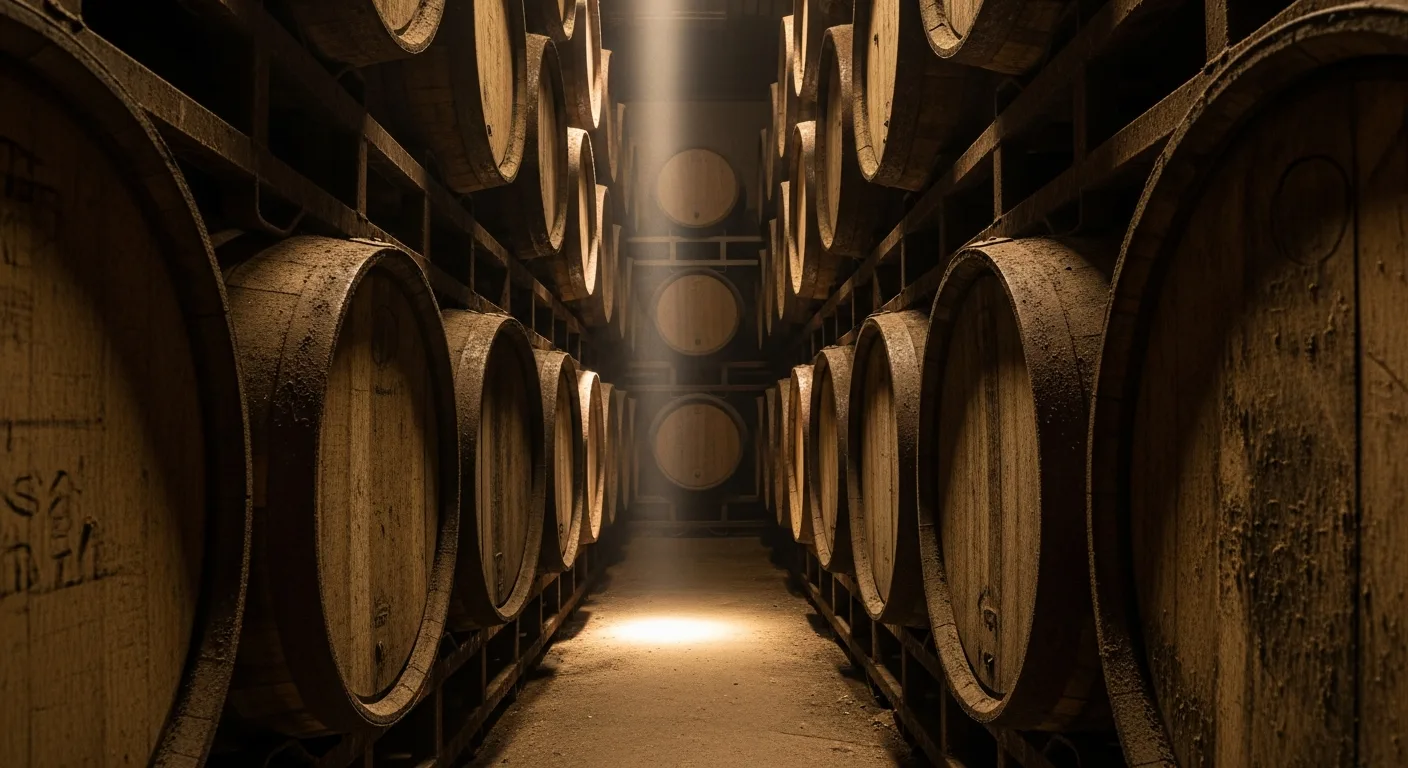
The angel share is the portion of aging spirit that evaporates through the wood of the barrel over time. It is not a defect, it is not a sign of poor craftsmanship, and it is entirely unavoidable. Oak is a porous material that breathes. A charred oak barrel sitting in a warehouse for years will give back a meaningful fraction of what you put into it.
For a standard 53 gallon barrel, distillers consistently report ordinary losses in the range of 2 to 3 percent per year. This number can climb as high as roughly 10 percent per year in hot, dry climates. Those are real world numbers from people storing real inventory, not marketing figures. Your own warehouse will land somewhere on that curve depending on climate, warehouse position, and how tight your barrels are.
Small barrels are a completely different animal. Because evaporation is driven by the ratio of barrel surface area to liquid volume, a small barrel loses far more liquid, far faster. Distillers have reported five gallon barrels losing 8 to 10 percent in just six months, which is several times the annual rate of a full size barrel. If you are aging in small cooperage, you must plan your fill quantities and your timeline around that fact, because the loss will eat into your total yield incredibly quickly.
A few other physical factors push the evaporation number around. Vertical, palletized storage tends to lose slightly more liquid than horizontal storage. This happens because of hydrostatic pressure resting heavily on the lower staves, though many commercial distillers gladly accept that trade off for the handling speed pallets provide. Stacking barrels four or more levels high stresses the staves on the bottom barrels and can force leaks or increase evaporation.
Additionally, dry, high altitude conditions accelerate loss and loosen wooden seals. This is exactly why some distillers periodically hose down the outside of their barrels to keep the wood swelled and the seams perfectly tight.
The physical science behind barrel breathing
To manage storage loss, you need to understand what is actually happening at a molecular level inside your warehouse. A barrel does not just act as a static container. It is a dynamic, semi permeable membrane.
As the temperature in your warehouse rises during the summer, the liquid inside the barrel expands. This expansion forces the spirit deep into the charred layers and the raw oak of the staves. When the temperature drops in the winter, the liquid contracts, pulling back out of the wood and bringing extracted sugars, color, and flavor compounds with it.
During this constant expansion and contraction, molecules of liquid escape through the microscopic pores of the wood. This is the exact mechanism of the angel share. The environment outside the barrel acts like a vacuum, pulling moisture out of the wood to equalize the humidity levels in the air.
Why does barrel proof rise in one warehouse and fall in another?
This phenomenon surprises many new distillers, but it is one of the more useful things to understand about aging spirits. When you lose volume to the angel share, the proof of the remaining liquid does not stay fixed. It moves, and the direction it moves depends entirely on the ambient humidity of your storage environment.
In a drier environment, water molecules pass through the oak staves faster than alcohol molecules. Water is a smaller molecule than ethanol, and dry air aggressively seeks out moisture. Because the water leaves the barrel faster than the alcohol, the spirit that remains inside gets stronger and the overall proof rises.
In a highly humid environment, the opposite happens. The air is already saturated with water, so the water inside the barrel stays put. Instead, the alcohol leaves the barrel faster than the water, causing the total proof of the remaining spirit to drop.
The barrel loses total liquid volume in both cases. Whether you end up with a higher proof or lower proof spirit at the time of dumping is simply a function of where the warehouse sits and what the air is doing over the years of aging.
This matters immensely for your loss math because of how federal regulations treat the two measurements. You barrel your spirit at a known, recorded proof. The quarterly loss you report is based entirely on the change in wine gallons, computed at that original barreling proof. You do not base your quarterly reports on a fresh proof reading every single quarter. Reproofing every barrel every three months would be operationally impossible. Instead, you reproof and record any additional loss only when the spirit actually leaves your bonded storage account.
Is the angel share subject to federal excise tax?
For most ordinary evaporation, the answer is no. This is the part of distillery management worth being incredibly precise about, because guessing wrong in either direction costs you money or invites regulatory trouble.
Federal excise tax on distilled spirits does not attach at the moment of distillation, and it does not attach while the spirit sits aging in your bonded premises. It attaches at removal from bond for consumption or sale.
That is the whole point of a Distilled Spirits Plant operating under bond. You can hold and age massive amounts of inventory without the tax coming due until you actually move the spirit out into commerce. The federal tax framework and the exact rates are well documented by the Alcohol and Tobacco Tax and Trade Bureau at ttb.gov, and the underlying statute on attachment and determination of tax sits in 26 U.S.C. Chapter 51.
When the angels take their share out of a barrel that is still sitting in your storage account, that spirit was never removed for sale. Therefore, the tax never attached to it. You did not destroy it and you did not sell it. For tax purposes, that reality is perfectly fine. Ordinary evaporative loss in storage is an allowable loss. You record it, you report it, and you are not assessed tax on it.
When does a distillery storage loss become taxable?
Allowable does not mean automatic. A storage loss is taxed when it is not allowable, and there are very real categories where that happens. This is the distinct line every DSP operator needs to understand.
Losses caused by theft, negligence, fraud, or other unlawful acts are a completely different matter. Furthermore, losses that the distiller simply cannot account for fall into this taxable category. If your physical gauging shows that a barrel is short by an amount that ordinary evaporation cannot possibly explain, the TTB has the authority to treat the unexplained shortage as if the spirit was removed without tax determination. When that happens, the missing volume becomes taxable.
The regulatory protection for ordinary evaporation rests entirely on the loss being genuinely ordinary and genuinely documented. An excessive or completely unexplained shortage does not get that protection.
This is the practical reason the TTB expects to see losses on your reports, and also expects those losses to be reasonable and recorded. A barrel that shows zero loss after two years of aging is just as suspicious to an auditor as a barrel that shows a fifty percent loss. The way you protect your distillery is the same in both directions. You must gauge consistently, record honestly, and keep the paper trail that proves your reported losses track with normal evaporation for your specific climate.
The regulations governing losses on bonded premises are thoroughly detailed in 27 CFR Part 19, which is viewable at ecfr.gov. You can also find the operational reports where you account for inventory and losses described in the reporting guidance at ttb.gov.
Keep in mind that voluntary destruction is its own distinct process. If you have to destroy spirits in bond due to contamination or severe defects, there are specific procedures and advance notice requirements for doing so without tax liability. That is separate from evaporation and is not what is happening when the angels take their share, but it is worth knowing the two paths exist.
How do you properly record and report evaporation?
The accounting workflow distillers describe is straightforward once you have done it a few times. At the end of each calendar quarter, you physically gauge your barrels in the storage account. You then compute the loss from the change in wine gallons, calculated at the original barreling proof.
You record that allowable loss on your storage operational report. You do not reproof the liquid at this stage. When the spirit later transfers out of the storage account for processing or bottling, you take a fresh proof reading and record any additional loss at that exact point.
The accounting principle underneath all of this is the proof gallon. A proof gallon is a gallon of spirit at 100 proof, meaning it measures the actual alcohol content, not just the raw volume of liquid. Your federal tax liability and your inventory of record both run on proof gallons. This is exactly why getting the wine gallon to proof gallon conversion right is the foundation of clean reporting.
We cover that mathematical conversion in detail in our guide on Proof gallons vs wine gallons. We also explore the broader question of operating legally under bond in our overview on Bonded warehouse and the DSP bond, explained.
Best practices to minimize excessive storage loss
A few operational habits keep quarterly reporting from becoming a massive fire drill at audit time.
First, mark your barrels permanently. Chalk washes off when you spray barrels to keep them tight, and a lost barrel ID is a lost audit trail. Always use permanent markers, branding irons, or secure tags.
Second, gauge on a consistent schedule rather than scrambling at quarter close. If you manage your inventory systematically, you will spot leaks or excessive evaporation early.
Finally, reconcile your reported losses against what is mathematically normal for your climate. If a number looks completely off, you want to find out before a regulatory auditor does. Losses that are real, ordinary, and thoroughly documented are not your problem. Losses you cannot explain will always cost you money.
How does ERP software simplify distillery compliance?
The angel share is simply a cost of making aged spirits, not a tax event. Ordinary evaporation in your bonded storage account is an allowable loss. Tax only attaches when you remove spirits from bond, based on the proof gallons you actually take out. Always confirm the specifics against current regulatory guidance before you file.
The hard part in practice is not understanding the rule. The hard part is keeping the records straight across hundreds or thousands of barrels so the numbers always reconcile properly.
This is where an enterprise distillery management system like Spirit Sight changes the game. Spirit Sight automatically tracks your proof gallons, quarterly gauges, and storage losses per barrel. By replacing fragile spreadsheets with a unified ERP, your operational reports tie out to your physical inventory perfectly, saving your distillery time, stress, and potential tax penalties every single quarter.
Key takeaways
- The angel share is unavoidable evaporative loss, typically ranging from 2 to 3 percent annually for standard barrels and up to 10 percent in hot climates.
- Barrel proof rises in dry environments because water evaporates faster than alcohol, while proof falls in humid environments as alcohol evaporates faster.
- Ordinary evaporative loss in a bonded storage account is generally not subject to federal excise tax, as the spirit has not been removed for sale.
- Storage losses become taxable if they are caused by theft, negligence, or remain completely unexplained by the distillery.
- Quarterly storage loss is recorded based on the change in wine gallons computed at the original barreling proof, without needing to reproof the barrel.
Frequently asked questions
Do I have to pay federal excise tax on the angel share?
No. Ordinary evaporative loss that occurs while spirits are aging in your bonded storage account is an allowable loss and is not subject to federal excise tax. Tax only attaches when the spirit is removed from bond for sale or consumption.
Why does my barrel proof go up during aging?
Barrel proof increases in dry environments because water molecules are smaller and evaporate through the porous oak staves faster than alcohol molecules. This leaves behind a spirit with a higher concentration of alcohol.
How often should I reproof my barrels to track loss?
You do not need to reproof barrels for your quarterly storage reports. Quarterly losses are calculated by gauging the change in wine gallons at the original barreling proof. You only take a fresh proof reading when the spirit is transferred out of the storage account.
What happens if a barrel leaks excessively?
If a barrel loses an unreasonable amount of spirit that cannot be explained by ordinary evaporation, the TTB may classify it as an unallowable loss. Losses due to negligence, poor maintenance, or theft can be treated as untaxed removals and become fully taxable.
Do smaller barrels lose spirit faster than large barrels?
Yes. Smaller barrels have a much higher ratio of surface area to liquid volume, which vastly accelerates evaporation. A 5 gallon barrel can lose 8 to 10 percent of its volume in just six months, compared to the 2 to 3 percent annual loss of a 53 gallon barrel.