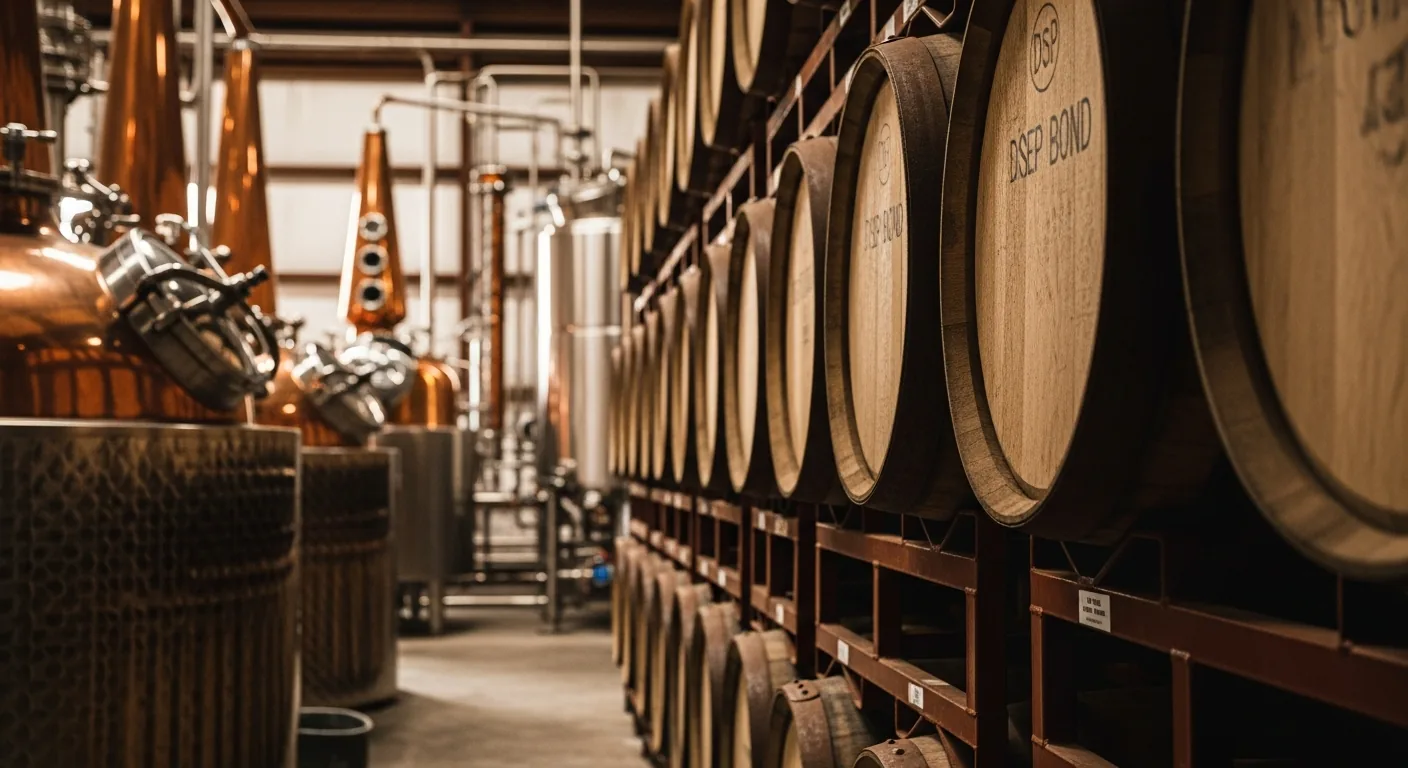
In short: Understanding what a DSP bond and bonded storage actually mean comes down to tax compliance. A DSP bond guarantees the federal government receives excise taxes on your spirits, while bonded storage is the physically secure, regulated area where untaxed spirits rest and mature before bottling.
Understanding what a DSP bond and bonded storage actually mean is essential for any distillery owner. These concepts dictate how you legally operate, store barrels, and pay taxes. In short, a Distilled Spirits Plant bond is a financial guarantee to the federal government that you will pay your excise taxes. Bonded storage is the physical, secure area where your untaxed spirits rest while they mature in barrels or wait for processing.
Before you can legally distill a single drop of alcohol, you must secure your DSP permit. A core part of that process is proving to the Alcohol and Tobacco Tax and Trade Bureau that your facility is secure and that the government's tax revenue is protected.
Please note that this article provides general educational information about distillery operations and is not formal legal or tax advice. Always consult a compliance professional or attorney for your specific situation.
Why do federal tax regulations require bonded storage?
The federal government taxes distilled spirits upon removal from the bonded premises, rather than at the exact moment of production. This system is incredibly beneficial for distilleries that make aged spirits like bourbon and whiskey. If you were forced to pay taxes on alcohol the day it came off the still, you would tie up massive amounts of capital for years while the product aged in barrels. Worse, you would be paying taxes on the alcohol that naturally evaporates during the maturation process.
Bonded storage allows you to defer this tax liability. When spirits are held in bond, they are essentially in a regulatory holding pattern. The federal government acknowledges that the spirits exist, but defers collecting the tax until those spirits are packaged and removed for sale or consumption.
To ensure they eventually get paid, the government requires a guarantee. This guarantee is the DSP bond. If a distillery goes bankrupt, suffers a massive theft, or simply refuses to pay its tax bill, the government can claim the bond amount to cover the lost excise tax revenue. You can read the foundational overview of these rules directly in the TTB's requirements for Distilled Spirits Plants.
What does an operations bond cover in a distillery?
When distillers talk about their bond, they are almost always referring to an operations bond. An operations bond covers the three main operational accounts of a distillery. These accounts are production, storage, and processing. Understanding the distinction between these three accounts is critical for maintaining accurate daily records.
In the production account, alcohol is created through the fermentation of raw materials and the distillation of mash. This is the birthplace of your spirit. Once the spirit is distilled and officially gauged for its proof and volume, it is transferred out of the production account and into the storage account.
The storage account is typically your rickhouse or bulk tank area. This is where spirits sit in barrels or stainless steel vessels until they are ready for bottling. For a bourbon distillery, the storage account is where the majority of your inventory and potential tax liability will reside for years.
Finally, the processing account is where spirits are proofed down, filtered, blended, and bottled. This account handles the final steps before the spirit leaves your facility.
An operations bond covers the tax liability for spirits across all three of these areas. In the past, distilleries had to maintain separate bonds for different operational phases. Today, the comprehensive operations bond streamlines this requirement. The operations bond acts as an umbrella policy. It protects the tax revenue for every drop of untaxed spirit inside your facility, regardless of whether it is flowing through a still, resting in an oak barrel, or moving through a bottling line.
How do you physically secure bonded premises?
Bonded storage is the physical manifestation of your tax deferral. It must be a strictly defined, physically secure area within your distillery premises. For most bourbon and whiskey producers, the primary bonded storage area is the barrel warehouse or rickhouse.
The federal regulations governing bonded premises are detailed and uncompromising. They are designed to prevent untaxed spirits from secretly leaving the facility. The specific rules are outlined in 27 CFR Part 19, which dictates exactly how a DSP must be constructed, secured, and maintained.
First and foremost, bonded areas must be physically secure. This usually means constructing sturdy walls, installing barred windows, and utilizing robust commercial doors. Historically, the federal government required specific government issued locks on all access points to bonded storage, and a federal agent had to be physically present to unlock the doors. Today, the regulations are much more modern. You are no longer required to host a federal agent, but you are still required to furnish substantial locks and maintain strict key control logs. Only authorized personnel should have access to the bonded storage areas.
Additionally, you must clearly separate your bonded, untaxed spirits from any tax paid spirits. If you have a tasting room or a retail shop attached to your distillery, the inventory in those areas has already had the tax determined and paid. You cannot store tax paid bottles on the same shelf or in the same immediate footprint as your bonded inventory without clear physical separation and signage. Many distilleries use chain link cages, painted lines on the floor, or entirely separate rooms to ensure there is no confusion between bonded and tax paid products.
Tracking inventory and proof gallons in bond
Accurately tracking your inventory in bonded storage is a cornerstone of distillery compliance. You must maintain continuous, daily records of how much spirit enters the storage area, how much remains, and how much leaves.
Every transaction must be recorded in the specific unit of measure known as a proof gallon. A proof gallon is defined as one liquid gallon of spirits at 100 proof at 60 degrees Fahrenheit. Because alcohol expands and contracts with temperature changes, you cannot simply measure the liquid volume. You must take accurate temperature and proof readings, known as a gauge, and use federal conversion tables to calculate the exact proof gallons.
When a barrel is filled and placed in the rickhouse, it is officially logged into bonded storage. Over the years, the whiskey undergoes chemical reactions with the wood, and a significant portion of the liquid evaporates into the air. Because the barrel remains in bond during this time, you do not pay taxes on the evaporated liquid. You only pay taxes on the remaining volume when the barrel is finally dumped, gauged a final time, and the spirits are removed from bond.
How do you calculate bond coverage amounts?
If your distillery is required to hold a financial bond, the dollar amount of that bond is directly tied to your potential tax liability. You must calculate the total number of proof gallons you expect to have on hand in your bonded premises at any given time, and multiply that figure by the federal excise tax rate.
For example, if you plan to store 5,000 proof gallons and the standard tax rate is $13.50 per proof gallon, your maximum theoretical liability is $67,500. Your bond must be sufficient to cover this amount up to certain regulatory maximum caps. To estimate these figures accurately, many operators use an excise tax calculator to project their liability as their barrel inventory grows year over year.
It is vital to regularly review your bond coverage. As your brand grows and you lay down more barrels, your tax liability will increase. If your inventory exceeds your bond coverage, you are out of compliance and could face severe penalties.
Who qualifies for a bond exemption under the CBMA?
There is a massive exception to the bond requirement that heavily benefits small and mid-size craft operators. Under the Craft Beverage Modernization Act, distilleries that anticipate paying less than $50,000 in federal excise taxes in a calendar year are generally exempt from the requirement to hold a financial bond.
This exemption removes a significant financial hurdle for startup distilleries, freeing up capital that would otherwise be spent on bond premiums. However, it is crucial to understand that even if you are exempt from purchasing the financial bond instrument, your facility must still be registered as a bonded premises.
You must still adhere to all physical security requirements, strict daily recordkeeping rules, and regular monthly reporting. The lack of a financial bond does not mean a lack of regulation. The federal government clearly explains this vital distinction in their guidelines on the Craft Beverage Modernization Act.
How do you transfer spirits between bonded facilities?
Many bourbon and whiskey brands source bulk spirits from larger producers while they wait for their own distillate to age. You can move these spirits between distilleries without paying tax through a process known as a Transfer in Bond.
When you execute a transfer in bond, the bulk spirits move from the supplier's bonded storage directly to your bonded storage. Because the spirits never leave the federal bonded system, no excise tax is triggered during the sale or transport. The tax liability simply shifts from the seller to the buyer upon receipt.
To accomplish this legally, both facilities must have active DSP permits. Specific federal transfer records must accompany the shipment on the highway. Once the tanker truck or freight delivery arrives, the receiving distillery must gauge the liquid and log the incoming proof gallons into their storage or processing account immediately. This system allows craft distillers to purchase mature whiskey, bring it into their own secure facility, and continue aging or blending it without having to front the hefty excise tax costs.
What happens when spirits leave bonded storage?
Spirits cannot stay in bonded storage forever if you intend to run a profitable business. Eventually, barrels are pulled from the rickhouse, dumped into a trough, and pumped to a processing tank. Here, the spirits are typically filtered and proofed down with reverse osmosis water to reach the desired bottling strength.
Once the spirits are bottled and cased, they are finally ready to leave the bonded premises. The moment the product crosses the physical or administrative threshold out of the bonded area, it is legally considered removed for consumption or sale. This is the exact moment the excise tax is determined.
You must calculate the precise number of proof gallons inside the bottles that are leaving bond and record this on your operational reports. Proper TTB reporting software can automate these complex calculations, ensuring you do not overpay or underpay your taxes.
Once the tax is determined and recorded, the bottles can be moved to a separate tax paid storage room, shipped to a wholesale distributor, or sold directly to customers in your tasting room.
Spirit Sight is an enterprise resource planning system designed to help distilleries manage every aspect of their bonded premises with ease. Our platform automatically tracks your proof gallons across production, storage, and processing accounts, ensuring your rickhouse inventory is perfectly synchronized with your tax liability. By digitizing your barrel logs and automating your monthly reports, Spirit Sight gives you total confidence in your compliance. You can stop worrying about federal tax audits and focus your energy on making exceptional whiskey.
Key takeaways
- A DSP operations bond serves as a financial safeguard for the federal government to ensure all excise taxes are paid.
- Bonded storage provides a legally secure space where spirits can age for years without triggering immediate tax liabilities.
- Federal regulations mandate strict physical security, access control, and comprehensive recordkeeping for all bonded areas.
- Distilleries with an expected annual excise tax liability under $50,000 are often exempt from holding a financial bond but must still maintain bonded storage areas.
- Removing spirits from a bonded area triggers an immediate tax determination that must be accurately logged and reported to the TTB.
Frequently asked questions
Can I store unbonded and bonded spirits in the same room?
Yes, but you must keep them physically separated and clearly identified in accordance with federal regulations. Most distillery operators use cages, marked floor lines, or completely separate rooms to prevent tax paid and untaxed inventory from mixing.
Do craft distilleries have to pay for a DSP bond?
Distilleries that expect to owe less than $50,000 in federal excise tax for the calendar year are generally exempt from the financial bond requirement. However, your physical facility must still be registered, operated, and secured as a bonded premises.
How are excise taxes calculated on aged spirits?
Taxes are based on the precise proof gallons of the spirit measured at the exact moment it leaves bonded storage. Any evaporation losses that occur naturally during barrel aging are not taxed as long as they are properly documented.
What happens if I spill spirits inside my bonded storage area?
Accidental spills or the destruction of spirits in bond must be formally documented in your operational logs. If the loss is proven to be accidental, the regulatory agency typically does not require you to pay the excise tax on the lost volume.