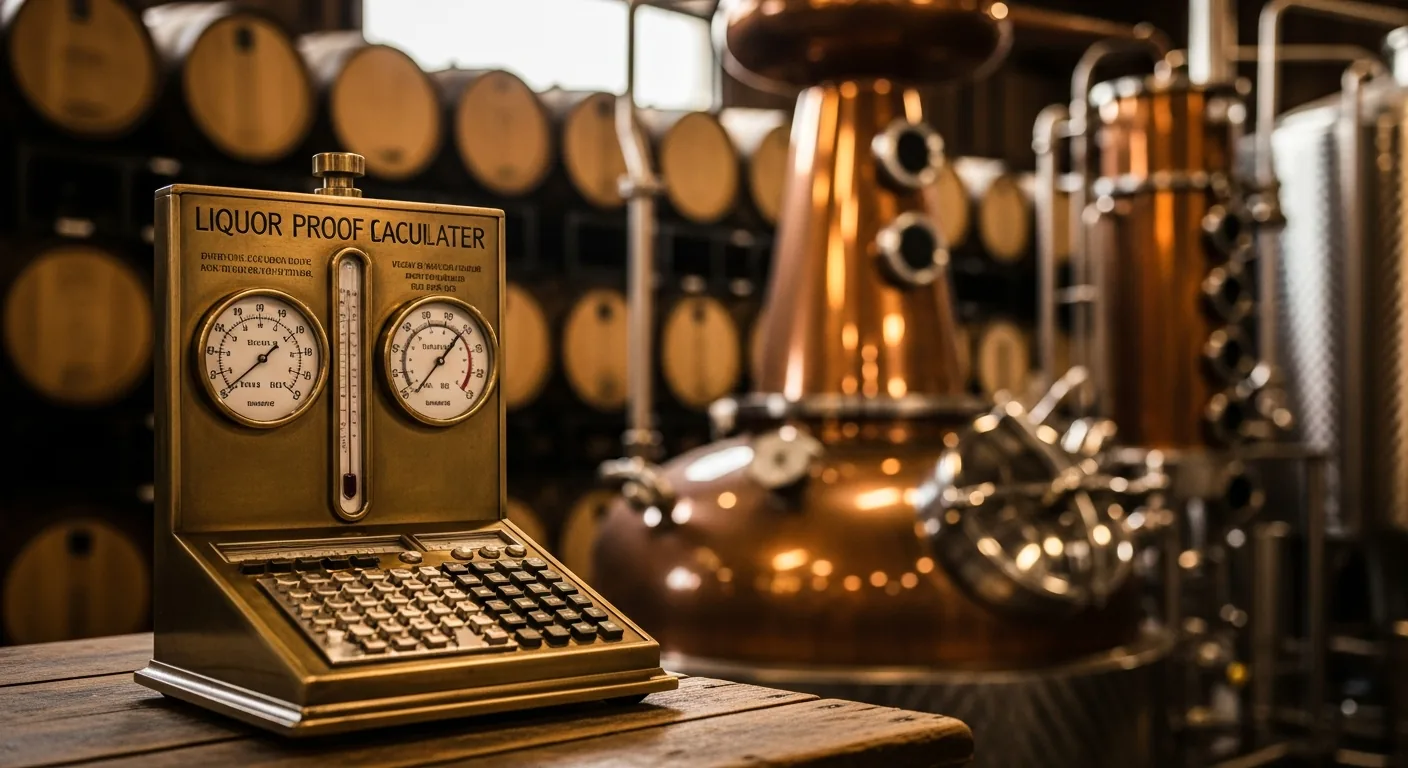
In short: A liquor proof calculator determines the true alcohol by volume of a spirit by correcting the apparent hydrometer reading for temperature. Distilleries rely on these calculators to accurately dilute spirits, calculate proof gallons, and report excise taxes to the TTB without manual chart lookups.
Using an accurate liquor proof calculator is a daily necessity for any commercial distillery. It takes the guesswork out of temperature correction, spirit dilution, and federal tax reporting. A proof gallon is one liquid gallon of spirits at 100 proof, which is exactly 50 percent alcohol by volume. Because federal excise tax is calculated and paid based on proof gallons, finding your exact, temperature-corrected true proof is the only way to accurately determine your tax liability.
Whether you are cutting a mature barrel of bourbon down to bottling strength, preparing white spirits for immediate sale, or recording your monthly production volumes, precise proofing ensures you stay compliant and profitable. Relying on rough estimates or ignoring the physical temperature of your spirits will inevitably lead to costly mistakes. By understanding how to properly gauge your spirits and utilizing modern digital calculators, distillery operators can protect their margins, satisfy regulatory requirements, and maintain absolute consistency in their finished products.
What does a liquor proof calculator do?
A digital calculator replaces the manual, tedious lookup process required by the official federal gauging manual. When you drop a hydrometer into a sample of distillate in your production area, the reading you see on the glass stem is only an apparent proof. Hydrometers measure the density of a liquid, but density is not a static property. It changes significantly depending on the temperature of the fluid.
Most professional precision hydrometers used in the United States are calibrated for spirits sitting at exactly 60 degrees Fahrenheit. If your liquid is exactly 60 degrees, the apparent proof matches the true proof. In a real-world working production environment, however, spirits are almost never at exactly 60 degrees. They might be coming fresh off the condenser at 75 degrees or sitting in a cold winter rickhouse chilling down to 45 degrees.
A true proof calculator takes your apparent hydrometer reading and the actual temperature of the liquid, then applies complex mathematical formulas to determine the exact alcohol by volume. Historically, distillers had to cross-reference massive paper grids, specifically Table 1 in the federal gauging manual, to find this number. You would find your temperature on one axis, your apparent proof on the other, and trace your finger to the true proof. Today, software automates this entire process. This modern approach eliminates human error, saves valuable time on the production floor, and ensures accurate records for your monthly compliance reports.
What equipment do you need for accurate gauging?
Software is only as good as the data you feed into it. To use a calculator effectively, you must gather precise initial readings. This requires investing in high-quality, laboratory-grade gauging equipment. The federal government sets strict standards for the instruments used to determine tax liability, and taking shortcuts here will compromise your entire operation.
First, you need a set of precision proofing hydrometers. These are delicate glass instruments weighted at the bottom and marked with a fine scale along the stem. For tax purposes, you cannot use a broad-range hydrometer that measures from zero to 200 proof. Instead, you need a set of specialized hydrometers, each covering a narrow range, such as 80 to 120 proof or 130 to 170 proof. These narrow increments allow you to read the apparent proof to a fraction of a degree.
Second, you need an extremely accurate thermometer. A standard kitchen thermometer is not sufficient for tax gauging. You must use a calibrated thermometer that reads to at least a tenth of a degree Fahrenheit. The federal government recognizes specific standards for thermometers, and you must periodically calibrate your instruments against a known standard to prove their accuracy to auditors.
Finally, you need a clear sample cylinder or proofing parrot. The cylinder must be tall enough to float your hydrometers without them touching the bottom, and clear enough so you can read the meniscus. The meniscus is the slight curve of liquid that creeps up the side of the glass stem. Reading the hydrometer exactly at the bottom of the meniscus is critical for feeding the right apparent proof into your calculator.
How do you calculate proof gallons for TTB taxes?
Calculating proof gallons is the foundation of federal compliance for any distilled spirits plant. The math itself is straightforward once you have your true, temperature-corrected proof. You multiply your physical liquid volume, known as wine gallons, by the true proof of the spirit, and then divide that number by 100.
For instance, if you have 50 wine gallons of whiskey sitting in a tank at exactly 120 true proof, you have 60 proof gallons. You can quickly run these numbers using a proof gallon calculator to double-check your manual math before recording it in your federal ledgers.
This calculation dictates exactly what you owe the federal government in excise tax. The standard federal excise tax is $13.50 per proof gallon upon removal from the bonded premises for retail sale. Under the Craft Beverage Modernization Act, many producers qualify for a reduced rate of $2.70 per proof gallon on their first 100,000 proof gallons removed in a calendar year. You can read the specific requirements for this reduced rate in the TTB CBMA guidance. Please note that this is general information, not tax or legal advice.
Federal rules dictate exactly how these measurements must be taken. According to 27 CFR Part 30, which governs gauging for tax purposes, you must use approved instruments and precise temperature corrections. If you under-report your proof gallons because of sloppy math or uncorrected temperatures, you are systematically underpaying your excise tax, which can trigger severe penalties during an official audit.
Why does temperature matter when reading proof?
Temperature is the single biggest variable when determining the alcohol content of a spirit. Ethanol and water expand when they heat up and contract when they cool down. Because a hydrometer measures density by floating in the liquid, the physical expansion or contraction of the spirit directly alters how high or low the instrument floats.
If your spirit is warmer than the 60 degree calibration point, the liquid is physically less dense. The hydrometer will sink further into the liquid, giving you an apparent proof that is higher than the actual alcohol content. If you fail to correct for this temperature difference, you will mistakenly believe the spirit is stronger than it really is.
Conversely, if the spirit is colder than 60 degrees, the liquid is denser and the molecules are packed tighter. The hydrometer will ride higher in the sample jar, yielding an apparent proof that is lower than reality. Relying on an apparent reading without running it through a true proof calculator means your daily logs will be fundamentally flawed. This bad data cascades into every other operation, from proofing down for bottling to reporting your physical inventory counts at the end of the month.
How does barrel entry proof differ from bottling proof?
Distillers use proof calculators at multiple stages of the production lifecycle. Two of the most critical stages are barrel entry and bottling, and the strategy changes significantly between these two phases.
When gauging for barrel entry, you are preparing raw, unaged distillate to go into oak casks. By law, straight bourbon cannot enter the barrel at higher than 125 proof. Many craft distillers choose to enter the barrel at an even lower proof, such as 110 or 115, to extract different flavor profiles from the wood. Water acts as a solvent for certain wood sugars, while alcohol acts as a solvent for different compounds. Using a calculator ensures you hit your target entry proof precisely before filling the cask. Accurate entry proofing also establishes your baseline inventory. You must record exactly how many proof gallons went into the warehouse so you can later calculate your angel's share losses when the barrel is dumped.
Bottling proof requires an even higher level of precision. When a barrel is dumped, the proof will have changed during the aging process. Depending on the climate of your rickhouse, the proof may have gone up or down. You must gauge the dumped spirit, calculate the necessary dilution, and proof it down to your exact label claim. The margin for error at bottling is essentially zero, making reliable digital calculators an absolute necessity.
How do you use a liquor proof calculator to dilute spirits?
Proofing down, or diluting spirits with water to reach your target bottling strength, requires incredible precision. You cannot simply use basic algebra to figure out how much water to add. When you mix ethanol and water, a chemical interaction occurs that causes the combined molecules to pack together more tightly. This physical phenomenon is known as volume contraction.
If you mix 50 gallons of pure ethanol with 50 gallons of pure water, you do not get 100 gallons of liquid. You get roughly 96 gallons. Because of this shrinkage, basic proportional math will always leave your final proof slightly off target, usually resulting in a spirit that is stronger than intended.
A specialized dilution calculator accounts for this contraction curve automatically. To use one effectively, you input your starting volume, your starting true proof, and your desired target proof. The software then tells you exactly how much water you need to add by weight or by volume to hit your exact target. Adding water by weight is generally preferred by experienced operators because weight does not change with temperature, making the dilution process much more repeatable and accurate on the packaging floor.
What happens if your proof calculations are wrong?
Failing to determine the correct proof of your spirits has severe financial and legal consequences for a distillery. The financial margins in craft distilling are notoriously tight, and careless gauging will rapidly erode your profitability.
If your proof calculations are too high, you might dilute the product too much. Putting under-proof spirits into a bottle is a strict violation of federal labeling laws. If your approved label claims 80 proof, the liquid inside must meet that standard within a very narrow legal tolerance. If federal authorities pull your product from a retail shelf and test it, an under-proof bottle can lead to mandatory product recalls, heavy fines, and a severely damaged brand reputation.
On the other hand, if your calculations lead you to over-proof a product, you are bottling spirits that are stronger than the label states. While consumers might not complain about slightly stronger whiskey, you are effectively giving away free alcohol. Since it takes immense time and capital to produce and age spirits, giving away excess ethanol in every single bottle will ruin your profit margins over a production run. Furthermore, you will have paid federal excise tax on proof gallons that you never properly accounted for in your pricing model. Strong distillery compliance practices rely entirely on accurate, repeatable proofing protocols.
Precise gauging is the heartbeat of a compliant and profitable distilled spirits plant. Spirit Sight provides comprehensive distillery management software that automatically calculates true proof, temperature corrections, and proof gallons across your entire operation. By replacing manual lookup tables with integrated digital production tools, Spirit Sight helps you eliminate math errors, maintain perfect regulatory records, and ensure every bottle hits its target proof with total confidence.
Key takeaways
- A liquor proof calculator corrects apparent hydrometer readings based on temperature to find the true alcohol by volume.
- Distilleries calculate federal excise tax based on proof gallons, requiring precise true proof and liquid volume measurements.
- Because spirits expand and contract with temperature, a 60 degree Fahrenheit baseline adjustment is required for legal gauging.
- Ethanol and water contract when mixed, requiring specialized dilution formulas rather than basic proportional math.
- Proofing errors can result in underpaid taxes, illegal label claims, or giving away free alcohol in every bottle.
Frequently asked questions
What is a proof gallon?
A proof gallon is one liquid gallon of spirits at 100 proof, which is exactly 50 percent alcohol by volume at 60 degrees Fahrenheit.
Why do distillers need to correct for temperature?
Liquid density changes with temperature, causing warm spirits to read artificially high in proof and cold spirits to read artificially low.
Can I use basic math to dilute my spirits to bottling strength?
No, because mixing ethanol and water causes volume contraction. You must use specialized formulas to account for this chemical reaction.
What is the federal excise tax rate for distilled spirits?
The standard rate is $13.50 per proof gallon, though eligible distillers may pay a reduced rate under the Craft Beverage Modernization Act.