In short: The TTB wine gallon definition 231 cubic inches establishes the standard U.S. liquid gallon for measuring distilled spirits. Distillers must determine the physical liquid volume in wine gallons before applying the alcohol by volume percentage to calculate taxable proof gallons and federal excise tax liability.
The TTB wine gallon definition 231 cubic inches is the foundational measurement every American distillery must understand to remain compliant. Before you can calculate your proof gallons and pay federal excise tax, you have to know exactly how much physical liquid you hold in standard United States volume. This measurement impacts daily operations, barrel management, and mandatory tax reporting.
Please note that this article provides general educational information about distillery compliance and does not constitute official tax or legal advice.
What is the TTB wine gallon definition 231 cubic inches?
When operating a distilled spirits plant, every drop of liquid must be tracked meticulously. The term "wine gallon" simply refers to the standard United States liquid gallon. According to federal regulations, specifically outlined in Title 27 of the Code of Federal Regulations, a gallon is defined as exactly 231 cubic inches of liquid at 60 degrees Fahrenheit. This specific geometric volume is the legal standard of measure for all liquids in a distillery.
When you hear distillers or compliance officers talk about bulk liquid, they are usually talking about wine gallons. It represents the total physical space the liquid occupies, regardless of how much ethanol or water is in the mixture. Whether you are filling a stainless steel tote with high proof neutral grain spirit, a fermentation vessel with mash, or a barrel with low proof wash, the physical footprint of that liquid is measured against this 231 cubic inch benchmark.
Understanding this concept is critical because all distillery accounting begins with physical volume. You cannot accurately report your operations to the federal government without first nailing down your basic liquid volume. Historically, this definition stems from the English Queen Anne gallon, which was adopted by the United States to standardize liquid trade across various industries.
For modern distillers, knowing that a gallon equals exactly 231 cubic inches is more than a trivia fact. It is the mathematical constant used to calibrate every tank, calculate the capacity of every still, and verify the accuracy of every volumetric flow meter on the production floor. Different vessel shapes, from cylindrical tanks to square totes and curved barrels, all rely on this same exact constant to ensure universal measurement.
Why does a physical geometric volume matter for distilleries?
You might wonder why distilleries do not simply measure everything in weight or liters. United States federal compliance relies strictly on the customary system, and 231 cubic inches provides a fixed geometric constant. When tank manufacturers build custom fermenters or blending tanks, their engineers use this geometry to determine how many inches of liquid equate to how many gallons. Distillers then use strapping tables to convert dipstick measurements from inches into liquid volume. Because the volume is a fixed spatial dimension, it allows for precise mathematical conversions when determining tank capacities and verifying barrel fills.
Furthermore, weighing spirits requires understanding density, which changes constantly with temperature and alcohol concentration. To find the exact volume using a scale, you must gauge the spirit accurately. A proper gauge gives you the weight per gallon, allowing you to convert the raw scale weight back into the spatial volume. Using a reliable TTB gauging calculator simplifies this process, ensuring your weight measurements accurately reflect the physical volume mandated by the federal government.
Sight glasses and dipsticks are helpful for quick checks, but scales are the gold standard for compliance because they eliminate the physical distortion of a tank. However, the scale only gives you pounds. The government taxes you on volume and alcohol content. Therefore, you must always translate those pounds back into the geometric space of 231 cubic inches per gallon before you can move forward with your compliance paperwork and tax reporting.
How do you convert standard liquid volumes to taxable proof gallons?
While the physical volume is crucial, it is only the first half of the compliance equation. A proof gallon is defined as one liquid gallon at 100 proof, which is 50 percent alcohol by volume. Excise tax scales with the alcohol content, meaning the tax on a given volume rises and falls with its proof. To find your proof gallons, you take your standard wine gallon measurement, multiply it by the true proof of the liquid, and divide by 100.
Consider these operational examples of converting physical volume to taxable alcohol content:
- If you have 100 wine gallons of bourbon at 120 proof, you have 120 proof gallons.
- If you have 100 wine gallons of vodka at 80 proof, you have 80 proof gallons.
- A standard 53 gallon barrel filled with 120 proof spirit contains exactly 63.6 proof gallons.
The physical footprint is identical in similar sized vessels, but the taxable alcohol content is vastly different depending on the proof. This conversion is the heart of distillery recordkeeping. Every time spirits move from a still to a tank, from a tank to a barrel, or from a barrel to a bottling line, operations staff must log both the physical liquid volume and the calculated proof gallons.
The proof gallon is essentially an abstract concept used purely for taxation and reporting. You cannot hold a proof gallon in your hand unless the liquid happens to be exactly 100 proof. The tangible liquid that you pump, store, and bottle is always measured in standard U.S. gallons. Distillers must master the mathematical relationship between the physical space the liquid occupies and the theoretical alcohol content it holds to maintain proper records.
How do wine gallons impact excise tax and CBMA rates?
The federal government sets no minimum production size to require a license. If you distill any amount of alcohol, you must have a federal basic permit and pay excise tax. The standard federal excise tax is $13.50 per proof gallon, as published in the TTB standard excise tax rates. However, under the Craft Beverage Modernization Act, reduced distilled spirits rates are available to eligible producers.
Currently, the reduced rate is $2.70 per proof gallon on the first 100,000 proof gallons removed from bond or imported. The rate moves to $13.34 per proof gallon on the next 22.13 million proof gallons, and returns to the standard $13.50 above that threshold. Federal tax is paid on removal from bonded premises, typically on a semi-monthly schedule, which means roughly every 15 days. Because these tax liabilities are based strictly on proof gallons, and proof gallons are derived directly from your physical volume measurements, an error in measuring your physical volume compounds directly into a tax error. Overstating your physical volume means overpaying your taxes. Understating it can trigger audits and severe penalties.
Additionally, a distilled spirits plant needs an operations bond sized to cover the potential federal tax liability of the spirits it holds. The required bond is computed as your maximum stored proof gallons multiplied by the applicable tax rate. Common minimums include a $10,000 operations bond, though it drops to $5,000 if you are only producing or only warehousing. If your volume measurements are incorrect, your calculated tax liability will be wrong, and your bond coverage might fall out of compliance. It is also worth noting a key processing activity caveat. A plant that only bottles spirits with no other processing activity may not be entitled to the reduced tax rate, so accurate tracking of every operational step is vital.
Managing Liquid Volume in Rickhouses and Production
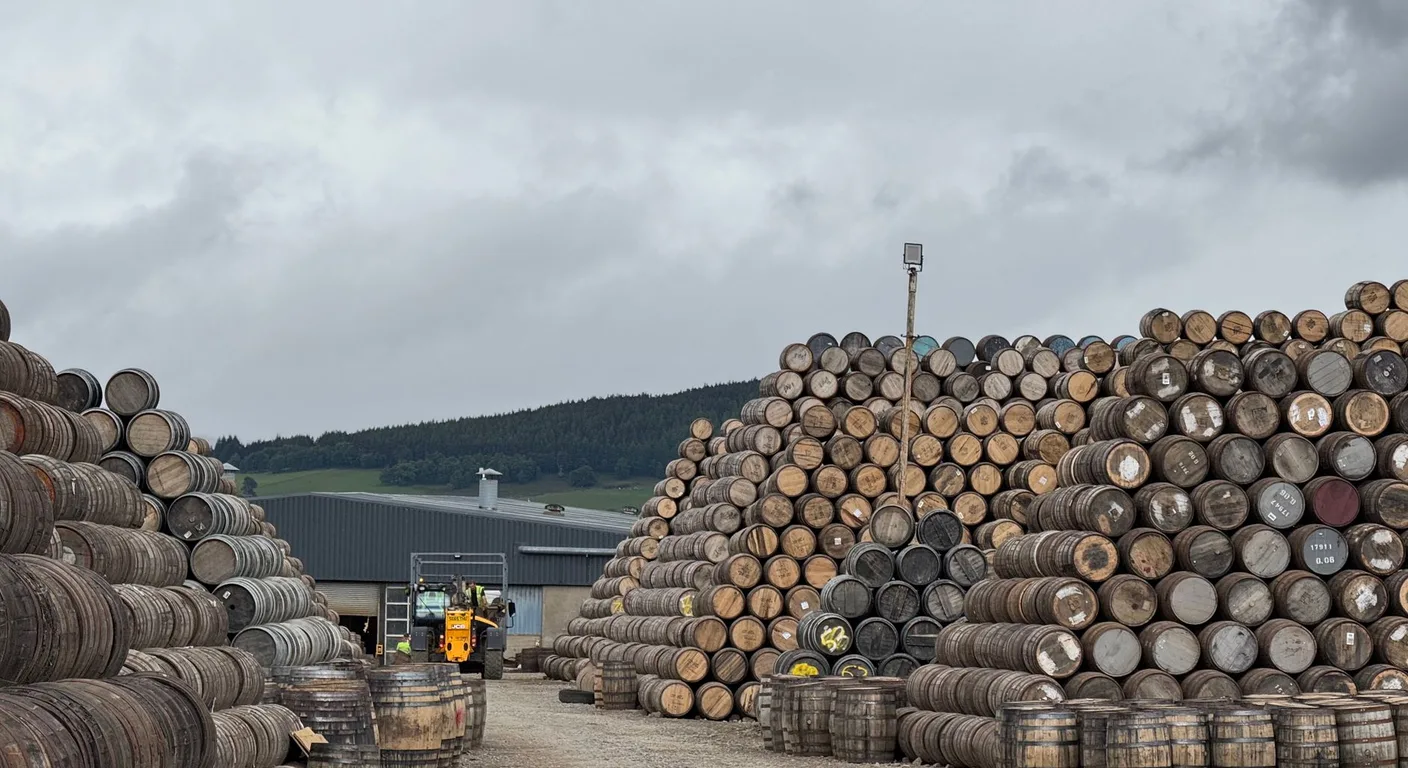
Barrel management introduces another layer of complexity to measuring physical volume. Barrels are not perfect cylinders, yet the volume inside them still answers to the 231 cubic inch rule. When a barrel is filled, the physical space the liquid occupies is recorded carefully. During maturation, the wood breathes, liquid evaporates, and the angels share takes its toll. When it is time to dump a mature barrel for bottling, the physical volume has decreased significantly.
Distilleries must measure the new, lower volume of liquid to account for these losses properly. This requires a careful regauge of the dumped spirits. Operations teams weigh the dumped liquid, check the temperature and apparent proof, and calculate the true proof. From there, they determine the exact remaining standard gallons. If a distillery does not rigorously track these physical volumes, it becomes impossible to calculate accurate production costs. Knowing your true cost per barrel requires knowing exactly how much physical liquid went in and how much came out. Your raw materials, labor, and overhead are spread across fewer gallons after evaporation, driving up the cost of the finished product.
Storage operations inside a bonded premises require precise recordkeeping. You are not allowed to conduct tax paid sampling or retail sales inside the bonded area. Any liquid removed for those purposes must be moved to a separate, non-bonded, tax paid retail area. The removed liquid must be properly gauged, converted to proof gallons, and logged as a taxable removal on a daily basis. Tracking the exact geometric volume of liquid moving through the rickhouse ensures that your evaporation losses are documented legally and that your inventory valuations remain accurate for financial reporting.
How do temperature and density affect volume measurements?
The federal definition of standard volume is strictly anchored at 60 degrees Fahrenheit. Alcohol expands when it warms and contracts when it cools. If you measure 1,000 gallons of spirit at 80 degrees Fahrenheit, the actual volume of that liquid at the standard 60 degrees will be noticeably less. This thermal expansion is why all federal gauging requirements mandate rigorous temperature correction.
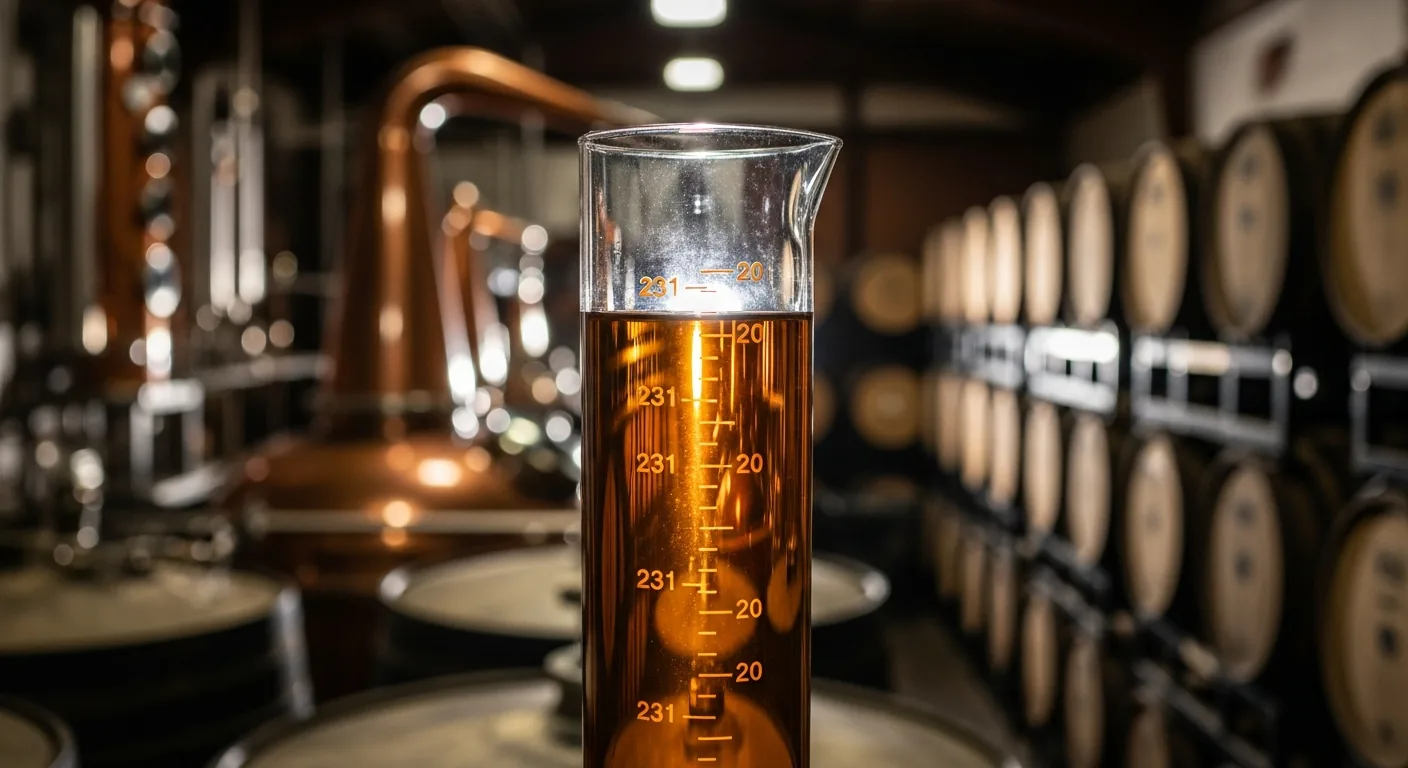
Distillers use precision hydrometers and thermometers to find the apparent proof and temperature of a sample. Reading a hydrometer accurately at the bottom of the meniscus is essential for an accurate apparent proof. They then consult federal tables to find the true proof at 60 degrees Fahrenheit. Because 231 cubic inches of liquid at varying proofs and temperatures will weigh different amounts, these standard tables are an absolute necessity. A standard gallon of pure water weighs roughly 8.32 pounds, while a standard gallon of pure ethanol weighs about 6.59 pounds. Every mixture of the two falls somewhere in between.
Correcting for temperature ensures that every distillery across the country pays taxes based on the exact same volumetric standard, regardless of the climate in their facility. A distillery operating in a hot Texas summer and a distillery operating in a cold Maine winter must both adjust their measurements back to 60 degrees. By respecting the rigid definition of 231 cubic inches at a standard temperature, the industry maintains a level playing field for taxation and trade.
Why is robust distillery management software essential?
Managing the complex conversions between weight, temperature, true proof, and standard volumes is a daily challenge for growing distilleries. Even small errors in gauging can cascade into significant inventory discrepancies over time. A misplaced decimal point or a misread temperature gauge means your reported wine gallons will be inaccurate. This inevitably causes your proof gallon calculations to be wrong, which ultimately leads to incorrect tax payments.
Spirit Sight provides specialized distillery management software that automates these vital calculations, ensuring your barrel records, tank volumes, and federal reports are always perfectly aligned. By removing the manual math from gauging and regauging operations, Spirit Sight helps distillery teams save time, maintain compliance, and focus on crafting exceptional spirits. The software inherently understands the relationship between 231 cubic inches, temperature correction, and alcohol density.
When your operations floor is integrated with a comprehensive ERP platform, you eliminate the risk of human error in translating scale weights into geometric volumes. You gain absolute confidence that your liquid inventory is accurate down to the final drop, protecting your business from audit risks and keeping your focus exactly where it belongs on your product.
Key takeaways
- The TTB defines a wine gallon as exactly 231 cubic inches, serving as the standard U.S. liquid gallon.
- Distilleries must accurately measure their physical liquid inventory in wine gallons before converting it to taxable proof gallons.
- Excise tax liability strictly scales with proof gallons, meaning precise physical volume and temperature corrections are mandatory.
- Using standard measurement formulas and temperature adjustments ensures accurate federal compliance and prevents costly tax reporting errors.
Frequently asked questions
What is a wine gallon in distilling?
A wine gallon is a standard United States liquid gallon, defined by federal regulations as exactly 231 cubic inches. It represents the total physical volume of a spirit regardless of its alcohol content.
How do you convert wine gallons to proof gallons?
You convert wine gallons to proof gallons by multiplying the total wine gallons by the true proof of the spirit, and then dividing the result by 100.
Why does the TTB care about cubic inches?
The 231 cubic inch metric is the historical and legal foundation of the U.S. liquid gallon, ensuring absolute uniformity across all measurements, scales, and gauging instruments.
Does federal excise tax apply directly to wine gallons?
No, federal excise tax for distilled spirits is applied to proof gallons. You only use the wine gallon measurement as a foundational step to calculate the final taxable proof gallons.