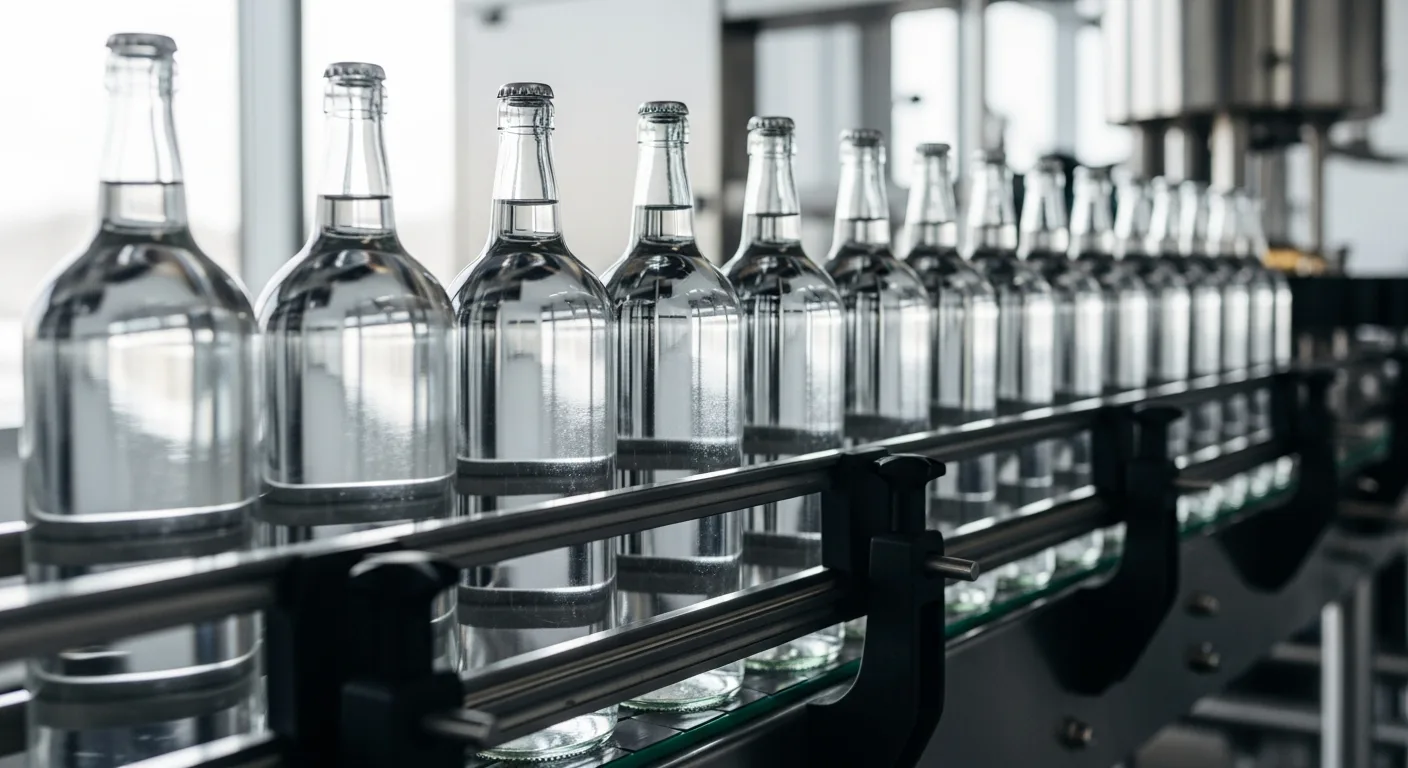
In short: New glass bottles usually do not require a full wash before filling with high-proof spirits, as the alcohol acts as a preservative. However, distilleries should rinse or blow out bottles to remove shipping dust, glass fines, and cardboard fibers to ensure visual clarity.
For most distillery owners, the question of whether to wash new bottles before filling comes down to risk management and visual quality. When a pallet of brand-new glass arrives at your facility, it looks pristine. The shrink wrap is intact, the tier sheets are neat, and the bottles shine under the warehouse lights. It is tempting to move those bottles directly from the pallet to the filler to save time, water, and labor.
However, new glass that ships clean from the manufacturer still carries hidden risks. While new bottles do not usually need a full wash with hot water and detergent, most experienced distillers still rinse or blow out every single bottle before filling. The reason is particulate control. You are clearing shipping dust, microscopic glass fines, and the occasional stray cardboard fiber. You are not typically performing sanitation.
That distinction matters deeply. It changes what equipment you buy, how much time you spend per bottle, and where your real quality risk actually lives. High-proof spirit is largely self-preserving, so the main question is whether the bottle is visually clean, not whether it is biologically sterile. Here is a detailed look at how to approach bottle preparation for your distillery.
Is washing about cleanliness or sanitation?
It helps to separate two concepts that often get blurred together on the bottling line. Sanitation is about killing microorganisms to prevent spoilage. Cleanliness is about removing physical debris to ensure clarity and visual appeal. For most distilled spirits, sanitation is mostly a non-issue.
Spirits bottled above roughly 20 percent alcohol by volume do not support microbial growth. The alcohol itself acts as a powerful preservative. That is the exact reason an open bottle of high-proof bourbon can sit on a back bar for months without spoiling or growing mold. Unless you are bottling a low-proof liqueur, a sugar-heavy cream product, or a canned cocktail, you are not fighting bacteria at the filler.
You are fighting specks.
Those specks are very real, and customers notice them immediately. A floating fiber or a glint of glass in a clear spirit reads as a severe defect even when it is physically harmless. The practical job of a pre-fill step is to get foreign material out of the bottle before the liquid goes in. Calling this step a "wash" oversells what is actually happening. For brand-new glass, a targeted rinse or an air blow is usually more than enough.
What is actually in a brand-new bottle?
New bottles are not dirty in the traditional food-safety sense, but they are rarely completely pristine. The journey from the glass manufacturer to your bottling line introduces several opportunities for contamination. Three specific things tend to show up inside new glass.
First, you will find shipping and warehouse dust. Bottles travel on pallets, get shrink-wrapped, sit in distribution warehouses, ride on trucks, and are eventually unpacked by hand. Fine environmental dust settles into the open necks throughout this entire journey.
Second, new bottles almost always contain glass fines. These are microscopic glass particles and shards left over from the manufacturing process. They also form when bottles vibrate and knock against each other during highway transit. Glass fines are the primary reason a lot of bottlers insist on rinsing, even when a bottle looks spotless under visual inspection.
Third, you will occasionally find larger foreign objects. A tiny piece of cardboard from a tier sheet, a fiber from a box divider, or a fleck of label adhesive can easily fall into an open neck. These instances are rare, but it only takes one visible piece of cardboard in a premium bottle of whiskey to ruin a customer's first impression of your brand.
None of these contaminants require hot water, soap, and a drying cycle. They require displacing loose material and getting it out of the bottle before the fill. That is why the most common pre-fill tool in a craft bottling line is a rinser, rather than a traditional washer.
Equipment options for craft bottling lines
Choosing the right equipment depends on your production volume, your floor space, and the specific spirits you are bottling.
Standard compressed air is the most entry-level option. A simple manual blow-out with filtered, dry compressed air can clear out loose dust. However, standard air often fails to remove glass fines because it does not address static electricity. Friction from transit builds a static charge inside the bottle, causing dust and microscopic glass to cling stubbornly to the inner walls.
Ionized-air rinsing solves the static problem. This equipment inverts the bottle, blasts filtered air or an inert gas inside, and uses an ionizer to neutralize the static charge. A vacuum then sucks the dislodged particulate back out. There is no water used, no floor drain required, and no drying step needed. For dry particulate in new glass, this is often the most efficient method.
Liquid rinsing is another popular approach. Some bottlers rinse with highly filtered reverse osmosis water. While effective at removing debris, water rinsing leaves residual droplets inside the bottle. These droplets can slightly dilute the spirit, which means you must carefully monitor your fill proofs to remain compliant.
Alternatively, you can rinse with the spirit itself. Product rinsing ensures there is no water dilution, but it can be expensive if you do not have a system to filter and recapture the rinse liquid.
How do small distillers rinse without floor drains?
This is a genuine pain point on the bottling line. Many small producers operate in spaces with limited floor drains, restricted water access, and no appetite for an expensive, large-scale inline washer.
Closed-loop liquid rinsing is the best solution for this constraint. This method uses a small reservoir of rinse liquid, often the spirit itself or a neutral high-proof rinse. The liquid gets pumped into the inverted bottle, clears the debris, and is then recirculated through a fine filter rather than dumped down a drain. It provides a thorough rinse without requiring a constant municipal water feed or a complex drainage system.
Vacuum-assisted ionized air is the other major solution for drain-free facilities. Because it relies entirely on air and electricity, you can place an ionized air rinser anywhere on your packaging floor.
Where do particles in finished bottles really come from?
If you are finding particles in sealed bottles, the glass is only one suspect. Often, the bottle is not the main culprit. Producing a visually flawless product requires looking at the liquid, not just the packaging.
Think of particulate contamination as coming from three distinct sources, and build a process to treat each one.
The glass itself contributes shipping debris and glass fines, which a bottle rinse addresses.
The spirit contributes its own particulate. Barrel-aged spirits carry char fines, wood sediment, and chill-haze fatty acids. Unaged white spirits can carry flocculation or mineral haze from proofing water. These issues are only solved by inline liquid filtration sized appropriately for the product. Distillers typically use tighter absolute filters for white spirits, and slightly more porous nominal filters for brown spirits to preserve flavor oils. You can easily manage and record these specific hardware configurations for every batch using your production tracking software.
The environment contributes airborne dust during an open, slow fill. Good housekeeping, maintaining positive air pressure in the bottling room, and utilizing a covered fill point will address environmental dust.
A bottle rinse with no liquid filtration will still let barrel char and haze through to the final product. Liquid filtration with no bottle rinse will still leave shipping dust in the neck of the glass. If clarity matters for your product, you generally need to do both. Rinse the bottle and filter the liquid.
Managing temperature and condensation
Even a perfectly rinsed, perfectly filtered bottle can develop a visual problem after it leaves your line. Condensation inside the glass is a frequent issue that frustrates many distillers.
It is important not to blame your rinse step for problems it did not cause. In-bottle condensation is almost always a temperature and humidity story. If you seal warm liquid inside a cool bottle, or if you fill cold bottles in a warm, humid room, condensation will form in the headspace. The moisture gets trapped by the cork or closure, resulting in a cloudy ring near the neck.
Diagnosing this condensation as a cleaning failure sends you chasing the wrong fix. You cannot wash away a temperature differential. The solution is tempering your glass. Bring your pallets of glass into the bottling room 24 hours before your run so they can adjust to the ambient temperature. Match the temperature of your liquid to the temperature of your glass as closely as possible.
The broader lesson is to know exactly which problem each step of your process solves. A rinse clears particulate. A filter clears haze and sediment. Temperature control and headspace management address condensation. Closure selection addresses seal integrity. Lumping all of these distinct challenges under the vague goal of washing bottles better will waste your effort.
Does the TTB require you to wash bottles?
Federal regulation governs bottling at a distilled spirits plant, but it is aimed at fill accuracy, proofing, labeling, and recordkeeping rather than at a specific bottle washing procedure.
The bottling and packaging rules for a distillery live in 27 CFR Part 19, and the labeling rules live in 27 CFR Part 5. Neither of these federal codes prescribes a mandatory pre-fill wash of new glass for standard spirits.
Washing or rinsing is a quality and brand decision that you make internally. It is not a federal step you are explicitly required to document in a specific way. However, you are strictly required to ensure your product is unadulterated and safe for consumption.
Please note that this is general information, not legal or tax advice. Always verify current requirements directly at https://www.ecfr.gov and https://www.ttb.gov, since regulations change and your specific operation may carry conditions that general guidance does not cover.
While the government is not explicitly telling you how to wash new bottles, the compliance answer and the quality answer point the same way. The decision to rinse is about ensuring exactly what your customer sees when they hold your bottle up to the light. Keeping accurate logs of your bottling runs remains critical for compliance, which you can easily manage through a dedicated TTB reporting log.
Building a reliable bottle preparation SOP
Consistency is the secret to a high-quality bottling line. To prevent particulate issues, you must turn your rinsing and filtration decisions into a repeatable Standard Operating Procedure.
Document the exact micron rating you run for each specific product. A heavy bourbon might run through a 5-micron filter to preserve mouthfeel, while a vodka might require a 1-micron absolute filter for brilliant clarity. Record these settings so they become a repeatable quality control standard, rather than a random setting that an operator changed and forgot.
Track your glass lot numbers. If a customer ever complains about a foreign object in a bottle, you need to be able to trace that specific bottle back to the exact pallet and manufacturing lot it came from. Utilizing a reliable inventory management system allows you to link your dry goods to your finished batches, providing full traceability.
The honest bottom line
For brand-new glass and high-proof spirits, you almost never need a true wash with soap and hot water. You need a targeted rinse or an ionized air blow to clear shipping dust and glass fines. Simultaneously, you need an inline filter sized to your specific product to clear haze and sediment from the liquid.
Match the packaging step to the specific problem, write down the settings you run, and you will have a repeatable production line instead of a guessing game. The recurring trap in the industry is treating cleaning, filtering, and tempering as one vague chore. By separating them, you can build a bottling process that is cost-effective, highly repeatable, and perfectly suited to protecting the quality of your spirit.
Key takeaways
- High-proof spirits act as their own preservative, meaning bottle sanitation is less critical than removing physical debris.
- New bottles frequently contain microscopic glass fines, shipping dust, and cardboard fibers that can ruin product clarity.
- Ionized air rinsers and closed-loop liquid systems offer effective particulate removal without requiring extensive plumbing or floor drains.
- Achieving a perfectly clear spirit requires both bottle rinsing for glass debris and proper liquid filtration for haze and sediment.
- While the TTB closely monitors fill volumes and proofing, federal regulations do not mandate a specific pre-fill wash procedure for new glass.
Frequently asked questions
Do I need to sanitize bottles for low-proof spirits or canned cocktails?
Yes. Products with lower alcohol by volume, added sugars, or dairy do not have the same preservative qualities as high-proof spirits and typically require strict sanitation and pasteurization protocols.
Can I use tap water to rinse my new bottles?
Using untreated tap water is not recommended because it can leave mineral spots on the glass and introduce chlorine flavors. Distilleries generally use reverse osmosis water, filtered compressed air, or the spirit itself.
Why is there a cloudy ring in the neck of my bottles after filling?
A cloudy ring is usually caused by condensation resulting from temperature differences between the liquid and the glass, not a failure to wash the bottle properly.
Does the TTB regulate how distilleries clean their bottles?
The TTB primarily regulates fill accuracy, proof, and labeling under 27 CFR Part 19 and Part 5. They do not prescribe specific bottle washing methods, but distillers must maintain safe, uncontaminated products.