In short: Water quality management in distilling and why it matters is fundamental because water drives heating, cooling, fermentation, and final product proofing. Proper filtration and chemistry control prevent scaled boilers, stalled fermentations, and cloudy spirits while ensuring full compliance with federal regulations regarding product purity and label accuracy.
Water is the single most utilized ingredient and utility in any distilled spirits plant. Understanding water quality management in distilling and why it matters is a foundational lesson every operator learns, often the hard way. Water makes up the majority of your finished spirit and is the absolute lifeblood of your facility heating and cooling systems. Poor water chemistry leads to stalled fermentations, scaled boilers, and cloudy off flavors in the bottle.
Managing your source water means testing for mineral content, filtering for chlorine, and using reverse osmosis for proofing. This proactive approach protects expensive copper stills, ensures consistent mash conversion, and keeps you compliant with federal regulations regarding product purity. Distillers who ignore their water chemistry often face expensive equipment repairs and inconsistent batches, while those who control it enjoy predictable yields and award winning profiles.
Why is water quality management in distilling so critical?
Water touches every single phase of a distilled spirits plant. It produces the steam that drives your boiler, provides the medium for your grain starch conversion, cools the vapor back into liquid form, and reduces your high proof distillate down to barrel entry and bottling strengths. Each of these four distinct processes requires an entirely different level of water purity.
Municipal water systems often contain chlorine, chloramines, calcium, magnesium, and trace metals. While these minerals are perfectly safe for drinking, they interact aggressively with distillery equipment and yeast. Well water presents an entirely different set of challenges, typically involving seasonal fluctuations in heavy metals, high iron content, and extreme hardness.
Failing to understand the chemistry of your water source forces you into a reactive position. You will spend valuable production hours chasing down reasons for stuck fermentations, cleaning stubborn scale out of heat exchangers, and trying to salvage spirits that turned cloudy during proofing. Implementing a comprehensive water management strategy up front reduces downtime, standardizes your operating procedures, and drastically lowers your long term capital expenditure.
Does hard water damage your copper stills and steam boilers?
Hard water is notoriously destructive to distillery heating and cooling infrastructure. The most severe financial impact of poor water quality typically hits the boiler room. As water boils and turns into steam, it leaves behind its total dissolved solids. These solids, primarily calcium and magnesium carbonate, precipitate out of the water and form a hard mineral scale on boiler heating elements and internal walls.
Scale is a phenomenal thermal insulator. Just a fraction of an inch of scale buildup can force your boiler to work twice as hard to reach the same temperature. This drastically increases your energy bills and risks a total element failure due to metal fatigue and overheating. When scaling up production, distillers often invest heavily in larger commercial steam systems. If you destroy a commercial steam boiler by feeding it untreated hard water, replacing it costs thousands of dollars in parts plus the heavy expense of production downtime. Treating your boiler feed water with a commercial water softener and appropriate chemical treatments prevents this catastrophic scaling.
Inside the distillation equipment itself, water quality dictates how well your copper components function. Copper on the hot side of your still, such as the pot, head, column, and plates, acts as a catalyst. It binds with harsh sulfur compounds like dimethyl trisulfide and hydrogen sulfide, producing a softer spirit. If you are running hard water through your still to clean it, or boiling hard wash, minerals can plate onto the copper. This plating covers the reactive surface area of the copper, physically preventing it from binding with sulfur. You lose the primary benefit of your expensive copper investment.
Meanwhile, in the cooler distillate path like condensers and spirit pipes, the catalytic benefit of copper largely disappears. This is why many experienced distillers use stainless steel for condensers. Stainless steel is more durable and much easier to clean when mineral scaling inevitably occurs.
Why is municipal water a risk for mashing and fermentation?
Mashing and fermentation rely entirely on biological and chemical reactions that are highly sensitive to water conditions. When you mix hot water with milled grain, enzymes like alpha amylase and beta amylase break down complex starches into fermentable sugars. These enzymes require specific pH ranges, typically between 5.2 and 5.6, and a certain amount of calcium ions to function efficiently.
If your water is entirely devoid of minerals, as is the case with pure reverse osmosis water, enzyme activity can sluggishly drop off. However, if the water is too hard or contains high levels of heavy metals, the yeast will struggle to reproduce and ferment those sugars completely.
Municipal water is particularly risky because it is treated with chlorine or chloramines to kill bacteria in the public supply. If you use city water straight from the hose to build your mash, that residual chlorine will actively attack and kill your expensive pitching yeast. Furthermore, chlorine can chemically bind with phenols in the grain to create chlorophenols. These compounds have a very low flavor threshold and give the resulting whiskey a distinct, uncorrectable medicinal or plastic flavor that carries over through distillation.
Transitioning to dedicated brewery equipment, like a proper mash tun and temperature controlled fermenters, allows you to effectively treat your mashing water in a separate hot liquor tank before it ever touches the grain. Running city water through a large activated carbon block filter removes the harmful chlorine and chloramines while leaving the beneficial calcium and magnesium intact for healthy yeast metabolism.
What are the TTB rules for proofing and reduction water?
When it comes to reducing the proof of your spirit for barreling or bottling, water quality moves from a best practice to a strict regulatory compliance issue. The Alcohol and Tobacco Tax and Trade Bureau dictates exactly what can and cannot be added to a distilled spirit.
According to federal regulations under 27 CFR 5.141, water used to reduce the proof of spirits must not add flavor or alter the essential character of the product. It must be exceptionally pure. Using untreated tap water to proof down a spirit can introduce foreign flavors and cause unexpected chemical reactions.
Note: Regulatory information provided is general guidance and does not constitute legal or tax advice.
When high proof alcohol mixes with hard water, the minerals in the water bind with the fatty acids, lipids, and congeners present in the alcohol. This reaction creates a visual phenomenon called flocculation, resulting in a cloudy haze floating in your bottles, often referred to as chill haze. To prevent this, distillers must use demineralized, distilled, or reverse osmosis water for all proofing operations.
Calculating exact water additions is a delicate process because alcohol and water do not mix perfectly linearly due to hydrogen bonding. Using a reliable dilution calculator helps you hit your target proof without over diluting. This is critical since you cannot easily take water back out once it is added. Missing your target bottling proof can result in severe compliance violations if the proof in the bottle does not match the approved label.
How does water chemistry affect barrel entry and rickhouses?
Before your whiskey ever enters a barrel, it must be proofed down from its distillation strength to its designated barrel entry proof. The quality of the water used at this specific stage heavily dictates how the spirit will interact with the wood over the coming years in your aging facility.
If your reduction water contains trace amounts of iron, that iron will react aggressively with the tannins in the newly charred oak barrel. This reaction turns the whiskey a dark, murky purple or black color and creates a sharp, metallic bitterness that ruins the batch. Because whiskey ages for years, an early mistake with barrel entry water compounds over time.
When operating a large aging program, tracking the exact proof and volume entering each barrel is essential for accurate barrel management. If you use impure water during the barreling process, you risk spoiling an entire production lot. Consistent, demineralized water ensures that the spirit ages exactly as intended, extracting only the desired vanilla, caramel, and oak notes from the barrel.
Furthermore, accurate water additions at this stage are necessary to determine your precise tax liability. Utilizing a proof gallon calculator when barreling ensures that your required federal storage operation reports are completely accurate from the very first day of aging.
Should you use different filtration for cooling loops?
Distilleries consume an enormous volume of water just for cooling. Bringing vapor back to a liquid state requires your condenser to exchange heat rapidly with cold water. Many facilities operate a closed loop cooling system featuring a chiller and a cooling tower to avoid wasting millions of gallons of municipal water down the drain.
Because this cooling water constantly recirculates and evaporates, the concentration of minerals in the loop increases over time. If left untreated, this concentrated hard water will form heavy scale on the inside of your condenser coils. While stainless steel condensers handle this scaling slightly better than copper, both will suffer a massive drop in thermal efficiency when coated in minerals.
To manage this, distillers must use specific water treatments and filters on their cooling loops. Bleeding off a portion of the water regularly and topping it up with fresh, softened water prevents the mineral concentration from reaching critical levels. Protecting your chillers and condensers with proper water chemistry ensures that your distillation runs take the expected amount of time. If your condenser loses efficiency due to scale, your still will run hotter, vapor may bypass the condenser entirely, and your production schedule will face major delays.
How do you build a proper water treatment system?
Building an effective water treatment system starts with establishing a baseline. You should send samples of your municipal or well water to a certified laboratory to determine your exact mineral content, pH, and chlorine levels. Because municipal water sources often shift treatments during different seasons, testing quarterly provides a more accurate picture of your water profile.
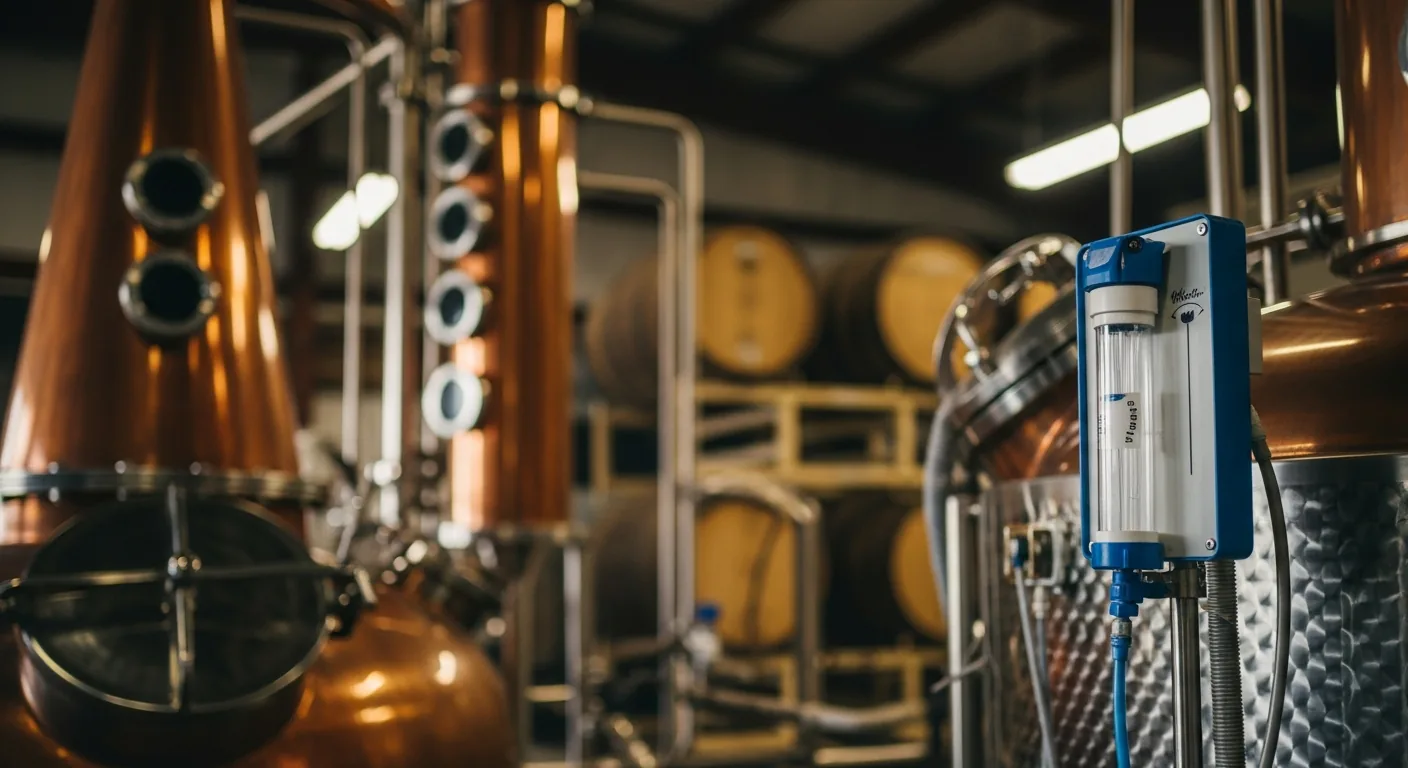
A typical distillery water treatment skid consists of multiple stages. First, a sediment filter removes large particulates, sand, and rust. Next, a heavy duty activated carbon filter strips out chlorine and chloramines, preparing the water for the mashing process. For the boiler loop, the water is then passed through a commercial water softener to exchange hard calcium ions for soft sodium ions. Finally, for proofing and barrel reduction, a portion of that water passes through a reverse osmosis membrane to strip out all remaining dissolved solids, yielding perfectly pure water that will not cloud your finished spirits.
Streamlining your production data
Managing a distillery requires tracking everything from mash water pH to the exact volume of reverse osmosis water used for final proofing. Spirit Sight is a comprehensive distillery production software designed specifically to handle these unique operational workflows.
By keeping your recipes, batch logs, water chemistry notes, and TTB compliance reports in one unified system, Spirit Sight eliminates the guesswork of manual spreadsheets. Documenting your water chemistry alongside your batch yields allows your team to analyze trends over time, ensuring absolute consistency and quality in every single bottle you produce.
Key takeaways
- Hard water causes severe mineral scaling that decreases boiler efficiency and masks the catalytic benefits of copper equipment.
- Municipal water often contains chlorine and chloramines, which can stall fermentations and produce medicinal off flavors.
- Proofing and reduction water must be completely pure to comply with federal regulations and prevent chemical reactions like flocculation in the bottle.
- Barrel entry water must be free of iron to prevent aggressive reactions with wood tannins that turn spirits dark and bitter.
- Tracking water chemistry and volume additions in a centralized software system guarantees regulatory compliance and product consistency.
Frequently asked questions
Do I need reverse osmosis water for mashing grain?
No, reverse osmosis water is generally stripped of all minerals. Yeast and grain enzymes require calcium and magnesium to function optimally, making carbon filtered water the preferred choice for mashing.
Can I use municipal tap water to proof down whiskey for bottling?
No, using untreated tap water introduces minerals that bind with fatty acids in the spirit. This reaction creates a cloudy chill haze and can alter the intended flavor profile.
Why does mineral scale reduce the effectiveness of copper stills?
Copper acts as a catalyst to bind and remove harsh sulfur compounds from alcohol vapor. Mineral scale physically covers the copper surface, preventing the vapor from making contact and neutralizing its benefits.
How does hard water impact my steam boiler?
Untreated hard water leaves behind dissolved solids when it turns to steam. These solids form a thick scale on the heating elements, acting as an insulator that dramatically increases energy costs and can cause the elements to fail.
How often should a distillery test its water source?
Distilleries should perform baseline laboratory testing quarterly, as municipal and well water profiles change with the seasons. Daily monitoring of pH and chlorine levels is also highly recommended for quality control.