In short: Effective production planning and mashbill management for consistent whiskey requires balancing precise water to grain ratios, mashing temperatures, and standardized distillation cuts. Controlling these variables helps distillers optimize starch conversion, stabilize yields, and guarantee a uniform flavor profile.
Effective production planning and mashbill management for consistent whiskey requires striking the perfect balance between raw ingredient chemistry, strictly controlled temperatures, and repeatable distillation practices. To maintain a uniform flavor profile batch after batch, operators must meticulously calculate their water to grain ratios, protect delicate conversion enzymes from excess heat, and standardize how they handle feints and cuts on the spirit run.
By standardizing these operational parameters, a distillery can stabilize its yields, predict inventory requirements, and confidently scale operations over time. This foundational control ensures that what enters the barrel today will match the profile your customers expect years from now. Utilizing robust management software bridges the gap between the chaotic reality of the production floor and the strict demands of business forecasting.
How much grain and water do I need for a consistent whiskey mash?
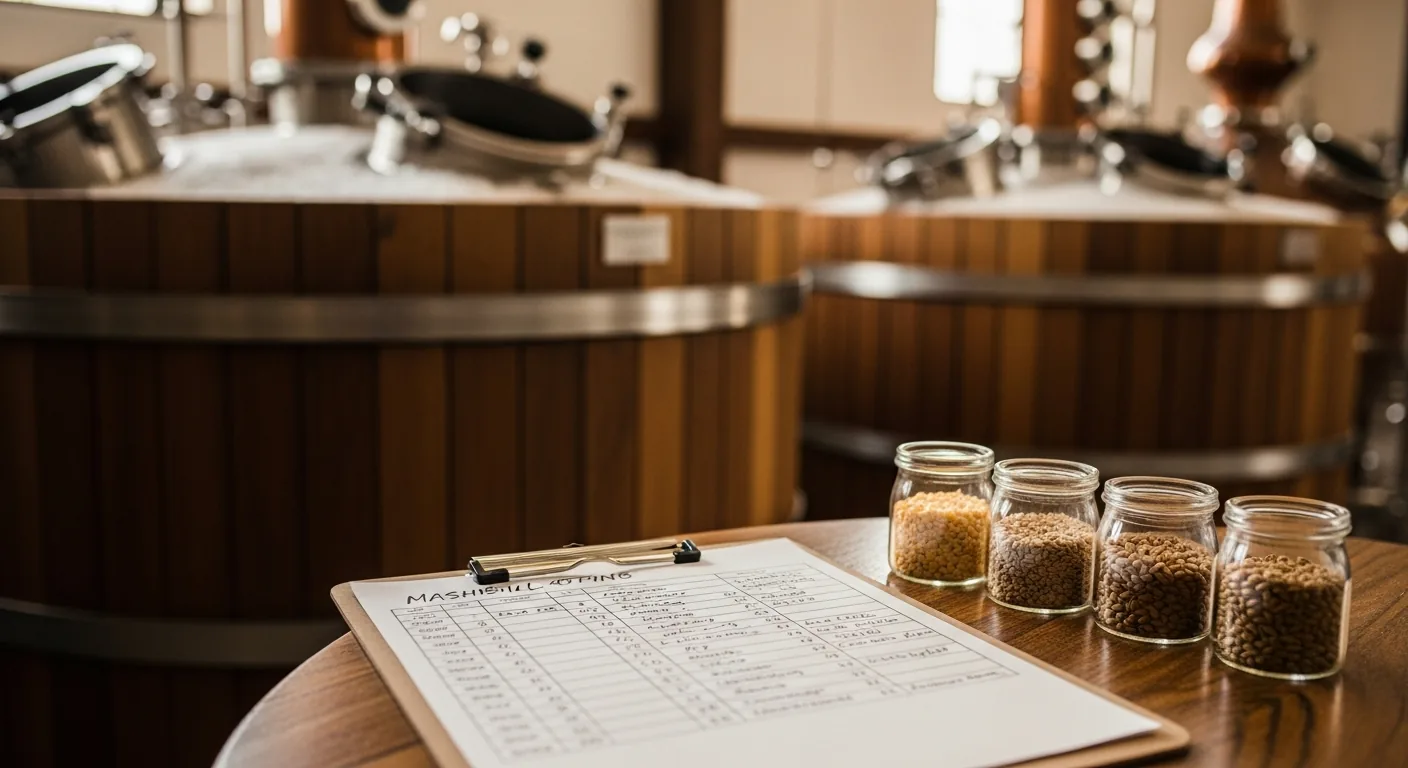
When designing a whiskey recipe, your baseline water to grain ratio dictates both the thickness of your mash and the potential alcohol by volume of your finished wash. There is no single universal ratio because starch content varies significantly by grain type and harvest season. However, a common starting point in the industry is about 1.5 to 2 pounds of grain per gallon of total mash.
Corn requires slightly less water to process than grains like wheat or barley. A classic benchmark for a corn heavy recipe is a 3 to 1 water to grain ratio by weight. This roughly translates to 8.43 pounds of grain to 3 gallons of water. For a traditional wash targeting around ten percent alcohol by volume, distillers often use roughly 2 pounds of grain per gallon.
Beyond the raw weight, milling consistency plays a massive role in your production planning. If you are using a hammer mill, you must ensure your screen size is appropriate for your specific cooking equipment. A finer grind exposes more surface area for starch conversion but can create an excessively sticky mash that is difficult to pump or lauter. A coarser grind prevents sticking but requires longer cooking times to fully release the starches.
Understanding these inputs is critical for predicting your distillery output. A rough rule of thumb for a basic pot still configuration is that your finished product volume will be roughly one twentieth of your original mash volume. You can generally expect about 5 gallons of spirit at 120 proof, or 7.5 gallons at 80 proof, per 100 gallons of 8 percent wash. In practical packaging terms, that yields roughly 35 to 40 standard 750ml bottles per 100 gallons of mash. Yields will also vary heavily depending on your specific still efficiency and the width of your cuts during the spirit run. Tracking these metrics in your distillery production software helps you schedule grain deliveries and forecast available barrel inventory with far greater accuracy.
At what temperature should I add malt and enzymes for starch conversion?
Heat is both your primary tool and your biggest risk during the mashing process. For an all corn recipe, you must first gelatinize the corn at high temperatures. This typically occurs between 183 and 190 degrees Fahrenheit using a high temperature alpha amylase enzyme. This step physically breaks down the rigid starch structures in the corn and turns a thick porridge into a fluid liquid.
However, alpha amylase only liquefies the starch. To break those liquefied starches into fermentable sugars, you must introduce glucoamylase or malted barley. Timing and temperature are absolutely critical here. You must cool the mash below 150 degrees Fahrenheit, ideally landing in the high 140s, before adding your malt or glucoamylase. Adding malt at 160 degrees will permanently kill the malt enzymes. Beta amylase specifically performs best around 144 to 145 degrees Fahrenheit. At 155 degrees it begins denaturing, and by 158 degrees nearly all beta amylase is destroyed, leaving you with unfermentable complex sugars.
Exogenous commercial enzymes are permitted in the United States, and many large commercial producers use them to supplement their mashing process. If you choose to rely entirely on malted grain for conversion, a standard rule of thumb is that a recipe requires roughly 15 percent high diastatic malted barley to convert an otherwise unmalted grain bill. Malted rye or wheat have lower diastatic power and require a significantly higher percentage in the mashbill to achieve full conversion.
If you are utilizing commercial enzymes, shelf life and storage conditions are a common concern. Do not automatically discard enzymes just because they have passed their printed date. Their conversion power degrades slowly over time. You can simply increase your feed rate by roughly 5 to 10 percent every few months past the expiration date, always confirming complete conversion using an iodine starch test. Logging your enzyme lot numbers and usage rates in your management system is a best practice for production tracking.
Why is my whiskey mash producing almost no alcohol?
One of the most frequent problems new distillers face is a stalled or extremely low yielding fermentation. When a mash produces almost no alcohol, the usual culprit is heat killing your conversion enzymes during the mashing process. If you heat the mash too high, for example taking a malted mash up to 170 degrees Fahrenheit, you destroy the amylase enzymes completely. This leaves the starch unconverted, giving the yeast nothing to consume.
Another common failure point is relying solely on alpha amylase. If your corn mash fails an iodine starch test despite a heavy enzyme dose, it is because alpha amylase only liquefies the mash. Glucoamylase is required to break both the 1,4 and 1,6 starch bonds into fermentable sugars, and it must be added after the temperature drops to a safe level. Glucoamylase also stays active through fermentation, continuously breaking down complex sugars as the yeast works.
A third issue is creating an overly thick, high gravity mash that stresses the yeast, or failing to properly manage your pH levels. For optimal enzyme performance, you should hold your mash pH near 5.1 to 5.2. If you are working with sticky grains like rye, distillers often step the pH down with each enzyme addition. You might start at 5.8 for beta glucanase, drop to 5.6 for alpha amylase, and finish at 5.2 for glucoamylase. Monitoring yeast pitching temperatures and daily specific gravity readings ensures you catch stalled fermentations before they become catastrophic losses.
How do I refine distillation practices for a uniform flavor profile?
Executing production planning and mashbill management for consistent whiskey extends beyond the fermenter and into how you run your stills. Maintaining a standard operating procedure for stripping runs, spirit runs, and distillation cuts is the only way to achieve true consistency in the bottle.
During the initial stripping run, your goal is to extract alcohol quickly. Do not make flavor cuts on the strip run. You only need to discard a small amount of foreshots to clean the still. Run the pot still fast and collect your low wines down to about 5 to 8 percent alcohol by volume, which reads as 10 to 15 proof at the parrot. Stopping the stripping run too early, such as at 25 percent alcohol by volume, leaves valuable alcohol and flavor compounds behind in the boiler.
For the spirit run, you want your boiler charge to sit around 30 percent alcohol by volume. Combining heavily stripped low wines with your recycled feints usually lands the charge perfectly in this range without requiring added water. You should recycle your feints into the spirit run rather than the stripping run. Adding feints to the spirit run promotes esterification. This is the chemical reaction between fatty acids and abundant ethanol that creates desirable fruity and floral flavor compounds. When pumping feints from your storage container, pull from the middle of the tank to avoid the concentrated oil layer floating on top.
When making cuts on the spirit run, never rely purely on vapor temperature. Boiling temperature is dictated by the liquid concentration, making it a proxy for composition rather than a strict control. Weather, barometric pressure, and run speed will shift these temperatures day to day. Instead, collect the run across many small numbered jars, dilute samples down below 80 proof to open up the aromas, and make your cuts strictly by taste and smell. Roughly 70 percent of the total alcohol comes off as usable hearts. A common split for a standard run is about 10 percent heads, 65 percent hearts, and 25 percent tails.
How do I ensure compliance and track my proof gallons?
Scaling a distilling operation requires rigorous recordkeeping and strict adherence to federal regulations. When producing distinct categories of spirits, you must follow specific standards of identity. For example, bourbon must be produced from a fermented mash of not less than 51 percent corn and distilled to no more than 160 proof. Federal regulations dictate these exact classifications, which you can verify directly in the code of federal regulations at 27 CFR § 5.143. Please note that this is general information and does not constitute legal or tax advice.
It is a common misconception that you can separate methanol purely by temperature on a small pot still. The liquid in the boiler is a miscible solution, meaning all components come over together in changing ratios throughout the run. Reliable methanol separation requires a large continuous column. On a traditional pot still, grain spirits contain very little methanol naturally, and you manage it safely by making careful sensory cuts rather than relying on a thermometer.
Beyond following recipe constraints, operators must accurately track production volumes for tax purposes. You are required to gauge your spirits and report them in proof gallons. A proof gallon is one liquid gallon of spirits that is 50 percent alcohol at 60 degrees Fahrenheit. Because ethanol expands and contracts with temperature changes, you cannot simply record the physical liquid volume and the hydrometer reading. You must correct both readings for temperature. Using a proof gallon calculator allows you to instantly determine the exact taxable volume of your spirit runs and barrel entries, preventing costly reporting errors.
Unifying distillery management to scale your operations
Consistent mashbills, standard distillation procedures, and accurate volume tracking work together to form the backbone of a successful distillery. By documenting every data point from grain delivery and milling sizes to barrel entry proofs, you build a reliable historical record. This data transforms educated guesses into predictable production planning.
Spirit Sight provides comprehensive distillery management software built specifically to handle the complexities of recipe tracking, batch costing, and federal compliance. By unifying your raw material inventory, production logs, and barrel management in one seamless platform, our system makes it easy to analyze your true yields and maintain strict quality control. Spirit Sight gives you the clear, actionable data you need to focus on what you do best, which is crafting exceptional spirits.
Key takeaways
- Base your water to grain ratios on specific grain types, generally targeting 1.5 to 2 pounds per gallon for standard washes.
- Protect critical conversion enzymes by gelatinizing corn at high heat before dropping the mash temperature safely below 150 degrees Fahrenheit.
- Maximize overall spirit yields by running stripping runs deep into the tails before making careful sensory cuts on the final spirit run.
- Maintain rigorous federal compliance by logging production volumes and barrel entries as temperature corrected proof gallons in your management system.
Frequently asked questions
How much finished whiskey will a standard batch of mash yield?
You can generally expect to produce about 5 gallons of spirit at 120 proof per 100 gallons of an 8 percent wash, which translates to roughly 35 to 40 standard 750ml bottles.
At what temperature do critical mashing enzymes die?
Malt enzymes and beta amylase begin denaturing around 155 degrees Fahrenheit and are completely destroyed by 160 degrees, meaning you must cool your mash before adding them.
Why does my new make whiskey have a harsh initial taste?
A harsh or excessively boozy first taste typically indicates that the heads cut was made too early during the spirit run, though allowing a diluted sample to open up in a glass can help you confirm this.
Can I make distillation cuts using only the vapor temperature?
No, boiling temperature is merely a proxy for alcohol concentration and shifts based on environmental factors, meaning you should always make cuts based on taste and smell.