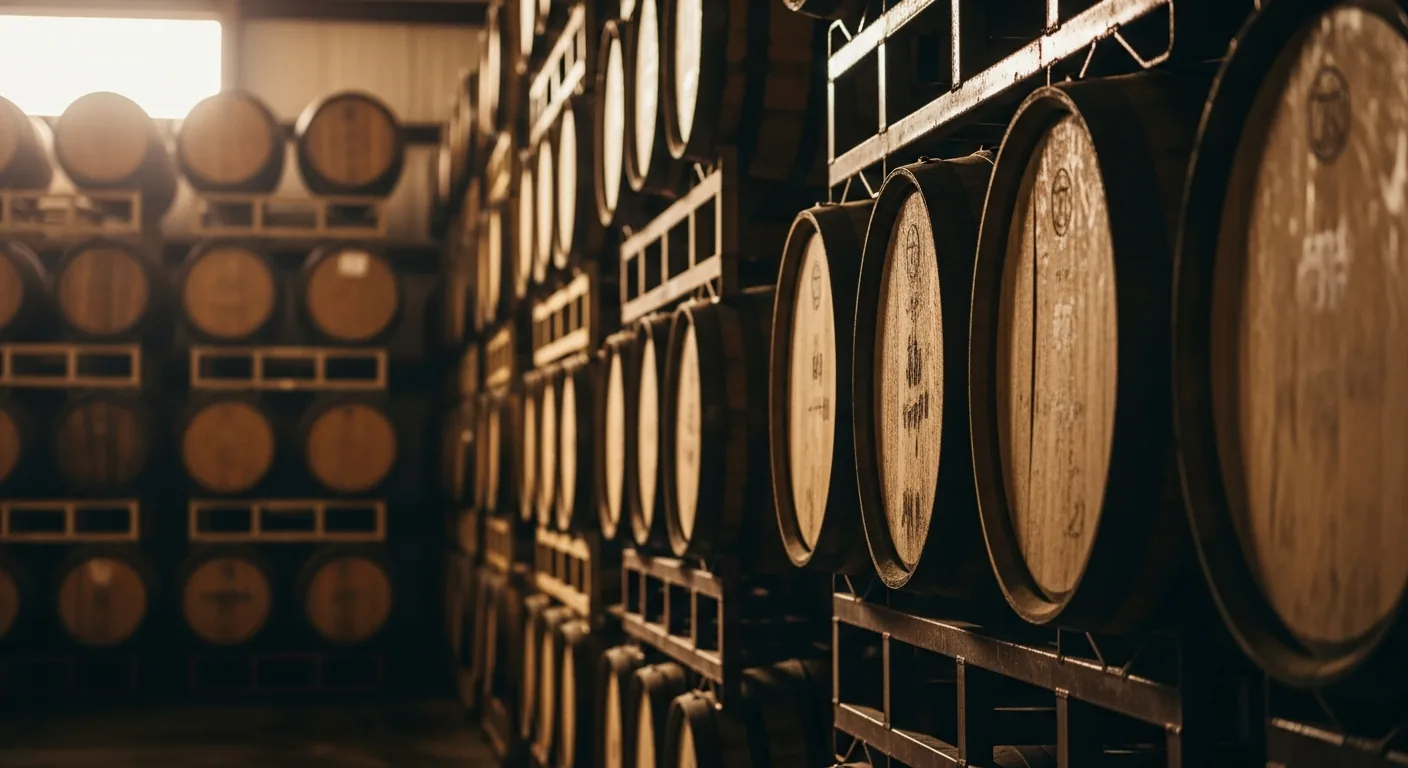
In short: Rickhouse barrel placement fundamentally changes your whiskey by exposing casks to different temperature and humidity levels. Top tiers create hot, dry conditions that increase proof and extract heavy tannins. Bottom tiers remain cool and moist, preserving sweet esters and often lowering the proof over time.
Understanding rickhouse barrel placement and how position changes your whiskey is critical for distillery operators focused on consistent maturation. Where a barrel sits in the warehouse dictates the temperature swings and humidity levels it experiences, directly impacting how water and alcohol evaporate through the oak over time. Planning your storage strategy is just as vital to your bottom line as your fermentation and distillation processes. Proper placement ensures your spirit develops the exact flavor profile you intend while keeping evaporation losses predictable and manageable.
How do temperature and humidity affect barrel maturation?
Wood is highly porous, making a whiskey barrel function as a semi-permeable membrane. As warehouse temperatures rise in the summer, the liquid inside the barrel expands. This pressure pushes the whiskey deep into the charred oak staves. During this expansion, the alcohol and water mixture dissolves and extracts essential wood compounds. Hemicellulose breaks down into wood sugars, lignin yields sweet vanillins, and tannins provide structure and color. Additionally, the interior char layer acts as a natural carbon filter, absorbing unpleasant sulfur compounds and smoothing out the raw distillate.
When the temperature drops in the winter, the liquid contracts. This physical contraction pulls those newly extracted flavor compounds out of the wood and back into the main body of the spirit. This continuous cycle of expansion and contraction, driven by seasonal shifts and even daily barometric pressure changes, serves as the engine of whiskey maturation.
However, the exact climate immediately surrounding the barrel dictates what evaporates out of the wood. This natural evaporation is commonly known as the angel's share. In an environment with low ambient humidity and high heat, water molecules transpire through the wood faster than the larger ethanol molecules. The result is a steady increase in the alcohol by volume of the remaining liquid in the barrel.
Conversely, if the barrel is stored in a cool, damp environment with high ambient humidity, the surrounding air is already saturated with moisture. This saturation slows the evaporation of water, allowing the alcohol to evaporate at a comparatively faster rate. In these cooler, moist conditions, the proof of the whiskey will naturally drop over time. Understanding this environmental dynamic is the first step in predicting your physical yields. Running your expected losses through an angel's share calculator can help you build accurate financial forecasts for your maturing inventory and estimate your true production costs.
How does rickhouse barrel placement change your whiskey profile?
Rickhouse barrel placement and how position changes your whiskey largely comes down to the natural convection of air inside the building. In a traditional multi-story, unheated warehouse with wooden ricks, heat naturally rises to the ceiling. The upper floors of the rickhouse trap hot air during the summer months, creating an intense, dry microclimate that fundamentally changes the chemistry of the spirit inside the casks.
Barrels located on the top tiers experience the most aggressive aging conditions. The extreme heat forces the whiskey deep into the staves, resulting in the rapid extraction of oak flavors and heavy wood tannins. Because these upper levels are also the driest areas of the warehouse, top-tier barrels typically see a significant increase in proof as water evaporates rapidly. The whiskey produced here is often bold, spicy, and robust. It requires careful monitoring so the liquid does not become over-oaked or overly astringent before it is ready for the blending vat.
Middle floors offer a much more balanced maturation environment. The temperature swings are moderate rather than extreme, leading to a steady, predictable aging curve. The evaporation rates of water and alcohol are often perfectly balanced in this middle zone, meaning the proof remains relatively stable throughout the entire aging process. Because of this consistency, middle-tier barrels usually form the reliable core of many large bourbon and whiskey blending programs.
Bottom floors rest closer to the cool earth or the concrete foundation. These lower tiers stay much cooler year-round and hold significantly higher ambient humidity. Barrels stored on the bottom racks extract wood compounds at a much slower pace, which preserves more of the delicate fruity esters and sweet grain notes from the original distillate. The high humidity often causes the proof to dip slightly as the years go by. Bottom-tier placement is excellent for longer-term aging, producing a whiskey that is soft, mellow, and highly approachable.
Historically, some large distilleries practiced physical barrel rotation, moving heavy casks from the hot top floors to the cool bottom floors halfway through their aging cycle to balance these environmental effects. Due to immense labor costs, physical rotation is rarely practiced by modern commercial distilleries. Instead, contemporary operators pull mature barrels from specific tiers and blend across different floors to achieve a consistent, complex final profile.
It is also worth noting that palletized warehouses, where barrels are stored upright on pallets rather than resting horizontally in traditional ricks, alter this natural airflow. Palletized storage is denser and restricts vertical air movement, which can create distinct temperature pockets. Operators utilizing palletized storage must be equally vigilant about tracking barrel locations to understand how their specific warehouse dynamics influence the final spirit.
At what proof should American whiskey enter the barrel?
Barrel entry proof is a critical operational decision that influences exactly which flavor compounds are extracted from the charred oak. Federal regulations state that the legal maximum barrel entry proof for United States whiskey, including bourbon, is 125 proof, or 62.5 percent alcohol by volume. Furthermore, the spirit must have been distilled to no higher than 160 proof before reduction. For specific regulatory definitions, operators should refer directly to 27 CFR Part 5 provided by the TTB. Please note this is general regulatory information, not tax or legal advice.
While 125 proof is the legal maximum, working distillers frequently choose to enter their spirit at lower proofs to achieve specific flavor profiles. Maximum solids extraction from American white oak actually occurs at around 55 percent ethanol, or 110 proof. Entering the barrel in the 110 to 120 proof range is highly recommended for long, stable aging. Over a multi-year period, water and alcohol will transpire through the wood at roughly equal rates at these specific concentrations, keeping the proof remarkably stable over time.
Lower entry proofs, such as 100 to 110 proof, excel at dissolving water-soluble wood sugars and sweet vanilla compounds from the staves. This creates a sweeter, rounder profile with a softer mouthfeel. Higher entry proofs closer to the 125 maximum tend to dissolve more alcohol-soluble compounds. This extracts heavier tannins, spice, and potential astringency. If a high-proof barrel is left unmonitored in a hot environment like a top tier, it can easily develop a sharp, spicy, or green-oak off-character.
How long does whiskey need in a new 53-gallon barrel?
The time required to properly mature whiskey depends entirely on the climate of your rickhouse, the preparation of the wood, and the flavor profile you want to achieve. For a standard 53-gallon new charred oak barrel, a timeframe of 18 to 24 months is widely considered the absolute minimum to produce a palatable product. However, most distillers plan for four or more years to achieve a fully matured, well-rounded straight bourbon whiskey.
Geographic location plays a massive role in this timeline. Distilleries located in hot, humid climates with extreme daily temperature swings, such as central Texas or the Deep South, force the whiskey into and out of the wood at a rapid pace. Operators in these regions often yield excellent, fully flavored bourbon in as little as three years. The aggressive climate heavily accelerates the extraction phase of maturation.
In contrast, distilleries operating in cooler, more temperate climates will experience significantly slower extraction. Without the intense summer heat pushing the liquid deep into the staves, the whiskey requires more time to interact with the wood. In northern or coastal climates, a standard 53-gallon barrel may need six or more years to reach the same level of oak extraction and flavor maturity.
Regardless of your region, utilizing staves that have been naturally air-dried for 18 to 24 months prior to coopering is crucial. Air seasoning utilizes rain and natural fungi to break down harsh green wood tannins before the barrel is ever assembled and filled, preventing bitter notes in your final product.
What happens when you age whiskey in smaller barrels?
Many craft distilleries utilize smaller barrels, such as 5-gallon, 15-gallon, or 30-gallon vessels, to bring products to market faster and generate early cash flow. Because smaller barrels have a much higher surface-area-to-volume ratio, the liquid makes significantly more contact with the wood. This allows the clear spirit to pick up deep amber color and heavy oak flavor very rapidly.
However, smaller barrels do not mature whiskey in the same way large barrels do. Proper maturation is a combination of two distinct processes: the extraction of wood flavors and the slow oxidation of the liquid. While a small barrel accelerates the extraction of wood flavors, it does not necessarily accelerate the slow oxidation of harsh alcohols into pleasant, fruity esters.
Furthermore, small barrels lose volume to the angel's share at a staggering rate. A small barrel will lose liquid to evaporation at roughly 5 to 15 times the rate of a full-size barrel. Distillers frequently report an 8 to 10 percent volume loss in just six months when storing 5-gallon barrels in dry warehouse areas.
A general industry rule of thumb is a maximum aging time of roughly 36 days per vessel gallon. This equates to about six months for a 5-gallon barrel, 18 months for a 15-gallon barrel, and 36 months for a 30-gallon barrel. Small barrels can over-wood your spirit very quickly, shifting from sweet vanilla to harsh sawdust notes in a matter of weeks. Frequent sensory checks and careful barrel placement in cooler, humid areas are required to prevent ruining the batch.
Tracking proof gallons and maintaining regulatory compliance
Proper rickhouse management requires meticulous, highly accurate record-keeping. As barrels age, they lose volume and change in proof, which directly impacts your tax liability and overall inventory valuation. Distilleries must accurately track the true volume and alcohol content of every barrel, converting physical measurements into standard proof gallons for federal reporting.
When you pull a barrel from your storage account for blending or bottling operations, you are required to perform a regauge to determine the actual amount of alcohol remaining. This process involves weighing the barrel, taking an accurate proof reading with a hydrometer, and carefully correcting the reading for temperature. These calculations can be tedious, and small mathematical errors can lead to major compliance issues or costly tax overpayments. Utilizing a TTB gauging calculator ensures your conversions are perfectly accurate, allowing you to correctly report your operational losses and maintain strict compliance with federal storage regulations.
Knowing exactly where every barrel sits and understanding its unique aging curve based on floor position is what separates good distilleries from great ones. Spirit Sight provides specialized barrel management tools designed exclusively for distilleries. This allows operators to easily map their rickhouses, track specific floor tiers, and automatically calculate proof gallon losses over time. By centralizing your production and storage data, Spirit Sight gives you the clear, accurate insights you need to manage your aging inventory, optimize your blends, and produce exceptional whiskey year after year.
Key takeaways
- Top rickhouse tiers experience higher temperatures and dry heat, which increases proof and accelerates oak extraction.
- Bottom tiers remain cooler and more humid, yielding softer flavor profiles and sometimes lowering the proof over time.
- The legal maximum entry proof for bourbon is 125, but entering between 110 and 120 proof often results in more stable long-term aging.
- Standard 53-gallon barrels typically require 18 to 24 months to become palatable, while small barrels mature much faster but lose volume to evaporation rapidly.
- Tracking floor placement and utilizing precise regauging calculations is essential for accurate cost accounting and federal compliance.
Frequently asked questions
At what proof is American whiskey entered into the barrel?
The legal maximum barrel entry proof for American whiskey is 125 proof. However, many working distillers prefer to enter spirit between 110 and 120 proof to achieve a sweeter profile and more stable long-term aging.
How does rickhouse floor position affect whiskey proof?
Barrels stored on hot, dry upper floors lose water faster than alcohol, causing the proof to rise. Barrels located on cool, damp bottom floors tend to lose alcohol faster than water, causing the proof to drop or remain stable.
How long does bourbon need to age in a 53-gallon barrel?
A standard 53-gallon virgin oak barrel typically takes a minimum of 18 to 24 months for the whiskey to become palatable. Depending on the local climate and temperature swings, it generally requires four or more years to reach full maturity.
Do small whiskey barrels age faster?
Small barrels extract wood flavor and color very quickly due to a higher surface-area-to-volume ratio, but they do not oxidize or mature exactly like large barrels. They also lose liquid to evaporation at 5 to 15 times the rate of a standard 53-gallon barrel.