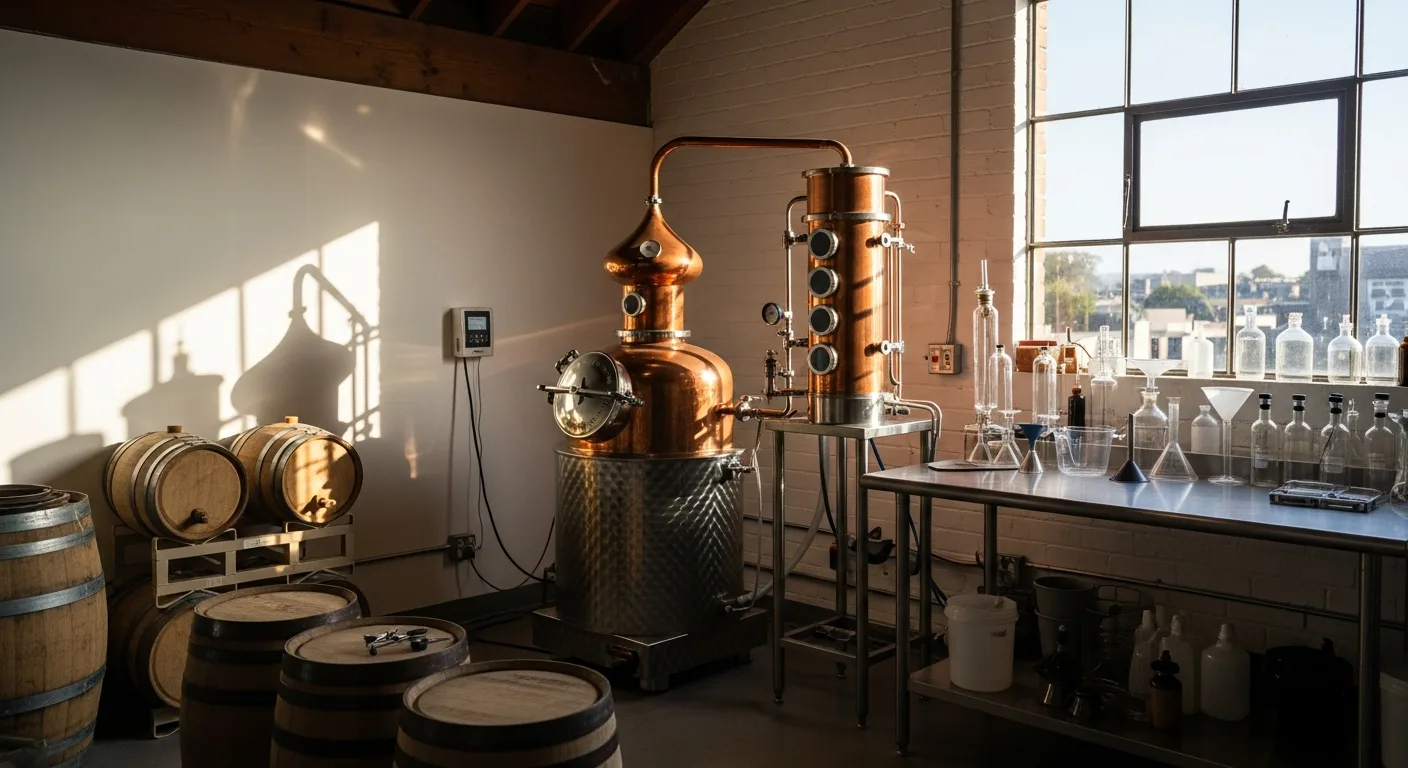
In short: Choosing your first still requires matching the equipment to your intended spirit, sizing your facility utilities properly, and balancing copper contact with maintenance. Expect long lead times that align with your federal licensing, and prioritize proper heating and cooling systems from day one.
Your first still is the single most consequential purchase your commercial distillery will make. The distillers who have already navigated this process tend to agree on what they would do differently. You must pick the still that matches the exact spirit you plan to sell. You must expect long lead times that will overlap heavily with your federal licensing. You must not underestimate how much copper placement, heating methods, water consumption, and daily cleaning will shape both your finished spirit and your daily workload. The rest of this guide walks through the technical decisions and facility requirements that working distillers raise most often when discussing their initial equipment purchases.
Pot, Column, or Hybrid: Which Still Fits Your Spirit?
Start with your end product, not the equipment catalog. A traditional pot still is the right tool for heavy, characterful spirits such as bourbon, single malt whiskey, brandy, and heavy rum. In these categories, the goal is to carry flavor compounds through the distillation process rather than strip them away. A basic pot still performs a single distillation per pass, meaning you will generally need a stripping run followed by a spirit run to reach barrel entry proof.
What surprises a lot of newcomers is the hard ceiling of a simple pot still. It is physically impossible to reach 95 percent ABV on a traditional alembic pot still. The federal government requires a spirit to be distilled or treated to at least that strength to be labeled and sold as vodka. Therefore, if vodka or a completely neutral spirit is on your roadmap, you must plan for rectification columns from the start.
A column still, or a hybrid unit that adds a rectifying column to a traditional pot, buys you both high proof and operational efficiency. Multi-plate columns create the effect of multiple distillations in a single pass. For example, a four-plate column can provide the equivalent of a double distillation without emptying and reloading the boiler. Because the largest recurring expense of running a distillery is labor, maximizing efficiency during a run is critical.
Plates also win on maintenance. Packed columns often foul with heavy grain oils and can take hours of manual disassembly to refresh. Conversely, a multi-plate column can typically be cleaned in place using a dedicated pump system in a fraction of the time. This is why most commercial production distillers lean toward plate columns over packed columns.
One caution that comes up repeatedly in the industry is that a hybrid still designed for one specific job may fight you on another. European pot-column stills built for fruit brandy are notoriously difficult to make grain whiskey on. They were never meant to handle a thick grain mash full of husks, proteins, and solids. If you buy a still designed strictly for clear fruit washes and try to run a heavy grain mash, you will be working against the physical design of the equipment.
Copper or Stainless: Where Does Copper Actually Matter?
This debate has a clear answer in commercial practice. Copper does real chemistry inside a still. It actively pulls sulfur compounds out of the vapor, preventing your spirit from smelling like struck matches or rotten eggs. Distillers who go entirely stainless to save money often regret the decision. Many find that sulfur compounds carry over into the distillate, forcing them to retrofit their equipment with copper packing later. This fix works, but it means paying twice and adding a difficult cleaning step to the workflow.
However, copper is not free of trade-offs. It tarnishes, it builds up sulfide deposits, and copper mesh packing can be genuinely hard to clean because it cannot be aggressively scrubbed. Furthermore, excess copper in the spirit pipe and the final condenser can leave metal precipitates that show up as an unwanted blue or green haze in the finished product.
The common middle ground is a hybrid construction. A stainless steel boiler offers superior durability, easier cleaning, and significantly lower cost. You then concentrate the copper in the areas where vapor contact and reflux actually happen. This means utilizing copper for the helmet, the column plates, the neck, and the lyne arm. This configuration puts the reactive metal exactly where it does the most good for the vapor, while keeping expensive and hard-to-clean copper out of the boiling vat that just holds boiling liquid.
The physical geometry of these copper components also matters. The angle of the lyne arm dictates how much vapor falls back into the boiler as reflux. An upward-angled lyne arm increases reflux, yielding a lighter and more refined spirit. A downward-angled lyne arm decreases reflux, pushing heavier oils and richer flavors into the final condenser. You must ensure the manufacturer understands the style of spirit you are trying to make before they finalize the geometry.
Gas, Electric, or Steam: Can Your Building Handle the Load?
How you heat the still affects your spirit less than where you put the still affects your heating choices. The recurring lesson for startups is to verify utilities before signing a commercial lease.
Steam is the gold standard for commercial distilleries, especially those distilling on the grain. A low-pressure steam boiler piped to a steam-jacketed still provides gentle, even, and highly controllable heat. It prevents scorching and allows for rapid temperature adjustments. However, sizing and powering a commercial steam boiler requires serious utility infrastructure.
Many industrial buildings have three-phase electrical service, but they simply do not have enough amperage to support a massive electric steam boiler. Bringing heavier electrical service across a building or down a street can be prohibitively expensive. This leads many distillers to natural gas boilers. Unfortunately, leased buildings often lack existing high-capacity natural gas service, and adding it can trigger local code objections or massive installation bills.
Direct-fired stills are another option, but they carry their own complications. Direct firing raises immediate local fire-code questions. Approvals can be slow, and a local fire marshal can block a build late in the process if they are uncomfortable with open flames near high-proof alcohol. Direct firing also creates intense hot spots on the bottom of the boiler. If you are running a thick grain mash, a direct-fired still will almost certainly scorch the solids unless you have a highly effective agitator and incredibly tight temperature controls.
Electric immersion heaters are the most efficient way to transfer heat, but they are generally only suitable for clear, strained washes. If you attempt to boil a thick grain mash using internal electric elements, the grain will bake onto the elements, ruin the batch, and potentially destroy the heaters.
Agitation and Automation: How Do You Move the Mash?
If you plan to distill on the grain, an agitator is not an optional upgrade. It is a mandatory piece of equipment. Grain solids will settle at the bottom of the boiler. Without constant movement, those solids will burn against the heating surface, ruining the entire batch with a bitter, acrid smoke flavor. A high-torque, explosion-proof agitator motor ensures the mash stays suspended and heats evenly.
Automation is another area where early decisions impact daily operations. While you cannot fully automate the sensory art of making cuts between heads, hearts, and tails, you can automate the mundane aspects of the run. Simple proportional-integral-derivative controllers can manage your steam valves or electric elements to maintain an exact boil rate. Automated cooling water valves can keep your condenser at a precise temperature, freeing you to focus on the spirit quality rather than constantly adjusting manual ball valves. Just ensure that all electronic controls located in the distillation area meet the required explosion-proof safety ratings.
Don't Forget the Water and the Cleaning
Two major costs often blindside first-time buyers because they are not strictly part of the still itself. The first is cooling water. A commercial still consumes a massive amount of water to knock alcohol vapor back into a liquid state. Equipment vendors will happily quote you an oversized mechanical chiller, and in many municipalities, you are legally prohibited from simply returning warmed process water to the municipal sewer supply. Furthermore, warm summer tap water drastically cuts the efficiency of stills that depend entirely on municipal pressure for cooling.
The good news is that a modest, well-designed recirculating cooling tower or a large tank-and-coil heat exchanger can handle small to medium volumes for a fraction of what a high-end mechanical chiller costs. You must price the cheaper, passive cooling paths before you commit to the expensive mechanical one.
The second hidden cost is material handling and cleaning infrastructure. Unclarified washes and rum molasses will bake onto the still walls over time. This demands regular caustic cleaning and acid repassivation to maintain the stainless steel and keep the copper functioning. Clean-in-place fittings, spray balls, and high-temp food-grade hoses all have their own failure modes. Brass fittings can crack under thermal shock, and cheap supply hoses will collapse when they soften under high heat. Professional cleaning equipment must be in your initial budget and your standard operating procedures from day one, not discovered during an emergency after your first dirty run.
Build, Buy New, or Buy Used?
The temptation to build your own still or piece together a used system is real. For some mechanically inclined distillers, it pays off in money saved and in achieving a deep understanding of their equipment. However, the industry record is full of cautionary tales. If you are evaluating used or imported equipment, watch for these common pitfalls:
- Obsolete gaskets and manways: Replacement parts are heavily brand-specific, and a cheap used tank can quickly become an expensive scavenger hunt for obsolete rubber seals.
- Fuel-ethanol contamination: You must never convert an industrial or fuel-ethanol still to beverage use without extreme diligence. The previous production path can carry highly toxic residues such as lead, benzene, or chemical denaturants.
- Shipping damage and warranty disputes: Importing a new still directly from overseas carries major risks. Systems frequently arrive with manufacturing defects or severe shipping damage. Insurance and warranty claims across international borders can drag on for months.
- Lack of vendor support: Large imported systems sometimes arrive with no operating instructions and no vendor support, forcing the new owners into a frustrating cycle of trial-and-error.
Scaling a recipe from a small test still to a massive production still is consistently harder than people expect, and having an equipment vendor who answers the phone makes a monumental difference.
Permitting and Lead Times: What is the Critical Path?
How long will it take to get a custom still? It will almost certainly take longer than you think, and this timing is not just an inconvenience. Custom production stills commonly take six to twelve months to build. High-demand, reputable manufacturers can be incredibly slow to even return an initial inquiry.
The primary trap is that startup tasks are deeply coupled. A federal Distilled Spirits Plant permit is the basic operating permit you need before you can legally produce alcohol. This permit is granted against a real, operable commercial premises, and the application requires you to detail your specific equipment, serial numbers, and plant description. In other words, your physical still build and your federal licensing run on parallel critical paths rather than back to back.
You must order your equipment early, secure a written lead time, and assume there will be slippage. For the most accurate and current federal requirements, see the TTB Distilled Spirits Plant guidance at https://www.ttb.gov and the statutory regulations in 27 CFR part 19 at https://www.ecfr.gov. Please note that this is general information, not tax or legal advice, and you should always consult a compliance professional.
The Bottom Line
Buy the still that is physically designed to make the spirit you intend to sell. Put the copper exactly where the vapor is. Order the equipment months earlier than feels comfortable, and firmly confirm your building's gas, power, and water capacity before any equipment ships. Almost every regret that working distillers share traces back to one of these core fundamentals, rather than to brand loyalty or initial purchase price.
Once the equipment arrives and the still is running, the heavy administrative work begins. You will immediately face proof gallons, manual gauging, daily transfers in bond, and the strict production and storage entries your federal permit obligates you to maintain. Software like Spirit Sight is built specifically to track that complex side of the operation. From barrel inventory tracking to automated TTB reporting, the right distillery ERP ensures that the operational data your new still produces stays perfectly organized and completely audit-ready. The right equipment makes the spirit, but the right records keep you in business.
Key takeaways
- Select a still design that matches the specific spirit you intend to produce, noting that vodka requires a multi-plate column to reach legal proof.
- Place copper strategically in the vapor path to remove sulfur, while utilizing a stainless steel boiler to reduce costs and simplify maintenance.
- Verify your building's electrical, gas, and water capacities before purchasing equipment, as utility upgrades often cost more than the still itself.
- Align your equipment purchase with your federal permitting timeline, as the TTB requires detailed equipment information for your DSP application.
Frequently asked questions
Can I make vodka in a traditional pot still?
No. The TTB requires vodka to be distilled or treated to at least 95 percent ABV, which is physically impossible to achieve on a simple pot still without a rectifying column.
Why is copper important in a still?
Copper reacts chemically with the alcohol vapor to remove unpleasant sulfur compounds from the spirit. Without copper contact, the final product can develop harsh, struck-match off-flavors.
Should I choose direct fire, steam, or electric heating?
Steam is the most controllable and safest option for grain mashes. Direct fire can scorch heavy mashes and poses fire code challenges, while electric elements are generally only suitable for clear washes.
When should I order my distillery equipment?
You should order your equipment six to twelve months before your planned opening, as custom fabrication lead times are long and federal DSP applications require specific equipment details to process.