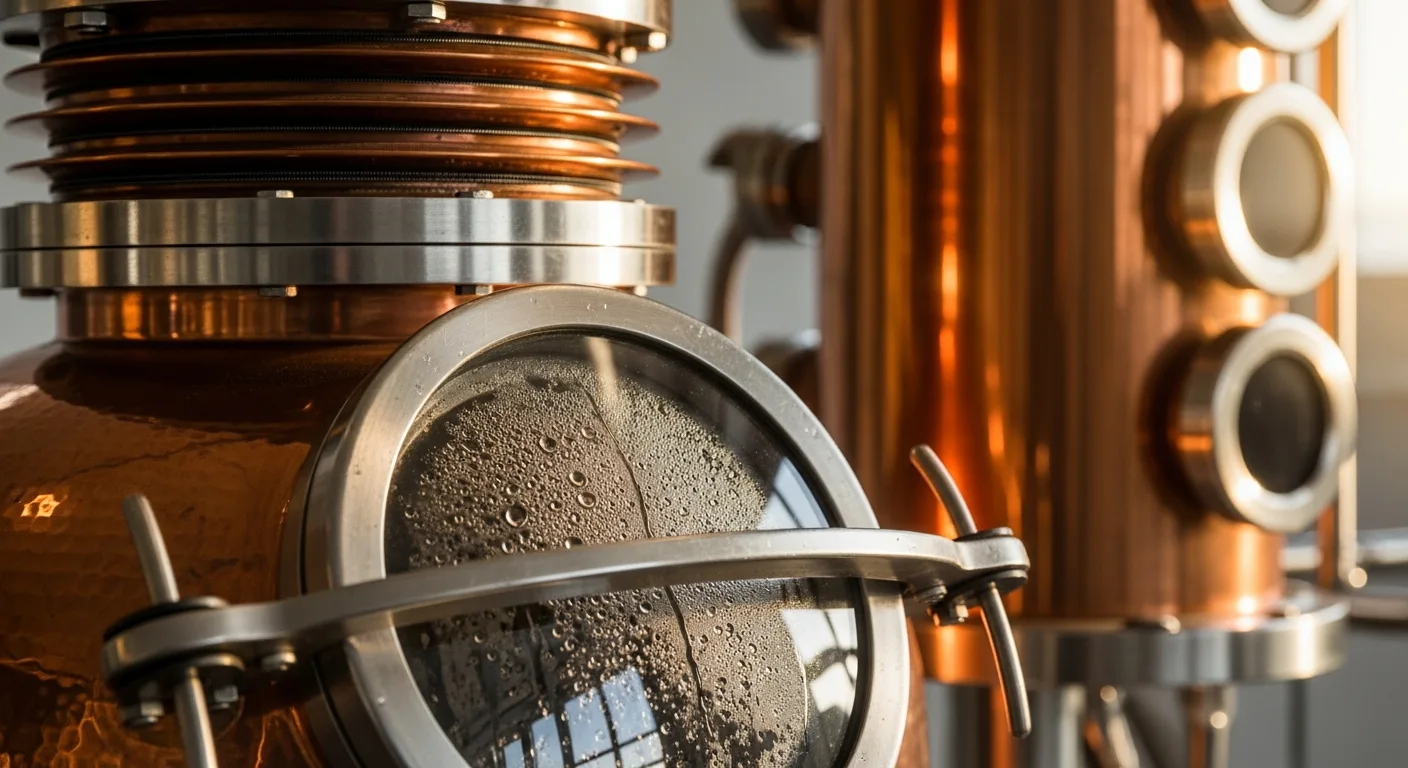
In short: A dephlegmator is a partial condenser sitting above your distillation column that controls how much vapor returns as liquid reflux. By adjusting cooling flow, operators dictate the reflux ratio, which directly controls the take-off rate and the final proof of the spirit.
A dephlegmator is a tube-type reflux condenser that sits above your column plates and condenses part of the rising vapor so it falls back down the column. That returned liquid is reflux. By deciding how much vapor you knock down versus how much you let pass to the final product condenser, the dephlegmator sets your reflux ratio. Control the reflux ratio, and you control the take-off rate and the proof of what comes off the still.
This component is one of the most asked-about and frequently misunderstood pieces of a modern still. Operating a plated column without understanding your dephlegmator leads to fluctuating proofs, smeared cuts, and constant adjustments. Below is a detailed look at what the dephlegmator does, how it balances with your boiler heat, how it differs from your plates, and how to get steady proof out of it instead of chasing the parrot all run long.
What does a dephlegmator actually do in a distillation column?
Picture vapor rising up your column from the boiler. As it passes through each plate, it becomes slightly more concentrated with alcohol. At the very top of the column, before the vapor can enter the lyne arm or bridge to the final product condenser, the dephlegmator intercepts some of that vapor. It acts as a partial condenser, turning a specific percentage of that vapor back into liquid.
That newly condensed liquid drains back down through the plates. Because alcohol and water separate a little more on every single plate the liquid passes back through, the vapor that finally does make it past the dephlegmator is much richer in alcohol than it would otherwise be.
The dephlegmator is not there to make the final product. It is there to send liquid back down. The more liquid it sends back, the more re-distillation happens inside the column, and the higher your proof climbs. The less it sends back, the faster the product flows to the final condenser, and the lower the proof becomes. That trade between proof and speed is the core dynamic of operating a plated column, and the dephlegmator is your primary control mechanism.
By using a dephlegmator, you can actively control the reflux ratio over the entire run. This keeps your column plates loaded with liquid and flattens the proof-versus-time curve. The result is more output at a higher, steadier proof and tighter heads-to-hearts cuts. Without active reflux control, the proof declines continuously as the boiler depletes, and you cannot fully utilize the separation potential of your plates.
What is reflux ratio and why does it set your proof?
Reflux ratio is simply the amount of condensed liquid you return to the column compared with the amount of vapor you draw off as product. A high reflux ratio means most of the condensed vapor goes back down the column, and only a trickle comes off the spout. A low reflux ratio means you are pulling product fast and returning very little liquid to the plates.
High reflux yields a high proof because the spirit is effectively re-distilled many times inside the column before it finally escapes. Low reflux yields a lower proof and a much faster run. There is no free lunch in distillation. If you want neutral-strength spirit, you pay for it in distillation time and cooling utility costs. If you want a heavier flavor profile, you back the reflux off, speed up the run, and accept a lower proof off the still.
This dynamic is exactly why a conventional pot still with no forced reflux cannot easily reach the high proofs that certain products require. A traditional pot still will not make 190 proof in a single pass. Furthermore, without a still that utilizes forced reflux, you will not be able to produce neutral spirits like vodka. For the federal standard of identity that ties vodka and neutral spirits to minimum distillation proofs, you can review the Alcohol and Tobacco Tax and Trade Bureau (TTB) standards in 27 CFR 5.143 at ecfr.gov. Please note that this is general information, not tax or legal advice.
How does cooling water to the dephlegmator change proof?
Mechanically, a dephlegmator is a heat exchanger. Most commonly, it utilizes a shotgun-style tube-and-shell design. Vapor passes through a series of vertical tubes, while cooling fluid circulates around those tubes inside the outer shell. You run coolant, usually water or a glycol-water mix, through the shell. The amount of coolant flow and the temperature of that coolant dictate how much vapor condenses.
More cooling flow knocks down more vapor. This creates more reflux, stacks the alcohol higher in the column, and drives up the proof. Less cooling flow condenses less vapor, reduces the reflux, drops the proof, and speeds up the take-off rate.
Adjusting the cooling flow is the practical control most distillers reach for first. You open the cooling valve to push proof up, and you close it slightly to bring proof down and speed up your collection. On many commercial production stills, this process is automated. A temperature-actuated valve or a PID controller on the dephlegmator cooling line holds the reflux ratio steady by modulating the cooling-water flow. This automation maintains a stable vapor temperature exiting the dephlegmator, which in turn holds the distillation rate and proof steady.
However, it is crucial to remember that a PID controller managing cooling flow to the dephlegmator is just keeping the physical environment stable. It is not the mechanism that makes your heads, hearts, and tails cuts. Sensory evaluation and precise cut timing are still the responsibility of the distiller.
Why does my proof drift even with the dephlegmator running?
Proof drift is the single most common complaint among new column operators, and it almost always traces back to the cooling side of the system, rather than the column itself.
The classic failure mode is the dephlegmator drifting warm during the middle of a run. If your cooling water is fed from a reservoir that heats up over time, or if your commercial chiller is undersized for your boiler heat input, the dephlegmator will slowly lose its condensing power. As the cooling fluid warms up, less vapor condenses. The reflux ratio falls off, and the proof at the parrot drops, often well before you expect the hearts cut to finish. Operators facing this issue will notice the dephlegmator vapor temperature climbing and the alcohol by volume in the parrot dropping rapidly. This forces them to continually open the cooling valve further to compensate until the valve is wide open and control is lost.
An undersized chiller turns your cooling loop into a moving target. When the coolant supply temperature keeps shifting, you are forever adjusting your trim valves, and the final product comes out inconsistent. The fix is not exotic. You must keep the coolant supply temperature stable, size your chiller properly for the total heat load of the still, and expect to trim your cooling flow only gradually as the boiler charge depletes and the vapor naturally becomes leaner in alcohol.
If your proof curve still will not flatten out, you should verify that your dephlegmator is actually receiving the flow volume it requires. There are documented cases of plumbing configurations that simply cannot circulate enough water pressure to hold a column in total reflux, regardless of the water temperature.
Another common issue is probe placement. If your vapor thermometer probe is installed poorly, perhaps sitting too close to the cold reflux coils instead of directly in the clean vapor path, it will read artificially cold. This causes the operator, or the PID controller, to overdrive the still while chasing a temperature number that does not accurately reflect the exiting vapor. Always ensure your temperature probes are positioned directly in the active vapor path.
Is a dephlegmator the same as just adding more plates?
No, and this distinction trips up a lot of people upgrading to their first plated column system.
Plates are fixed physical separation stages. Each plate buys you a roughly fixed amount of additional vapor-liquid separation. Reaching a very high proof requires a tall column with many physical stages. Experienced operators generally report topping out around 180 to 185 proof with a standard four-plate column. Pushing toward 190 proof or higher requires significantly more stages of separation, which is achieved either through a much taller column with ten to twenty plates, or through a series of stripping runs followed by dedicated rectifying passes.
The dephlegmator is an entirely different kind of tool. It does not add physical stages to your still. Instead, it allows you to actually use the stages you already have. By actively controlling the reflux, you keep the plates loaded with boiling liquid across the whole run.
Many whiskey distillers actively choose to bypass or disable a plate or two, and they manage the dephlegmator to pull the proof down on purpose. They do this because they want heavy flavor carryover, not a neutral spirit. Single distillation on a modern plated pot still can produce excellent, robust whiskey precisely because the physical plates and the active dephlegmator give the distiller ultimate control over the flavor profile.
Treat plates and dephlegmators as complementary components. The number of plates sets your maximum proof ceiling. The dephlegmator sets exactly where you operate beneath that ceiling.
How does boiler heat interact with the dephlegmator?
A critical concept that many operators miss is the balance between boiler heat and dephlegmator cooling. The dephlegmator does not operate in a vacuum. Its effectiveness is directly tied to the velocity and volume of the vapor rising from the boiler.
If you apply too much heat to the boiler, the vapor velocity becomes so aggressive that it simply blows right past the dephlegmator tubes before the cooling water has a chance to condense it. In this scenario, even a dephlegmator running at maximum cooling flow will fail to hold the column in total reflux. The operator might mistakenly blame the dephlegmator or the chiller, when the real issue is excessive heat input at the base.
Conversely, if the boiler heat is too low, the vapor velocity is weak. The dephlegmator will easily knock down all the vapor, sending the column into total reflux, but you will struggle to get any product to exit the still. Finding the sweet spot means balancing your boiler heat input to provide a steady, manageable vapor speed, and then using the dephlegmator cooling flow to finely tune the reflux ratio.
How does maintenance impact dephlegmator performance?
Like any heat exchanger, a dephlegmator requires regular maintenance to perform predictably. Over time, the internal cooling jackets or the outer surfaces of the internal tubes can accumulate scale, especially if you are using hard city water in an open-loop cooling system.
Mineral scale acts as an insulator. A scaled dephlegmator will lose its heat transfer efficiency, meaning it will require significantly more water flow to achieve the same amount of vapor knockdown as when it was new. To prevent this, distillers should implement a closed-loop cooling system using distilled water or a proper glycol mixture.
On the vapor side, oils and congeners can build up inside the tubes. Running a proper Clean-in-Place cycle with hot caustic solution will strip away these organic deposits, ensuring the copper or stainless steel surfaces remain highly conductive. Keeping your equipment clean is a core part of effective /equipment-maintenance, ensuring that your standard operating procedures remain valid from batch to batch.
How do I run the dephlegmator for steadier cuts?
Adopting a few proven habits will drastically improve your consistency. These practices come straight from distillers who run plated columns daily:
First, bring the column to total equilibrium before taking any product. When the boiler reaches a boil, run the dephlegmator at maximum cooling to achieve total reflux. Let the column stack for an extended period, often thirty minutes to an hour depending on the still size. This allows the plates to fully load with liquid and the distinct alcohol fractions to stack neatly by boiling point. Once the column is stabilized, gently ease the dephlegmator cooling back to start your slow take-off for the heads cut.
Second, make very small cooling changes and wait. A tall column has significant lag time. When you nudge a cooling valve, it takes time for the temperature change to alter the reflux, for that liquid to cascade down the plates, and for the resulting vapor change to finally reach your parrot. Resist the urge to stack multiple valve adjustments on top of each other before the first adjustment has fully settled.
Third, watch your cooling supply temperatures, not just the product spout. Since most proof drift is essentially cooling drift, placing a thermometer on your main coolant supply line will tell you exactly why the parrot is moving. If your supply water jumps by five degrees, your proof is going to drop shortly after.
Finally, remember the dephlegmator is not your primary cut tool. It controls the proof and the flow rate. Your transition cuts still must come from careful tasting, smelling, and operator judgment as the run progresses naturally from heads to hearts, and eventually into tails.
A note on measuring, recording, and compliance
None of this careful control matters if you cannot trust the numbers you are recording. Off-the-still proof readings depend entirely on calibrated instruments, and the TTB requires certified gauging procedures for all tax-related purposes. For the specific gauging rules, temperature corrections, and the required use of certified instruments, you must refer to 27 CFR Part 30 at ecfr.gov, as well as official TTB gauging guidance at ttb.gov. Again, this is provided for general informational purposes and does not constitute compliance or legal advice.
Working hydrometers and benchtop densitometers serve different roles in the distillery. Only certified, calibrated instruments belong on your official production records.
The harder problem most distillers face is not taking a single accurate reading. The real challenge is keeping the entire distillation run repeatable. You need to know exactly what cooling flow, boiler temperature, and proof curve produced a batch you loved, so you can replicate it flawlessly next week. That is a comprehensive record-keeping challenge, which is where proper /production-tracking software becomes invaluable.
A dephlegmator gives you a live handle on your reflux ratio, which sets your proof and your take-off rate. By mastering your cooling-water flow, balancing your boiler heat, and keeping your coolant supply steady, you can keep your proof curve perfectly flat. Spirit Sight helps bridge the gap by logging your run data, gauging readings, and batch outcomes directly into your ERP system, ensuring your best runs stay repeatable and your compliance records remain audit-ready.
Key takeaways
- A dephlegmator dictates the reflux ratio by returning a controlled amount of condensed vapor back down the column.
- Higher cooling flow increases reflux and raises your proof, while lower flow speeds up collection and lowers proof.
- Most unexpected proof drift is caused by fluctuating cooling supply temperatures, not by column behavior.
- Balancing boiler heat against dephlegmator cooling is essential to prevent vapor from blowing past the condenser.
- Plates establish the maximum potential proof of your still, while the dephlegmator allows you to select where you operate below that ceiling.
Frequently asked questions
What is the difference between a dephlegmator and a product condenser?
A dephlegmator is a partial condenser designed to return liquid reflux to the column, whereas a product condenser is designed to fully condense all remaining vapor into the final liquid spirit.
Why does my proof drop in the middle of a distillation run?
Proof drops usually occur because the cooling water supply warms up over time. If the dephlegmator cannot condense as much vapor, the reflux ratio drops and the proof decreases.
Can I make 190 proof vodka with just a dephlegmator?
A dephlegmator alone is not enough. You need both an active dephlegmator and a tall column with enough physical plates or stages of separation to reach the 190 proof required for neutral spirits.
How do I fix a dephlegmator that will not hold total reflux?
First, ensure your boiler heat is not so high that vapor velocity is overpowering the condenser. Then, check that your cooling water is cold enough and flowing at a sufficient volume.