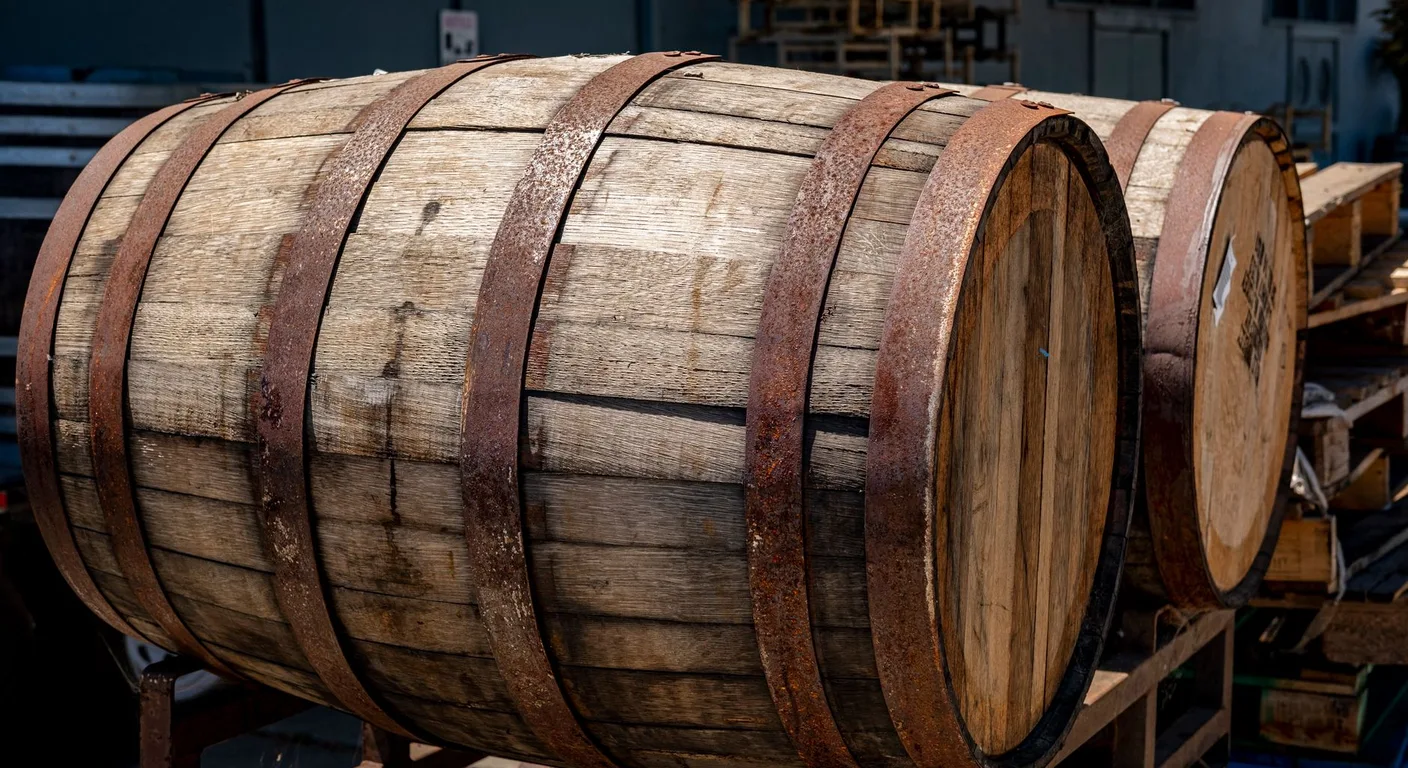
In short: Mastering char level and toast: how the barrel changes your whiskey is essential for flavor development. Toasting degrades hemicellulose to create vanilla and caramel notes, while charring creates a carbon filter that removes harsh sulfur compounds. Together with entry proof, these wood treatments dictate the final spirit profile.
Mastering char level and toast: how the barrel changes your whiskey is one of the most critical variables a distiller controls. The combination of heat treatment and time transforms a harsh, clear spirit into a complex, amber product by extracting wood sugars and filtering out impurities. Understanding the mechanics behind barrel preparation, entry proof, and maturation time allows production teams to dial in their desired flavor profile with precision.
Before a single drop of new make spirit enters the barrel, the wood itself has been fundamentally altered by heat. Distillers rely on the specific interplay between toasted wood and the charred surface to build the foundation of their spirit. This guide breaks down how these heat treatments work, how entry proof dictates extraction, and how time and barrel size impact the final liquid.
Char level and toast: how the barrel changes your whiskey over time
When coopers build a barrel, the raw oak staves are stiff, full of sap, and packed with harsh tannins. If you were to fill a raw, untreated oak barrel with whiskey, the resulting liquid would be astringent, bitter, and largely undrinkable. Heat treatment is what unlocks the desirable flavors in the wood.
Heat is applied in two distinct phases: toasting and charring. While people often use the terms interchangeably, they serve entirely different purposes in the maturation process. Toasting is a slow, penetrating heat that reaches deep into the staves. Charring is a rapid, intense burst of fire that obliterates the immediate surface of the wood.
When a barrel experiences temperature fluctuations in a rickhouse, the whiskey expands and contracts. As the temperature rises, the liquid pushes through the charred inner surface and deep into the toasted red layer of the stave. As the temperature drops, the liquid contracts back into the belly of the barrel, pulling dissolved wood compounds and sugars along with it. This cyclical breathing process is the engine of whiskey maturation.
What happens during the toasting process?
Toasting is responsible for creating the flavor reservoir inside the barrel stave. By applying a low, steady heat over a prolonged period, coopers force a chemical breakdown of the wood's structural components.
The most important transformations happen to hemicellulose and lignin. Hemicellulose is a complex carbohydrate present in the wood. When exposed to the gentle heat of toasting, it breaks down into simple wood sugars. These sugars are what give aged whiskey its distinct caramel, toffee, and brown sugar notes.
Simultaneously, the heat degrades the wood's lignin. Lignin is the polymer that gives a tree its rigidity. When toasted, lignin breaks down into vanillin, the exact same chemical compound found in vanilla beans. This is why American oak, particularly when given a deep toast, imparts such strong vanilla characteristics to bourbon and rye.
Oak lactones are also released during this phase. These compounds contribute the classic woody, coconut, and earthy aromas synonymous with barrel aged spirits. Different toast levels (light, medium, and heavy) will dictate exactly which of these compounds become most prominent. A light toast might preserve more of the raw, spicy tannins, while a heavy toast will caramelize more sugars and create a richer, darker flavor profile.
What is the function of the barrel char?
While toasting creates the flavor, charring acts as both a filtration system and a gateway. Coopers create the char by blasting the inside of the barrel with open flames for a very brief period, usually between 15 and 60 seconds.
This flash of intense heat creates a layer of active carbon on the innermost surface of the staves. Just like the carbon filter in a water pitcher, this charred layer acts as a chemical sponge. As the whiskey rests and breathes in the barrel, the carbon layer absorbs and filters out unwanted congeners and harsh sulfur compounds left over from distillation. This filtration removes the sharp, metallic, or cabbage like off notes that can be present in raw new make spirit.
Beyond filtration, the charring process physically cracks and blisters the surface of the wood. These deep fissures create pathways for the spirit to bypass the destroyed surface layer and easily reach the toasted, sugar rich wood underneath.
Char levels are typically graded on a scale from one to four. A Level 1 char is a brief 15 second burn that leaves a very thin carbon layer. A Level 4 char, often called an alligator char because the blistered wood resembles the hide of an alligator, is a 55 second burn. The heavy Level 4 char provides maximum filtration and creates deep channels into the wood, making it the standard choice for most major bourbon producers.
How does barrel entry proof affect wood extraction?
The strength of the spirit when it enters the barrel is just as important as the char and toast levels. The alcohol by volume (ABV) of the liquid completely changes which chemical compounds are extracted from the wood.
Water and ethanol are both solvents, but they dissolve different things. Water is excellent at dissolving the caramelized wood sugars and vanillin created during the toasting process. Ethanol, on the other hand, is highly effective at dissolving the lipids, harsh tannins, and heavier organic compounds deep in the oak.
Extensive testing and distiller experience show that the maximum extraction of total wood solids from American oak occurs at roughly 55 percent ABV (110 proof). If you enter a spirit into the barrel at a lower proof (around 100 to 110 proof), there is more water present in the solution. This allows the liquid to pull out significantly more water soluble sugars, resulting in a sweeter, rounder spirit with heavy vanilla and caramel notes.
If you enter a spirit at a higher proof (between 115 and 125 proof), the higher ethanol concentration will extract more alcohol soluble compounds. This tends to pull out more tannins, resulting in a drier, spicier, and sometimes more astringent whiskey. Very high proofs can even extract a green oak character that many distillers find undesirable.
There are also strict legal frameworks governing entry proof. By federal regulation, bourbon must be distilled at not over 160 proof and entered into a new charred oak container at no more than 125 proof. You can review the exact class and type designation standards in 27 CFR Part 5. Please note this is general information and not legal or tax advice.
Many distillers choose to barrel their whiskey in the 110 to 120 proof range. Over a long maturation period, water and alcohol transpire through the wood at roughly equal rates, keeping the proof relatively stable in moderate climates. Using a reliable proof gallon calculator helps production teams track these proof changes accurately as they gauge barrels throughout the maturation lifecycle.
What is the optimal aging time for a 53 gallon barrel?
The standard 53 gallon barrel is the workhorse of the American whiskey industry. Because of its specific surface area to volume ratio, it provides a slow, steady maturation process that balances wood extraction with long term oxidation.
For a new 53 gallon charred barrel, it typically takes 18 to 24 months for the whiskey to become palatable and lose its rough edges. In fact, 24 months is a very common benchmark for younger craft bourbons. However, to achieve a fully matured, deeply complex bourbon, most distillers plan for four or more years of aging.
These timelines are heavily dependent on the climate of the rickhouse. In cold, stable climates, maturation is slow, and a barrel might need six to eight years to reach its peak. In hot, humid, highly variable climates like central Texas, the aggressive temperature swings force the liquid in and out of the wood at a rapid pace. Distillers in these environments often report that their bourbon reaches an excellent maturity profile in just three years.
Does using smaller barrels speed up the aging process?
Many newer distilleries experiment with small barrels (ranging from 5 to 30 gallons) in an attempt to rush products to market. Because smaller barrels have a much higher ratio of wood surface area to liquid volume, the spirit extracts color and flavor compounds incredibly fast.
However, extraction is only one half of the maturation equation. The other half is oxidation - the slow chemical reactions that occur as oxygen permeates the wood over years, creating complex esters and softening the spirit. Small barrels cannot speed up oxidation.
As a result, small barrels run a severe risk of over-wooding the whiskey. The spirit can quickly become dark and heavily tannic, tasting like liquid sawdust while still retaining the sharp, immature notes of young alcohol.
A rough rule of thumb observed by many distillers is a maximum of 36 days of aging per vessel gallon. This equates to roughly 6 months for a 5 gallon barrel, 18 months for a 15 gallon barrel, and 36 months for a 30 gallon barrel.
Furthermore, small barrels suffer from massive evaporation rates. While a standard 53 gallon barrel might lose 2 to 3 percent of its volume annually to the angel's share, small barrels can lose 5 to 15 times that amount. It is not uncommon to see an 8 to 10 percent volume loss in just six months inside a 5 gallon barrel stored in a dry environment. Close monitoring is absolutely essential when utilizing small format cooperage.
Managing your barrel program effectively
Balancing char levels, toast profiles, entry proofs, and maturation times requires meticulous record keeping. Distilleries cannot rely on guesswork when managing hundreds or thousands of high value casks scattered across multiple rickhouses. You need to know exactly what is in every barrel, what it cost to put it there, and when it is ready to dump.
Using dedicated barrel inventory software like Spirit Sight allows you to track every variable of your maturation program. You can log the specific cooperage, char level, entry proof, and fill date for every single barrel, while automatically calculating your aging costs and angel's share losses over time. It gives production teams the real time data they need to make confident blending decisions and ensures your distillery remains fully compliant and profitable.
Key takeaways
- Toasting breaks down wood structures into extractable sugars and flavors, while charring creates a carbon layer that filters out harsh impurities.
- Maximum wood solids extraction in American oak occurs around 55 percent ABV, drawing out more water-soluble vanilla and caramel notes.
- Entering spirit at higher proofs closer to the 125 proof limit extracts more alcohol-soluble tannins, resulting in a spicier, more astringent profile.
- Small barrels accelerate wood extraction but lose liquid rapidly, requiring close monitoring to avoid over-oaking the whiskey.
Frequently asked questions
At what proof should American whiskey be entered into the barrel?
Most American whiskey is entered at or near the legal maximum of 125 proof, though many distillers prefer entering between 110 and 120 proof to maximize the extraction of water-soluble sugars and prevent excessive tannin extraction.
How long does whiskey need to age in a new 53-gallon barrel?
A typical 53-gallon barrel requires 18 to 24 months for the whiskey to become palatable, while fully matured bourbon generally requires four or more years depending on the local climate and rickhouse conditions.
Can small barrels successfully mature whiskey faster?
Small barrels extract wood flavor much faster due to a higher surface area ratio, but they do not accelerate long-term oxidation. This means the spirit can easily become over-oaked and astringent if left in the wood too long.
What is the highest proof you can enter bourbon into a barrel?
By federal regulation, bourbon cannot be entered into a new charred oak container at higher than 125 proof, and the spirit itself must be distilled at no more than 160 proof.