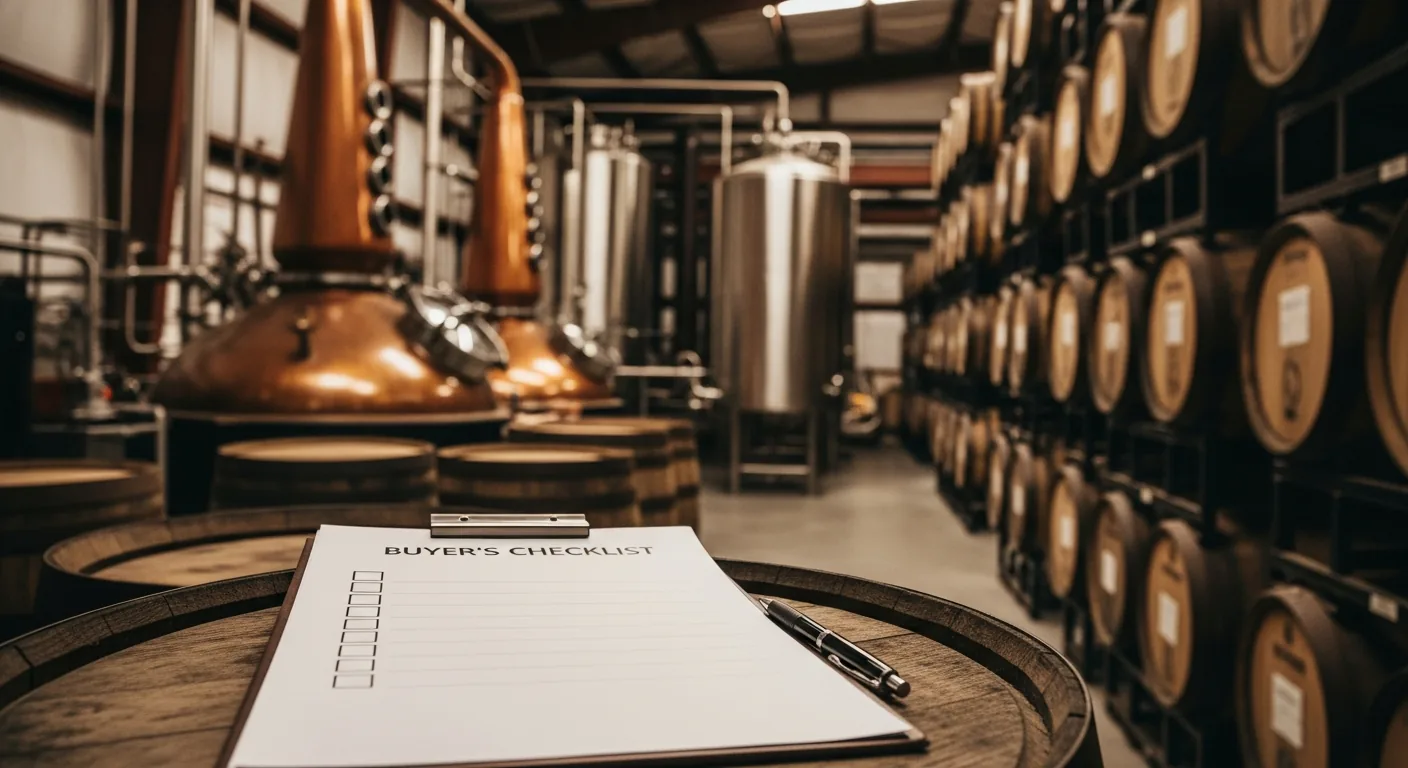
In short: Choosing a distillery management system means looking past generic manufacturing software. A capable platform must seamlessly handle proof gallon conversions, track barrel maturation and evaporation, calculate complex cost of goods sold over years of aging, and accurately automate federal compliance reporting to keep your distillery profitable.
Choosing a distillery management system: a buyer’s checklist begins with understanding your unique production, storage, and processing needs. A generic manufacturing platform will not cut it when you have to track proof gallons, manage evaporating barrel inventory, and file strictly regulated federal reports. Standard software operates on fixed bills of materials and discrete item counts. Distillers operate in a world of liquids that expand with temperature, change alcohol by volume over time, and require precise tax calculations. This guide breaks down the core functionalities your software must have to keep your operations compliant and profitable.
What goes into choosing a distillery management system: a buyer's checklist?
The foundation of your evaluation must be built on the realities of the distilling lifecycle. From mashing grain to shipping a finished bottle, the workflow of a distillery is entirely distinct from a brewery, winery, or traditional food manufacturer. When auditing potential software platforms, operations and finance teams need to look past basic inventory tracking and focus on how the system handles the unique math of distilled spirits.
A specialized distillery software platform connects the floor operations with the accounting ledger. Every time a distiller makes a cut on the still, transfers spirit to a holding tank, or fills a cask, the software must capture that action in both volume metrics and financial metrics. The checklist for a successful system implementation revolves around several core pillars:
- Regulatory compliance and automated reporting
- Liquid inventory accuracy and barrel tracking
- Comprehensive cost of goods sold calculations
- Lot traceability for quality control
- Scalability for multi-site operations
Generic systems fail because they treat whiskey like widgets. If you purchase grain, generic software can easily track it by the pound. However, once that grain is mashed, fermented, and distilled into liquid, generic systems struggle to convert solid weights into liquid volumes. They struggle even more when that liquid changes volume due to temperature fluctuations. Your checklist must prioritize software that natively understands distillery physics and federal regulations.
Handling TTB compliance and reporting seamlessly
Federal reporting is arguably the highest administrative burden for any American distillery. Your software must act as a seamless bridge between your daily floor actions and your monthly or quarterly federal filings. Please note that the following is general information and does not constitute legal or tax advice.
Every movement of spirits must be recorded in accordance with 27 CFR Part 19, which dictates the rules for Distilled Spirits Plants. A capable software system will automatically map your daily logs to the three primary federal reports: the Production Report (TTB Form 5110.40), the Storage Report (TTB Form 5110.11), and the Processing Report (TTB Form 5110.28).
To do this accurately, the system must have an internal math engine that understands how to calculate proof gallons from wine gallons and temperature readings. It should natively follow the rules laid out in the TTB Gauging Manual. If your team still has to manually plug temperature and hydrometer readings into a separate spreadsheet or use an external TTB gauging calculator to figure out the proof gallons for a transfer, the management software is failing to do its primary job. A modern system should allow a distiller to enter the temperature and apparent proof, and the software should instantly generate the true proof and proof gallons.
Can the system accurately track barrel inventory and rickhouse movement?
For bourbon and whiskey producers, the rickhouse is where the majority of your capital is tied up. Managing this inventory requires highly specialized tools. A barrel is not just a storage vessel. It is an active ingredient that fundamentally transforms the liquid inside it.
When evaluating systems, dig deeply into their barrel management capabilities. The software must track each individual cask as a unique asset with its own data profile. You need to be able to instantly look up the fill date, the entry proof, the specific mashbill, the cooperage, the char level, and the exact location in your warehouse down to the building, floor, and rick.
Crucially, the software must handle volume loss gracefully. As whiskey ages, it undergoes evaporation, commonly known as the angel's share. This volume loss requires adjustments to your inventory records. When a team pulls a sample for tasting or quality control, the system needs to deduct that fraction of a gallon. When it is time to harvest, the software must allow you to regauge the barrel, record the new proof and weight, and calculate the exact loss before the spirit is transferred into the processing account for batching. It is also helpful if the software integrates with barcode or RFID scanners to speed up physical inventory audits in the rickhouse.
True distillery cost accounting for aging spirits
Accurate financial tracking in a distillery is notoriously difficult. You purchase raw materials today, ferment and distill them this week, and then place the resulting liquid into a wood container for four to ten years. Standard accounting platforms treat aging inventory as a static asset. In reality, the cost of that whiskey increases every single month it sits in the warehouse.
This is why native distillery cost accounting is a non-negotiable feature for mid-size and growing operations. Your management system must capture the direct costs of grain, yeast, and enzymes. It must then add the cost of direct labor and the factory overhead for the distillation run.
Most importantly, it must capitalize the cost of the barrel itself into the bulk liquid asset. As the barrel ages, the software should allow you to allocate ongoing storage costs, such as warehouse rent, insurance, and utilities, to the resting inventory. By the time you dump an eight-year-old bourbon, the system should tell you exactly what that specific liquid costs per proof gallon. Without this capability, pricing your finished bottles for wholesale or retail becomes a dangerous guessing game. When you know your true cost of goods sold, you can make informed decisions about product margins and distributor discounts.
How well does the system manage production, storage, and processing accounts?
The federal government requires distilleries to strictly delineate their operations into three distinct accounts. A high-quality management system will visually and functionally separate these areas while making transfers between them frictionless.
The production account handles the mashing, fermenting, and distilling phases. The system should track the yield of each batch, showing you exactly how many proof gallons you extracted from a specific weight of grain. It should capture data points like fermentation gravity and still temperatures to help distillers dial in their quality control.
The storage account manages bulk spirits resting in tanks or aging in barrels. The system must lock down these assets so they cannot accidentally be bottled or shipped without first being formally transferred. Storage accounts require meticulous record-keeping to track bulk transfers in bond, additions of water, and regauging events.
The processing account is where blending, proofing down, filtering, and bottling take place. Your software must provide tools for building complex blend recipes, calculating the exact amount of water needed to reach your target bottling proof, and recording the final yield of cased goods against the volume of bulk spirits consumed.
Supporting complex blending and bottling workflows
The transition from bulk aged spirit to a finished, bottled product involves careful chemistry and precise tracking. A robust distillery management system needs to support the complexities of blending. When a master blender selects twenty specific barrels for a small batch release, the software must cleanly consolidate those individual barrel assets into a single processing tank.
Once the liquid is batched, proofing down requires accurate liquid math. The software should tell you exactly how many gallons of water to add to reach your target bottling proof. If you accidentally over-proof or under-proof, the system should log the corrective actions.
Bottling runs also generate their own unique data. You need to track the consumption of dry goods, including glass bottles, labels, closures, and cardboard cases. The software should deduct these packaging materials from your dry goods inventory in real time as the finished cases are produced. Additionally, the system must track lot numbers for traceability. If a glass supplier issues a recall for defective bottles, your software must be able to instantly report which finished cases contain the affected glass and where those cases were shipped.
What are the integration and hardware capabilities?
A distillery management system does not operate in a vacuum. It needs to communicate with other tools and hardware to keep your business running smoothly. When running through your checklist, ask potential software vendors about their integration ecosystem.
Most distilleries use standard accounting software like QuickBooks or Xero for their general ledger, accounts payable, and accounts receivable. The distillery ERP should push clean, summarized financial journal entries to your accounting platform. This ensures your bookkeeper does not have to learn the intricacies of proof gallon conversions or TTB reporting to balance the books.
Hardware integration is equally important. Weighing grain, weighing empty barrels, and weighing full barrels are daily tasks. A system that can connect directly to your digital scales saves time and prevents manual data entry errors. Furthermore, the ability to use mobile devices and barcode scanners on the production floor or in the rickhouse is a massive advantage. Distillers should be able to log a barrel fill or scan a tank transfer using a tablet right where the action happens, rather than writing it down on a clipboard and entering it at a desk later.
Will the ERP scale with your distillery as you grow?
Switching management software is a painful, time-consuming process. You want to choose a platform that will grow alongside your business for the next decade. Assess the scalability of the software by looking at how it handles complex growth scenarios.
If you open a secondary off-site rickhouse, can the system manage multi-site inventory and generate the correct paperwork for transfers in bond? If you start co-packing or contract distilling for other brands, can it separate their inventory and costs from your proprietary liquid? You need a system that allows you to easily add new users, set specific permission levels, and manage multiple Distilled Spirits Plant registry numbers if your business structure evolves.
Furthermore, the system must help you navigate shifting tax liabilities. For example, the software should be fully equipped to help you track your tier volumes under the CBMA, ensuring you take full advantage of reduced excise tax rates for your first 100,000 proof gallons. It should track removals from bond accurately, calculate the tax owed, and help you prepare your excise tax returns.
Choosing the right system means finding a balance between operational ease of use on the floor and rigorous financial controls in the back office. Take your time, request detailed demonstrations using your own hypothetical batch data, and ensure the vendor truly understands the nuances of the distilling industry. Check their references, talk to their current customers, and evaluate their customer support and onboarding processes.
Spirit Sight provides a comprehensive, cloud-based ERP built explicitly for the workflows of modern distilleries. From seamless federal reporting and precise barrel tracking to complex cost of goods calculations, Spirit Sight gives operations and finance teams the exact tools they need to run a compliant, profitable distillery without the headaches of generic software.
Key takeaways
- Evaluate management systems based on their ability to handle the specific liquid math and temperature corrections required by federal regulations.
- Ensure the software natively supports complex cost accounting by capitalizing barrel costs and ongoing overhead into your aging spirit assets.
- Confirm the platform tracks individual barrels as unique assets, accounting for evaporation, sampling losses, and precise rickhouse locations.
- Look for systems that automatically map daily floor operations directly to the required federal production, storage, and processing reports.
- Choose a platform designed to scale with multi-site warehouse expansions, hardware integrations, and complex tax structures.
Frequently asked questions
Why is standard manufacturing software a poor fit for distilleries?
Standard manufacturing software relies on fixed bills of materials and discrete units. Purpose-built distillery software handles liquid volume conversions, temperature corrections, and alcohol by volume changes over long aging periods.
How does a distillery management system simplify federal compliance?
Purpose-built systems automatically track daily operations in proof gallons and map those movements directly to the required federal production, storage, and processing reports to eliminate manual data entry.
What features are most critical for managing aging whiskey inventory?
Accurate barrel tracking is critical for aging spirits. A good system must account for volume loss due to evaporation, track specific cooperage details, and continuously capitalize storage costs into the aging spirit.
Can distillery software help calculate excise taxes?
Yes. A robust system will track the proof gallons removed from bond for consumption or sale and apply the appropriate tax rates, including tracking volume thresholds for reduced rates under the Craft Beverage Modernization Act.