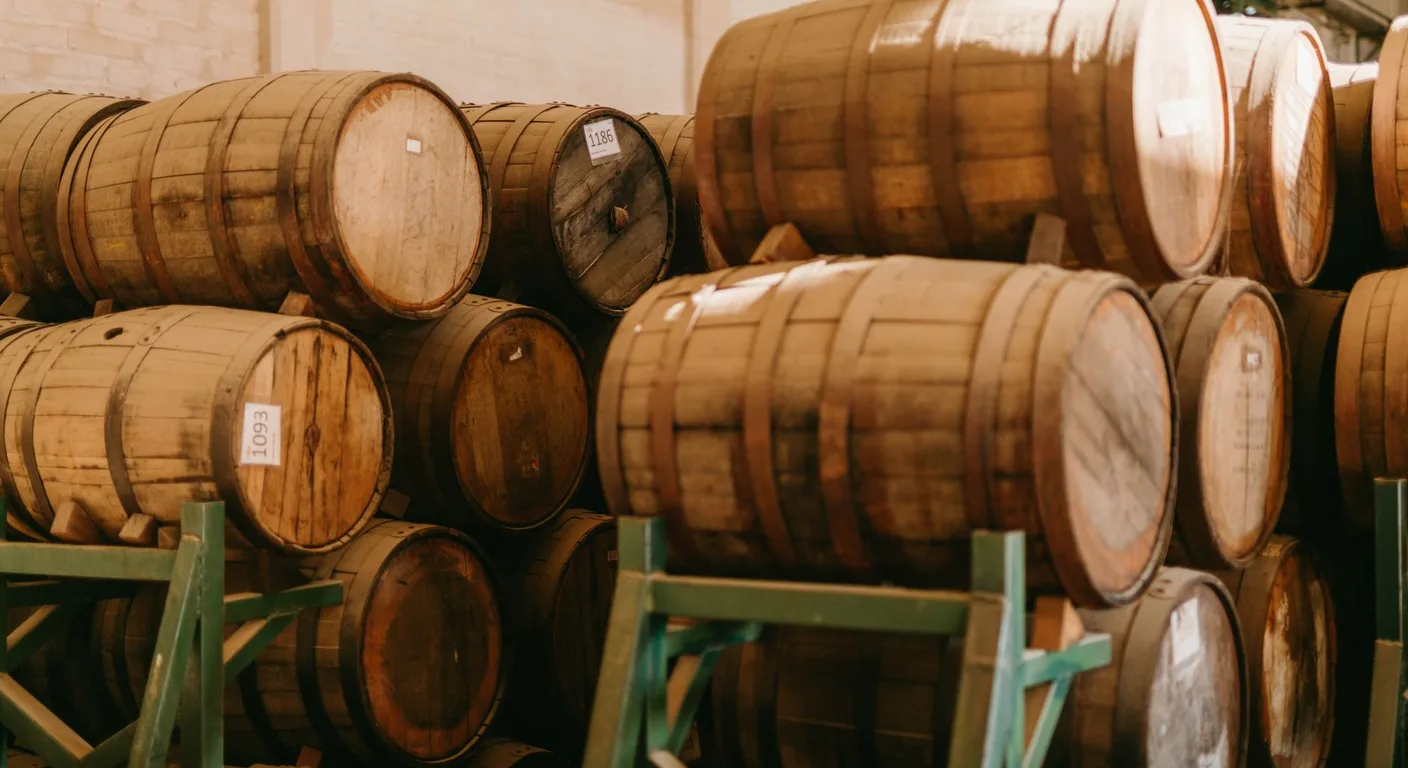
In short: Managing evaporation loss across a rickhouse requires balancing temperature, humidity, barrel size, and entry proof to control the angel's share. By tracking these variables, distilleries can predict yields accurately, maintain TTB compliance, and calculate the true cost of goods sold as volume decreases over time.
Managing evaporation loss across a rickhouse is a central challenge for any distillery aging spirits, directly impacting your final yield, production costs, and tax liability. As bourbon or whiskey matures, the surrounding environment, barrel size, and entry proof dictate exactly how much water and alcohol transpire through the porous oak. By understanding these variables, distillery operators can accurately project mature volume, dial in their flavor profiles, and maintain compliant production records.
The science behind managing evaporation loss across a rickhouse
Understanding the physics of a wooden barrel is the first step in controlling your yields. White oak is liquid-tight but it is not vapor-tight. As ambient temperatures rise during the summer months, the liquid inside the barrel expands and pushes deep into the charred and toasted layers of the staves. When temperatures drop in the winter, the liquid contracts, pulling soluble wood extracts back into the main volume of the spirit.
During this continuous seasonal cycle, vapor transpires through the wood grain and escapes into the atmosphere. This lost volume is affectionately known as the angel's share. For a standard 53-gallon virgin oak barrel, operators typically plan for an evaporation rate of two to three percent of the total volume per year. However, this is not a flat linear rate. The volume loss is usually steepest in the first year as the completely dry wood soaks up a small percentage of the spirit - a phenomenon often called the devil's cut - and then settles into a steadier rate of vapor transpiration over subsequent years.
How does entry proof affect the angel's share?
By law, bourbon must be entered into the barrel at no more than 125 proof, which is 62.5 percent alcohol by volume. You can find these federal standards of identity outlined in 27 CFR Part 5. However, operating at the absolute legal maximum is not always the best choice for maximizing yield or balancing flavor. Many experienced distillers find that entering spirit at a lower entry proof, commonly in the 110 to 120 range, creates a more stable maturation environment for long-term aging.
When a spirit goes into the barrel at 110 to 120 proof, water and alcohol tend to transpire through the wood at roughly equal rates over a long aging period. This keeps the internal barrel proof relatively stable. If you enter at a much higher proof, alcohol transpires faster than water, which wastes valuable ethanol to the atmosphere.
Furthermore, your entry strength dictates what flavor compounds you extract from the oak. Maximum solids extraction from American oak occurs around 55 percent alcohol by volume. A lower entry proof pulls more water-soluble wood sugars and vanilla notes, resulting in a sweeter profile. Conversely, a higher entry proof extracts more alcohol-soluble compounds, which can include heavier tannins and astringency that may require longer aging times to mellow out.
What impact does barrel size have on evaporation rates?
Many craft distilleries start with smaller barrels to bring a product to market faster, but this changes the evaporation math drastically. Small barrels, such as five, fifteen, or thirty-gallon casks, have a significantly higher surface area to volume ratio than a standard 53-gallon barrel. Because proportionally more of the liquid is in direct contact with the wood, transpiration happens at a highly accelerated rate.
Small barrels can lose five to fifteen times the angel's share of full-size barrels. In dry storage conditions, it is not uncommon for a five-gallon barrel to lose eight to ten percent of its volume in just six months. A practical rule of thumb for small formats is to age no more than 36 days per vessel gallon. For example, a five-gallon barrel is usually ready in about six months, while a 15-gallon barrel might hit its sweet spot around 15 to 18 months. Because they extract wood flavor so quickly and lose volume so rapidly, these smaller vessels require constant monitoring to prevent the spirit from becoming over-wooded and astringent.
Standard 53-gallon barrels provide a much more gradual, balanced maturation process. They typically require 18 to 24 months just to become palatable, and a full four years or more to produce fully matured, well-rounded bourbon.
How do temperature and humidity change alcohol transpiration?
The specific microclimate of your rickhouse plays a massive role in managing evaporation loss over time. Temperature swings drive the expansion and contraction of the liquid within the staves, while ambient humidity determines whether you lose more water or more alcohol to the surrounding air.
Water molecules are smaller than ethanol molecules. In a hot, dry environment - such as the top floors of a tall rickhouse or a facility located in a very dry climate - water evaporates through the staves much faster than alcohol. As a result, the overall liquid volume drops, but the proof of the remaining spirit rises. It is very common for a barrel entered at 120 proof to climb to 130 proof or higher after a few years in a hot, dry location.
Conversely, in cool and damp environments - like the ground floor of a rickhouse, a concrete basement, or a facility located in a humid coastal region - the ambient air is already highly saturated with moisture. This high humidity prevents water vapor from escaping the barrel easily, meaning ethanol evaporates at a faster rate than water. In these damp conditions, the volume drops and the proof also falls over time. Distillery operators use these differences strategically, rotating barrels or blending stocks from different rickhouse zones to achieve a consistent final product and mitigate extreme evaporation.
How do you track and regauge barrels accurately?
Predicting evaporation is helpful for general business planning, but actual physical measurement is both legally and financially required. Distilleries measure true evaporation loss through a physical process called regauging. This hands-on procedure involves pulling the barrel from the rack, weighing it, measuring the temperature and the apparent proof of the liquid, and calculating the true proof and current volume.
The difference between the original fill volume and the current measured volume gives you your exact evaporation loss. While a reliable angel's share calculator can give you a strong mathematical estimate for production planning, physical regauging is the only way to know exactly what is left before you dump a barrel for a batch. Regular sample pulls and periodic spot checks help operations teams monitor whether a specific vintage is losing more volume than expected, allowing them to adjust storage conditions, patch minor leaks, or plan an earlier dump date before the loss becomes too severe.
Accounting for evaporation loss legally and financially
Managing a rickhouse is as much an accounting exercise as it is a production one. The Alcohol and Tobacco Tax and Trade Bureau requires distilleries to maintain strict records of their inventory and accurately report any losses. Under the federal regulations for distilled spirits plants, operators must conduct physical inventories and document any shortages on their required reports. You can review these compliance guidelines and inventory requirements directly in 27 CFR Part 19. Normal evaporation during maturation is considered an expected loss and is generally not subject to excise tax. However, excessive or unexplained shortages can be treated as taxable events if they are not properly documented. Please note that this is general information, not tax or legal advice.
On the financial side, evaporation fundamentally changes your cost of goods sold. When you run a distillation campaign, you incur hard costs for the raw grain, the yeast, the utilities, the production labor, and the new charred oak barrel itself. A rough rule of thumb for a basic pot still is that your finished spirit run yields roughly one-twentieth of your original mash volume. You invest significant time and energy to produce those highly concentrated gallons.
If a barrel costs five hundred dollars to fill and holds fifty proof gallons, your starting cost is ten dollars per proof gallon. If evaporation claims twenty percent of that volume over four years, you now only have forty proof gallons remaining. The total sunk cost is still five hundred dollars, but your true cost per proof gallon has jumped to twelve dollars and fifty cents. Using a dedicated barrel management system ensures your finance team is continuously updating inventory values based on actual measured yield, protecting your profit margins when it comes time to price your finished bottles.
Managing evaporation loss across a rickhouse requires careful attention to the physical environment, precise record-keeping, and a deep understanding of how your spirit interacts with the barrel. Spirit Sight helps distilleries track every drop from fill to dump, offering comprehensive tools to record regauge data, monitor storage microclimates, and automatically update your cost of goods sold as the angel's share takes its cut. It simplifies the math and the compliance, so you can focus on producing exceptional whiskey.
Key takeaways
- Standard 53-gallon virgin oak barrels typically lose two to three percent of their volume per year to evaporation.
- Small barrels possess a higher surface area to volume ratio, causing them to lose spirit up to fifteen times faster than standard full-size barrels.
- Hot and dry storage environments cause water to evaporate faster than ethanol, raising the barrel proof over time.
- Entering spirit at a lower proof helps stabilize evaporation rates between water and ethanol while extracting more water-soluble wood sugars.
- Distilleries must track physical evaporation losses through regauging to update their cost of goods sold and maintain accurate TTB storage records.
Frequently asked questions
How much liquid does a standard whiskey barrel lose per year?
A standard 53-gallon barrel typically loses two to three percent of its total volume annually. This rate is often slightly higher during the first year of aging as the dry wood soaks up a small portion of the spirit.
Does the proof of whiskey go up or down in the barrel?
The proof can go up or down depending on the storage environment. In hot, dry conditions, water evaporates faster than alcohol, causing the proof to rise, while humid conditions cause alcohol to evaporate faster, lowering the proof.
How long should you age whiskey in a 15-gallon barrel?
Small 15-gallon barrels typically yield palatable whiskey in roughly 12 to 18 months. Because they extract wood flavors so quickly, they require close monitoring to prevent the spirit from becoming overly astringent.
Are evaporation losses in a distillery subject to excise tax?
Normal evaporation during the aging process is considered an expected loss and is generally not taxed by the TTB. However, excessive or undocumented shortages may trigger tax liabilities, making accurate physical inventory records essential.