In short: A proof gallon is one liquid gallon of spirits at 50 percent alcohol by volume (100 proof). Mastering proof gallons and gauging: getting the math right is essential for distilleries to accurately calculate federal excise taxes, maintain compliant barrel inventories, and ensure production yields align with TTB regulations.
Mastering proof gallons and gauging: getting the math right is the foundation of operating a compliant and profitable distillery. If your measurements are off, your tax liabilities, barrel inventory valuations, and production records will all be incorrect. This guide covers how to accurately calculate proof gallons, properly gauge spirits, and apply those numbers to federal compliance and daily operations. Please note that this article provides general information, not tax or legal advice.
What exactly is a proof gallon?
A proof gallon is the standard unit of measurement used by the Alcohol and Tobacco Tax and Trade Bureau (TTB) to track and tax distilled spirits. By definition, a proof gallon is one liquid gallon of spirits that is exactly 100 proof, which is 50 percent alcohol by volume at 60 degrees Fahrenheit. Because federal taxes scale with the actual alcohol content rather than the sheer volume of liquid, the tax on a given batch rises and falls with its proof.
For example, if you have ten liquid gallons of whiskey at 80 proof, you hold eight proof gallons. If you have ten liquid gallons of new make spirit at 120 proof, you hold twelve proof gallons. Distillers calculate this continuously, which is why utilizing a reliable proof gallon calculator is a standard daily practice. Every operations report you file with the government revolves around this single, vital metric.
How do you calculate federal excise tax based on proof gallons?
Once you know your proof gallons, you can determine your exact tax liability. The standard federal excise tax on distilled spirits is $13.50 per proof gallon. To put that in perspective, this equals about $2.14 per standard 750 ml bottle at 80 proof. However, most craft and mid-size producers benefit from reduced rates under the Craft Beverage Modernization Act (CBMA).
Under the CBMA, the reduced excise rates are $2.70 per proof gallon on the first 100,000 proof gallons removed or imported for the year. The rate goes to $13.34 per proof gallon on the next 22.13 million proof gallons, and returns to the standard $13.50 per proof gallon for anything above that threshold. You can verify these current rates in 26 U.S.C. 5001. Utilizing an excise tax calculator can help you project these costs accurately over the fiscal year. There is an important regulatory caveat to remember regarding these rates: a distilled spirits plant that only bottles products and conducts no other processing activity may not be entitled to the reduced CBMA rate. You must actively distill or process the spirits to qualify.
Proof gallons and gauging: getting the math right in the rickhouse
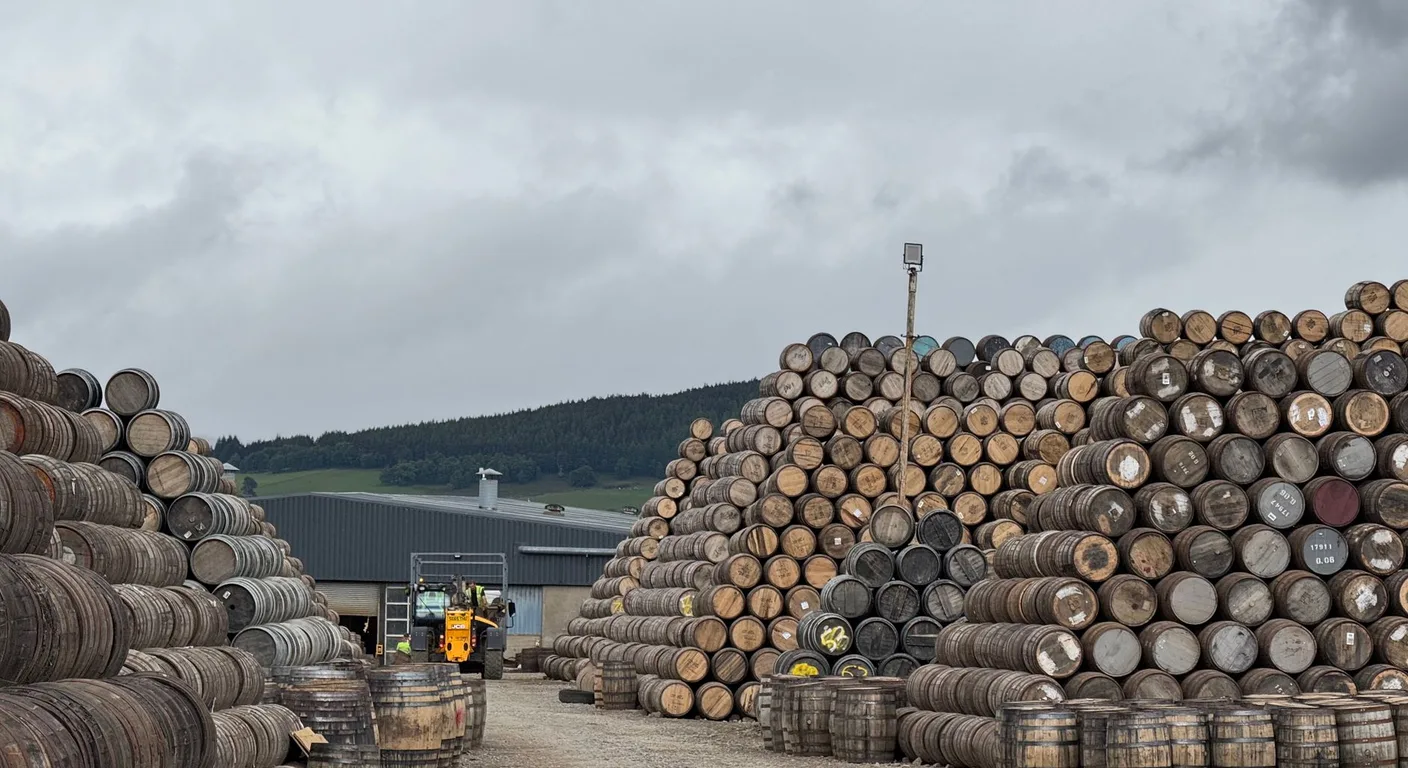
Gauging is the formal physical act of determining the exact quantity and proof of distilled spirits. You perform official gauges when you enter spirits into a barrel for aging, during physical inventory audits in the rickhouse, and when dumping barrels for bottling. The official procedures are outlined in the TTB Gauging Manual found in 27 CFR Part 30.
When spirits age in oak barrels, they extract tannins, sugars, and color compounds from the wood. These dissolved solids change the overall density of the liquid, a phenomenon known as obscuration. Because traditional hydrometers measure density to determine alcohol content, obscuration will cause a standard hydrometer to read an artificially low proof. To get the math right, distillers must calculate the apparent proof and then determine the obscuration factor, usually by distilling a small laboratory sample of the aged spirit to remove the solids before measuring again. Adding the obscuration factor back to the apparent proof yields the true proof, which is the legally required number for tax reporting and labeling.
How do you gauge barrels by weight versus volume?
When dealing with bulk spirits and barrels, attempting to measure proof gallons by physical liquid volume is highly prone to error. Temperature fluctuations cause alcohol to expand and contract significantly. Instead, commercial distillers gauge spirits by weight. Gauging by weight relies on the physical mass of the liquid, which does not change with temperature, making it far more precise.
To gauge a barrel by weight, you start by recording the tare weight, which is the empty weight of the barrel. Once the barrel is filled, you weigh it again to get the gross weight. Subtracting the tare weight from the gross weight gives you the net weight of the liquid inside. Next, you take a highly accurate hydrometer reading and a temperature reading of the spirit. Using the tables provided in the TTB Gauging Manual, you cross-reference the proof and temperature to find the exact weight per wine gallon. Dividing your net weight by the weight per wine gallon gives you the exact liquid volume at 60 degrees Fahrenheit. Finally, you multiply those liquid gallons by the proof percentage to determine your precise proof gallons. This strict adherence to weight-based measurement is critical for maintaining accurate inventory and surviving an audit.
Why is bond size tied directly to proof gallons?
Every distilled spirits plant needs a surety bond to operate legally. This bond, known as a penal sum, is sized to cover the potential federal tax liability of all the spirits held on the bonded premises at any given time. Because tax liability is calculated per proof gallon, your required bond size is entirely dependent on your proof gallon inventory.
The basic calculation involves taking your maximum stored proof gallons and multiplying that figure by the standard $13.50 tax rate. Common minimums cited by active distillers include a $10,000 operations bond. This minimum drops to $5,000 if your facility is strictly limited to only producing or only warehousing. You will also need a minimum $1,000 withdrawal bond, making a combined unit bond start around $11,000 to $16,000 for a typical startup that produces, stores, and bottles. As your aging program grows and you accumulate more barrels, the total proof gallons on hand will eventually exceed your bonded limit. When this happens, you are legally required to increase your bond before producing or storing more spirits. Maintaining proper distillery compliance requires vigilant tracking of this threshold. You can find the exact bond formulas in 27 CFR Part 19.
How do distillation cuts impact your total proof gallons?
Translating your mash bill into final proof gallons requires an understanding of realistic production yields. A rough rule of thumb for a basic pot still is that you will lose about 80 percent of your volume when going from mash to low wines. The subsequent spirit run yields roughly a quarter of that remaining volume. Ultimately, your finished product is on the order of one twentieth of the original mash volume. Practically speaking, you can expect to collect about 5 liquid gallons at 120 proof from 100 gallons of an 8 percent mash. That 5 liquid gallons translates to exactly 6 proof gallons, which will yield roughly 35 to 40 standard 750ml bottles at 80 proof.
During the spirit run, roughly 70 percent of the total alcohol comes off as usable hearts. A common operational split is 10 percent heads, 65 percent hearts, and 25 percent tails. Distillers who take a full third of their run as heads are discarding too much viable spirit, which usually points to an underlying fermentation problem or a still charge that is too strong. To optimize your final proof gallon yield, collect low wines down to about 5 to 8 percent ABV during the stripping run. Combine these low wines with recycled feints to reach a charge strength around 30 percent ABV for the spirit run. This balance ensures maximum flavor retention and optimal alcohol recovery.
What are the most common gauging mistakes?
The most frequent errors in gauging and proof gallon calculations stem from a lack of environmental control and reliance on inaccurate proxies. Common pitfalls include:
- Failing to correct for temperature: A hydrometer only reads true if the liquid is exactly 60 degrees Fahrenheit. If the spirit is warmer, the density changes, giving an artificially high proof reading.
- Ignoring obscuration: Failing to account for dissolved solids in aged spirits leads to artificially low proof readings and inaccurate tax filings.
- Improper rounding: Federal rules dictate specific rounding methods, usually to the nearest tenth of a percent. Inconsistent rounding compounds over hundreds of barrels and results in significant inventory discrepancies.
- Relying on temperature for cuts: Temperature and ABV do not reliably map to cuts because still type, run style, weather, and elevation shift the relationship. You cannot separate methanol by temperature alone on a small still. Make cuts by taste and smell.
Spirit Sight provides the digital infrastructure to handle these exact calculations automatically. By replacing error-prone spreadsheets with purpose-built software, you can seamlessly track proof gallons from the still through the rickhouse and into the bottle. It applies automatic temperature corrections, factors in obscuration, and generates accurate compliance reports, giving you total confidence in your numbers and your tax liability.
Key takeaways
- A proof gallon is calculated as one liquid gallon of spirits containing 50 percent alcohol by volume at exactly 60 degrees Fahrenheit.
- Federal excise tax and mandatory operational bond sizes are based directly on total proof gallons rather than liquid volume.
- Distillers must gauge barrels by weight rather than physical volume to accurately account for temperature fluctuations.
- Aged spirits require obscuration calculations to correct for dissolved wood solids that alter standard hydrometer density readings.
- Relying on temperature rather than taste and smell for distillation cuts leads to poor product quality and inaccurate yields.
Frequently asked questions
What is a proof gallon in distilling?
A proof gallon is a standard unit of measurement equal to one liquid gallon of spirits containing 50 percent alcohol by volume at 60 degrees Fahrenheit. The TTB uses this metric to track production and calculate excise taxes.
How do you calculate federal excise tax for a distillery?
Federal excise tax is calculated by multiplying your total proof gallons by the applicable tax rate. Under the CBMA, the reduced rate is $2.70 per proof gallon for the first 100,000 gallons removed or imported.
Why do distillers gauge barrels by weight instead of volume?
Gauging by weight is far more accurate because physical mass does not change with temperature. In contrast, the physical volume of liquid alcohol expands and contracts significantly as temperatures shift in the rickhouse.
What does obscuration mean in whiskey distilling?
Obscuration refers to dissolved solids, such as sugars and tannins extracted from an oak barrel, which change the density of the liquid. These solids cause a traditional hydrometer to read an artificially low proof, requiring distillers to calculate an obscuration factor to find the true proof.